Been in a shipwreck lately?

A beached shipwreck

Have you been in a shipwreck lately? I mean of course, a figurative shipwreck.

The kids are driving you bonkers… The car needs extensive repairs… Or someone you know received a dire diagnosis…

What can comfort you?

It can be hard, can’t it?

Kids can experience shipwrecks too.

A friend moves out of town… A new school is looming on the horizon… Or there is sibling strife…

What can comfort your kids?

Sure, you’ll be there to give them a hug when needed. But what will they use as comfort inside?

What sort of self-talk will get used, in a shipwreck when you’re not around?

A recent Bible story our kids encountered at Vacation Bible Camp was about Paul in a shipwreck; a literal shipwreck! Read the story in Acts 27. Paul received comfort from God, before, during and after his shipwreck.

Will our kids seek comfort from God in the midst of their shipwrecks?

We hope that they will, but it takes some practice.

God’s word is comforting.

Spend time teaching your children to search for comfort in God’s word – the Bible.

The key is to put God’s word into their long-term-readily-available-brain-storage. (Often known as “learning by heart.” Call it memorization if you must, but perhaps not in front of your kids!) Make this a regular (and fun) activity – at bed time or at dinner time or at breakfast… any time. Just make time.

Why not start with the Bible Buddies – those little plastic characters that the kids receive at VBC. Look at them closely. There’s a Bible verse printed on each one! Tuesday’s verse was:

Open quote markYour promise revives me; it comforts me in all my troubles.

That’s from Psalm 119:50.
If that seems too complicated, try this version:

Open quote markWhen I am hurting, I find comfort in your promise.

What can you do to ensure that in your child’s shipwrecks, they turn to God?

a blue line

A heart with the word 'God' etched in itFor hints on ways to work at verse “memorization” see here and here and (updated) here!


Photo credits:
Shipwreck, by Katherine Hoppe, licensed on Flickr under a Creative Commons License.
Heart clip art by rygle, who has waived rights and dedicated the work to the Public Domain.
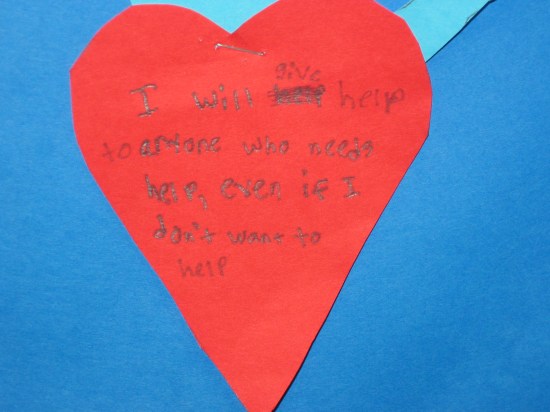
Cheerful giving?

A cut out heart with words

That would be giving cheerfully!

Those words were written by a Cool Disciple, one of our rising 1st through 6th graders, at FUMC in Ann Arbor. This child had just heard the story of the “Widow’s Offering” in Mark 12:41-44. The class had discussed how people in the temple in the time of Jesus were giving gifts of coins just like people today give money to the church. They had also learned why we give an offering in worship: as a response to God’s love.   (This summer we are learning about  various aspects of worship.  In June the topic is Offering.)

But kids don’t typically have any income so how can they respond to God’s love? Delving deeper into the Widow’s Offering story teaches us that the size of an offering doesn’t matter. It doesn’t even matter what the offering is because sometimes our offering doesn’t fit into the offering plate! It’s the attitude that counts!

Each of you must give as you have made up your mind, not reluctantly or under compulsion, for God loves a cheerful giver.
2 Corinthians 9:7 (NRSV)

How do we teach giving cheerfully?

Well, we can always say: “we do it because Jesus taught us to.”  Which I suppose is one way to approach the topic… though probably not very convincing (if we are being realistic!)

Let’s face it, the only way to teach a behavior is to live the behavior. We need to be cheerful in our giving whether it’s while writing a check or making a meal for someone.

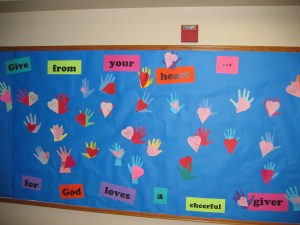
A bulletin board of hearts & hands made by the kids

Lots of hearts and hands were created by kids sharing ways that they can give cheerfully

Some ways to model giving (hopefully cheerfully!):

  • Join the FUMC Prayer Chain. Share the emails received and pray together.
  • Involve your children in preparing a meal to be given to a family in need. Even if it is just to ask them to help wash lettuce, stir brownie mix or fold napkins!
  • Donate toys they no longer play with or clothes that no longer fit. Investigate this link of organizations in our area that accept various types of donations.
  • Have any flowers in your yard or veggies in your garden? Deliver some to your neighbors (with the kids along).
  • What ways do you model cheerful giving?


Photos by Carol H.

This is a test… but who is being tested?

As noted in the schedule we are doing something different for the month of May with the Sunday’s Cool Disciples. This week we’ll all be playing a game called “Are You Smarter Than a Sixth Grader?”

But wait, you ask… Isn’t the TV game show called “Are You Smarter Than a Fifth Grader?”
Well, yes and that isn’t the only thing that will be different about our game! For instance, the questions won’t be asked of the adults and we won’t use elementary school textbooks as a source for our queries. (And sorry, but the prize winners won’t receive a million dollars.)

Though I hear that everyone gets a prize for showing up, and the winning team members each receive a coupon for a free drink at the World Peace Café!

So what is the purpose of this game (besides a little fun)?

It’s two-fold: First off, to recognize our 6th graders who will be moving on to the youth program next year.   And secondly to see how much kids have learned about the Bible stories we’ve studied since September.

You mean like, this is a test?

Yes. But don’t worry, it won’t be graded. This is a test for us as educators: how are we doing with our teaching? Do kids know what we THINK they know?

For example we would expect that 6th graders who are regular attendees can…

  • Name the first four books of the New Testament.
  • Understand the meaning of the word “Gospel.”
  • Tell the basic story of Jesus’ birth, life, death and resurrection.
  • Name a couple of Beatitudes and can incorporate them as “keys” to how we should live.
  • Define a “parable.” (It’s a story that teaches with a hidden meaning.)
  • Re-tell the parable of the Good Samaritan in his/her own words.
  • Define a prophet (God’s messenger) and name a couple of prophets.
  • And the list goes on…

How about attending our “game show” this Sunday with your kids (in the Social Hall; after the Children’s Moment in church) and see if you are smarter than a sixth grader?

Are you seeing ads? They are not from me! They are placed by WordPress, who otherwise offers a free platform from which to share lots of good-ness. If you see an inappropriate ad, please report it to support@wordpress.com. Include the URL, the date/time the ad appeared, and a screenshot of the ad.

Saul/Paul: noticed any changes lately?

a spring flowering treeSpring is a great time of year to talk about change! Every day brings new changes in God’s creation. Have you noticed buds ready to burst forth into blossoms? How about trees; yesterday they were just branched silhouettes! And doesn’t it seem like if you stood still, the grass would grow greener beneath your feet?


It is thus appropriate that discussing change is a part of our April 2010 Rotation (for our 1st – 6th graders at FUMC in Ann Arbor, MI). Our Bible story for this month comes from the New Testament book of Acts (in Acts 9:1-22).

We’ll be studying the revolutionary transformation that came about in a man known by two names: Saul and Paul. Saul’s life was turned around when he met Jesus.

stain glass windows depicting the conversion of Saul/Paul

Saul/Paul’s conversion is an event that is remarkable for its dramatic impact and profound results. Saul started off determined (and violent!) in his quest to squelch Christianity, which at the time, was beginning to spread. A meeting with the risen Messiah transformed him; he became a courageous, dogmatic advocate of Jesus as our Lord and Savior! (And a traveling missionary who braved ship wrecks, imprisonment, beatings, and death threats.)

Studying the change that occurred in Saul/Paul leads us to questions for ourselves:
  • What does the presence of Jesus in our lives look/feel like? Is it as obvious as a bright flash of light or subtler? What ways does God use to get your attention?
  • How does being in the presence of Christ change me?
  • Do we change just once, the initial time we meet Jesus or are we continually changed as our relationship with Jesus deepens?
  • How do we seek out this sort of change?
  • After Saul met the risen Jesus he was a changed man. His life was totally different. How do others know that I am a follower of Jesus? What in my life is evidence of it?

Just a few questions to get some discussion started in your family.

And be sure to catch church this weekend because… Rev. Gil Miller is set to preach on the story of Saul using Acts 9! His sermon is titled “Saintly Sinners.” I wonder what we'll learn?


Photo credits:
Flowering tree: Lightgate-Imagery.com
Stainglass:TheRevSteve’s
All licensed under: Attribution-Noncommercial-Share Alike 2.0 Generic

Are you seeing ads? They are not from me! They are placed by WordPress, who otherwise offers a free platform from which to share lots of good-ness. If you see an inappropriate ad, please report it to support@wordpress.com. Include the URL, the date/time the ad appeared, and a screenshot of the ad.

Preparing for Easter: Notice the sacred in the secular

Words on the street warning: look both ways

'How is God calling us to look around with God’s eyes

and see all things sacred, and act accordingly?

This question was posed by Rev. J. Douglas Paterson in a sermon at FUMC Ann Arbor—the first sermon in a Lenten series entitled “Intentionally Christian.”

Intentionally Christian? What does that look like?

In the days of the early church, “Lent” was a time when the focus was on teaching new followers what it meant to be a Christian. It was like a prerequisite class to joining the church! The sermon series “Intentionally Christian” seeks to take this olden-days practice as an example, by asking questions like: “How do we conscientiously and purposefully live out our calling as Jesus-followers?” and “What is God asking me to do?”

In his first look at being intentionally Christian, Doug talked about how we often separate our lives into two facets: the sacred and the secular.

Our sacred life is when and where we practice our faith; it’s when we notice God. We hear ourselves say, “there is Holiness in this moment.”

And then there is the rest of our life, the secular or, the “worldly.” Unfortunately this latter slant is where we often forsake our faith and behave as if God is not involved. We don’t notice God’s presence and in fact, we aren’t even looking!

OK, so there should be no difference in the way we view what is secular and what is holy. That should be easy enough to do, right?

Wrong! I, surprisingly, have found that this can be hard to do! It takes careful thought. It takes being deliberately intentional! (Oh yeah – the title of the sermon series!)

We live in a world that is waiting for us to notice holiness. Share with your family members what mundane aspect of life looked holy to you. And share with all: What have you been noticing lately?

Photo credits:

Look by Travis Nep Smith; licensed on Flickr under Creative Commons (BY-NC 2.0).

How do I answer their questions?

A friend relayed the following Heart-thumping-What-should-I-say-Yikes-I’m-stumped-Situation:

She was reading to her preschoolers the story of Noah’s Ark and they asked her:

Where did all of the other people go?

(Meaning: those who weren’t on the ark.)

This mom wondered: How should I answer!??
(While thoughts swirled in her head: what if my reply causes my kids to become fearful of rain storms!)

Hmmmm… There is always the response of answering a question with a question:

Where do you suppose they went?

Would that work in this situation?
How would you have answered this question?

Would you have explained that…

  • The people were very bad. (And left it at that.)
  • Or…The people were very bad and as punishment it rained and rained. It rained so hard there was a flood. (And left it at that.) Or
  • Or would you have gotten more specific and said… The people were very bad; they were so bad that God decided to wipe them all out and so he created a flood.

I think that I would have liked to add a couple of questions to this conversation:

Do you suppose that all of that rain was really rain or was it God’s tears?
Why do you suppose God was crying?
Do you suppose this story is meant to teach us to obey God?

You know your kids best. What would you have answered? (Please share your answers!)

Photo credit: Josh Madison
Licensed under: Creative Commons Attribution 2.0

Talking about disaster

Helpers work at the Haiti earthquake

With the earthquake in Haiti on our minds, I refer you to this excellent article by Thomas Haller and Chick Moorman on talking to your kids about this tragedy (click on the words below).

Explaining World Tragedy to Children

I love how the authors of this excellent article (as well as numerous books about parenting) say to…

…encourage your children to look for the helpers. Helpers always come.

If you donate to relief efforts include your children in the check writing or key-board-clicking. Talk about what helpers you’ve had in your life. (Has anyone ever brought you a casserole?)

Ask them to be on the look-out for helpers in their lives. Point out when someone lets you cut in line with your car (or when you allow someone else in!) Teach them the language: “I’m being a helper” or “There’s a helper!”

As Haller and Moorman say,

Let them see and be love in action.

Where have you seen love in action?

-------


Photo credits:
Helpers at the Jan. 2010 earthquake in Haiti, originally uploaded by the United Nations Development Programme, who licensed this photo on Flickr under a Creative Commons License.

Are you seeing ads? They are not from me! They are placed by WordPress, who otherwise offers a free platform from which to share lots of good-ness. If you see an inappropriate ad, please report it to support@wordpress.com. Include the URL, the date/time the ad appeared, and a screenshot of the ad.