Holy ground

A well-used sneaker

Our current Rotation on Moses is so full of areas for contemplation. We can’t do it all in 45 minutes of Saturday or Sunday’s Cool! Here’s a topic which is not touched on but is still important. Ask these questions at the family dinner table. (Or wherever your family is gathered together.) To print out a one-page family discussion guide go here.

Moses met God at the burning bush. God’s first instruction to Moses was: take off your shoes. (Okay, he called them sandals.)

“Do not come any closer,” God said. “Take off your sandals, for the place where you are standing is holy ground.”   Exodus 3:5

“Holy,” in this instance, means “set apart,” “specially recognized” or “declared sacred.” What made this spot holy for Moses, was the presence of God. Anywhere we meet God can be considered holy!

Ordinary desert dirt became holy ground.

When you hear the words “holy place” what do you think of? What/where are
the holy spots in your life? Mention a holy place and right away our thoughts go to chapels, churches and cathedrals. Think of our church sanctuary. The word sanctuary means “safe place” or “holy place.” Churches are places designed for us to have an encounter with the holy. The next time you are waiting together as a family for worship to begin, talk quietly about what parts of the sanctuary help it to feel like “holy ground.”

At home, where can you talk to God? Discuss how any space can feel like holy ground, an acceptable spot to meet God! Anywhere we talk to God can be considered a “holy place;” it’s not that a space needs to be holy before God will enter! How do you prepare yourself to enter holy ground?

Do you suppose there ought to be a special “holy spot” in your home that
reminds you that God is near? What should that space feel like? Look like? Spend time arranging such a holy place – a bench or a chair or windowsill. Encourage everyone to spend quiet time in this holy location.


Photo credits:
Empty shoes by Jérôme, who licensed this photo on Flickr under a Creative Commons License.

Are you seeing ads? They are not from me! They are placed by WordPress, who otherwise offers a free platform from which to share lots of good-ness. If you see an inappropriate ad, please report it to support@wordpress.com. Include the URL, the date/time the ad appeared, and a screenshot of the ad.


What does “God at work” look like?

Moses and the burning bush

Moses’ story, from his birth to his experience with the burning bush, is rich in content, and opens numerous chances for discussion. One of our targets for this Rotation is to help kids recognize God “at work” in the lives of Moses and other story characters. A second objective is to apply the concept of “God at work” to their own life. Great topics for families to discuss!

What does God at work look like in this portion of our story?

Read the scripture together as a family. Since it’s a long story, use the following chart to read and talk about our story in stages, over the course of several days. (If you’d like to print out this reading plan/discussion guide, click here.)

Read a passage and then ask where you see God making his presence known. I’ve provided some suggestions. Feel free to comment on other ways you notice God taking action.

Read Discussion points. How is God at work in the lives of story characters?
Exodus 1:1-7 Fulfilling God’s promise to Abraham to have as many descendants as the stars in the sky (Genesis 15:5).
Exodus 1:8-21 What are two Hebrew midwives able to do?
Exodus 1:22-2:4 Imagine the trust in God necessary to hide your child in a basket in the river!
Exodus 2:5-6 Just at the right time, Pharaoh’s daughter decides to take a bath.
Exodus 2:7-10 Miriam showed some courage. And Moses gets the best of two worlds – being raised as a youngster by his family (and being seeped in Hebrew culture) and life in Pharaoh’s palace.
Exodus 2:11-15 What good ends up coming from this bad? (It does require knowing the rest of the story.)
Exodus 2:16-25 Moses lived in Midian for 40 years. I wonder what sort of “learning” Moses needed to acquire during that long time in the “wilderness.”
Exodus 3:1-4 God is starting his rescue plan! I wonder what would have happened if Moses hadn’t said, “Hmm, that’s unusual. I’d better go and look at that.”
Exodus 3:5-12 This one is obvious: God speaks to Moses!
Exodus 3:13-15 Pagan gods never revealed their name because disclosing a name was like giving away power. But our God is a personal God; he has a name!
Exodus 4:1-9 God gives Moses concrete examples of his power. I wonder how Moses will feel when God doesn’t seem so close at hand?
Exodus 4:10-12 God really wants Moses to do this job. I wonder why Moses is so hesitant?
Exodus 4:13-17 What does God give Moses to remind him that God will be with him?

What are ways that you see God at work in your life?

-------


Photo credits:
Burning bush by the Providence Lithograph Company [Public domain], via Wikimedia Commons.

It’s still looking like Christmas


The Christmas decorations are being stored away for another year, but the story of Christmas is still being talked about! And rightly so; we can talk about Christmas every day! (After all, the whole story is about Jesus.) So for this reason, it shouldn’t seem strange that this coming weekend, the Cool Disciples will be reviewing the story of Jesus’ birth.

Continue to reinforce the learning happening at church, by talking about this story at home; how about around the dinner table?

Ready for some family discussion about our story?

Time Out. Talk about…A speech bubble
Jesus described himself as “the light of the world” (John 8:12). Name some ways that your family used light to celebrate this season?

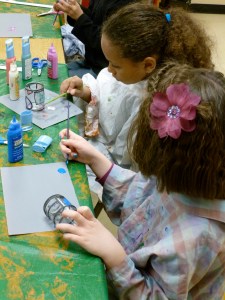
In the Art workshop for this Rotation, kids were creating stained glass candle holders. I would have liked to have seen them all lit up with the light shining through the various colors!

telling the story in the art workshop 3rd graders paint stained glass candle holders
1st graders use colored pieces of felt representing various story elements to tell the story; creating stained glass! 3rd graders use stick-on lead lines and glass paint to create.

Time Out. Talk about…A speech bubble
“The Light of the World” was just one name Jesus had. He had many other names with different meanings; the name we normally use, Jesus, means “God saves.” Jesus was also called “Immanuel.” What does Immanuel mean?

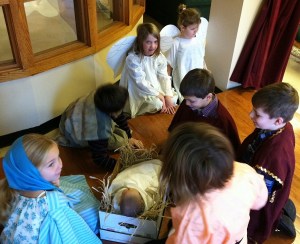
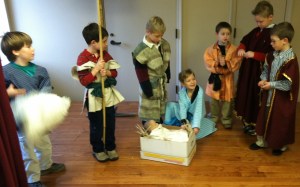
Drama Workshop - visitors to the new born King 1st graders enact the story - shepherds arrive
2nd grade enacts visitors to the newborn King. 1st grade enjoys their first visit to the Drama workshop!

Immanuel means “God is with us.” God sent Jesus to be with us! God meant for his son Jesus to live as a person like us, to show us how to live, and ultimately, to die for us so that our sins could be forgiven.

Time Out. Talk about…A speech bubble
How have you experienced God with you?
Do you suppose our interactions with God will be a dramatic experience like a visit from an angel, or could it be in a quieter way?
What are some ways that God connects with us?

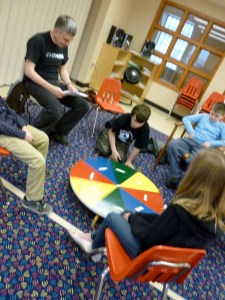
4th graders play a quiz game 2nd graders wait for the questions to be asked
4th graders use the game wheel to determine how many points a correct answer was worth. 2nd graders are eager to hear the next question. They’ll ring a bell if they know the answer!

Time Out. Talk about…A speech bubble
The questions asked in the Games Workshops highlighted the difference between what the Bible tells us, and what people think the story says (in a fun way). Here are a few to try out. (Check a Bible if you’d like; the kids were allowed to do so!)

  • How did Joseph and Mary get to Bethlehem?
  • Which animals does the Bible say were housed in the stable where Jesus was born?
  • How many wise men came to see Jesus?
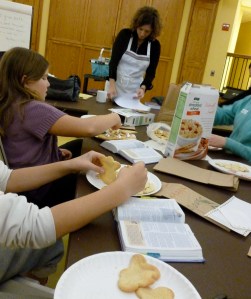
  • 6th graders in the cooking workshop Playing with their food!
    6th graders assemble a bag of snacks to use to retell the story. Playing with their food! Exactly what I hoped they’d do!

    Did you find the answers to the previous questions? In all cases, the answer is: the Bible doesn’t say! Were you surprised?

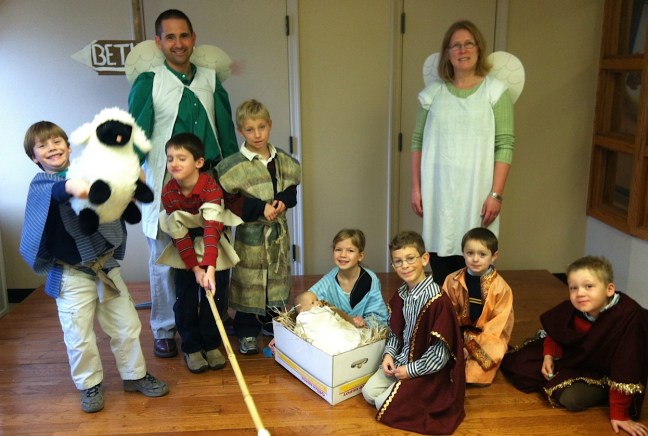
    Finally, I just had to share this picture.
    Care to join us in our workshops? You may get drafted to play a role! (But not unless you want to do so.)

    Drama Workshop - 1st grade - everyone poses for a picture!
    1st graders in the Drama Workshop with their Shepherd and Workshop Leader. Fun!


    Photo credits:
    Photos by Carol Hulbert and Beth Pascoe. Used by permission.

    Listening for God?

    New here? Welcome to this spot on the web that seeks to be your Companion In Family Faith Growth. Easily read future posts by subscribing over on the right. Enter your e-mail address to have posts sent directly to your inbox. Or click on the orange RSS icon to subscribe in a reader.

    Our Cool Disciples (both the Saturday’s Cool and the Sunday’s Cool varieties) are learning this month about Jesus’ visit to Mary and Martha’s home. In this story Jesus is teaching us that the best choice is to spend time listening to him. The question becomes: How do we teach our children to spend time listening to Jesus?

    A baby wears large headphones while listening to music

    The next time you are at the family dinner table (or wherever your family is gathered together) talk about listening. If you’d like to print out this Family Faith Companion discussion guide, click here.

    First up, play some listening games:

    • Have everyone remain silent for one minute. When the time is up, ask everyone to say what sounds they heard.
    • Read a well-known Bible story, except change some of the details. See who notices.
    • Tap out a rhythm and see if everyone can repeat it. Make it harder. Can everyone still follow along? Try it again.
    • Have two people sit on the floor back-to-back. Give both people 5 toothpicks. Ask one person to layout the toothpicks in a pattern while describing to the other person what they are doing. (Example: Put one toothpick down so that a pointed end is facing you.) Do the two designs match up?

    Debrief and extend the Bible learning:

    • What helped you to listen?
    • What made it hard to listen?
    • Jesus taught Martha something about listening. Let’s read the story to review. Read about it in Luke 10:38-42.
    • What did Jesus mean when he said that Mary had chosen what is better? (She chose to listen to Jesus, to spend time with him.)
    • What can you do in your daily life to make that same sort of choice?
    • What does it mean to listen to Jesus?

      Perhaps listening for Jesus doesn’t only happen with our ears. God made us different kinds of listeners. Some of us hear Jesus speaking to us when we see a pretty sunset. Some of us hear Jesus when we laugh at a funny joke or when we are reading the Bible.

      How were you made to best listen for Jesus?


      Photo credits:
      Click here for info on banner photo (not visible in readers or email).
      Baby wearing large headphones via photopin by Jo Jakeman, who licensed this photo on Flickr under a Creative Commons License.

    Are you seeing ads? They are not from me! They are placed by WordPress, who otherwise offers a free platform from which to share lots of good-ness. If you see an inappropriate ad, please report it to support@wordpress.com. Include the URL, the date/time the ad appeared, and a screenshot of the ad.

    Are your kids bonding with their Holy Shepherd?

    a cute little lamb

    New here? Easily read future posts by subscribing over on the right. Enter your e-mail address to have posts sent directly to your inbox. Or click on the orange RSS icon to subscribe in a reader. Thanks for visiting.

    Lambs look so cuddly don’t they? (Yes, dirt and all.)

    My favorite stuffed animal as a child was a lamb. Yep. Serious loving. If that sheep could have talked it probably would have said, “Stop squeezing me so tight!”

    Psalm 23 gives us the words of a different lamb doing some talking.

    This lamb is describing the care of a watchful, loving shepherd.

    He lets me rest in green meadows;
    he leads me beside peaceful streams.

    Psalm 23:2, The New Living Translation

    The author David (of David and Goliath fame) wrote Psalm 23 over 3,000 years ago, painting a tranquil portrayal of life lived under a close relationship with God. Trusting. Loved.

    Are your kids fostering that sort of a relationship with God?

    Help ensure they do by talking about Psalm 23 around the family dinner table. (Or wherever your family is gathered together.) If you’d like to print out the following Family Faith Companion Guide click here.

    • Play a couple rounds of the game Twenty Questions. Point out that in order to figure out what the object is, you need to gather clues that help you describe something.
    • Say: The Bible gives us a description of what our relationship with God can be like. Let’s read that passage. Be thinking about what sort of picture you get when you hear these words.
    • Get out a Bible and read Psalm 23. (If your child is in 3rd grade or up, ask them the clue for quickly finding the book of Psalms.) Or check it out on-line: here.
    • Ask: What do those words describe to you?
      What would it mean to a sheep to have a green pasture and still water?
    • Say: That sounds like one very contented and trusting sheep! David’s words describe what God can be like for us! Protective. Caring. Always watching over us.
    • Ask: Do you suppose those words describe your relationship to God?
      How does God take care of you?
      What are your quiet waters?
      How do you get there?
    • Say: Sheep are covered in scratchy wool. That wool can get bugs and stickers in it and sheep don’t have arms to reach and scratch.
    • Ask: Have you ever had itchy bug bites?
      Do certain situations or things that people do, sometimes irritate you?
    • Say: When we have troubles, we need our shepherd-God to help us so that we can find rest and enjoy our lives!
    • Close with a short prayer. A suggestion: Lord, thank you for being our protecting shepherd. Help us to turn to you, our friend, trusting in your care so that we can reach green, restful pastures. Amen.

    How did this work? Share about your family devotional time.


    Photo credits: Click here for info on banner photo (not visible in readers or email).
    Little lamb by Chris Rice, who licensed this photo on Flickr under Creative Commons License

    Is God’s name Art?

    New here? Easily read future posts by subscribing over on the right. Enter your e-mail address to have posts sent directly to your inbox. Or click on the orange RSS icon to subscribe in a reader. Thanks for visiting.

    children's time with Pastor Doug

    Imagine a leader with a bunch of kids, and the conversation goes like this:

    Leader: Hello everybody, I’d like to read to you the world’s most famous prayer, the Lord’s Prayer. Does anybody know how it begins? (pause)
    Yes, that’s right, we start by praying the words: Our Father who art in heaven.
    Child: Excuse, me, excuse me.
    Leader: Yes?
    Child: Who is Art? Is God’s name Art? I never heard God called Art before.

    Okay, so that was just a hypothetical situation but when you think about it, just what does the Lord’s Prayer mean to kids? Take a look at the Lord’s Prayer with your kids, a line at a time. Read a line and ask your kids what it means. Listen to their replies. (They might have a thing or two to teach us adults!)
    If you’d like to print out this list, click here.

    Our Father, who art in heaven,

    • “Art” in this case means “is.” Our Father, who is in heaven.
    • We can think of God as someone as close to us as a loving parent.
    • Addressing God as a father would have been radically different for the followers of Jesus. To them God was grand and majestic… and intimidating and fearsome! To call God something chummy like “father” – this was new!
    • God as our father makes us all a part of God’s family. What a great, big wonderful family!
    • Even though God is in heaven, he hears you and wants to talk with you.

    hallowed be thy name.

    • Hallowed means holy.
    • By calling God’s name holy, we acknowledge God’s greatness.
    • Our great and Holy God wants to have a close relationship with us! Amazing!

    Thy Kingdom come. Thy will be done on earth as it is in heaven.

    • “Thy” is a fancy way of saying “your.”
    • “Will” refers to the plans that God wants to have happen.
    • This line is like saying: God, may things here on earth be just like they are in heaven. May things be run according to God’s standards — peaceful and free from unfair treatment of anyone.
    • Because God is after all, God, he can cause his will to be done. So why ask for this? It is an invitation for us to participate in making sure that God’s plan happens.

    Give us this day our daily bread.

    • This is asking God for what we need on a daily basis. (Which is different than what we want!)
    • It is asking for the necessities of life, not just food.
    • God knows what we need. Why should we have to ask? It reminds us of our need for God and that we can trust God.
    • We live in a world where the focus is on being self-sufficient (taking care of yourself). Yet God wants us to depend on him for daily needs.

    And forgive us our trespasses, as we forgive those who trespass against us.

    • Trespasses, sins, debts… all mean the same – things we do wrong. Things we do that separate us from God.
    • Forgiving someone can be hard because forgiving fells like it makes an act seem less serious. But when you are forgiving, it is like saying: what you did was wrong but I am giving you a second chance. There is acknowledgment that what was done was wrong.
    • Nursing the grudges of something that has hurt us wastes our energy. Forgiving allows us to put the past behind us.

    And lead us not into temptation, but deliver us from evil.

    • Protect us from doing things that would harm ourselves or other people.
    • God provides us our “daily bread” however we are completely free to make choices about what we do with it. This temptation comes from our own doing.

    For thine is the kingdom and the power and the glory forever.

    • You God, are awesome!

    Amen.

    • Amen means “so be it.”


    Credits:
    The quoted text was adapted from a drama by Neil MacQueen of Rotation.org.
    Click here for info on banner photo (not visible in readers or email).
    Other photo: from the archives.

    Are you seeing ads? They are not from me! They are placed by WordPress, who otherwise offers a free platform from which to share lots of good-ness. If you see an inappropriate ad, please report it to support@wordpress.com. Include the URL, the date/time the ad appeared, and a screenshot of the ad.

    Giving abundantly because we trust in abundance

    Kids participating with the Cool Disciples have been learning this month, about giving. They’ve learned how our offerings can be more than a monetary gift; they’ve had two chances to work at it during Sunday’s Cool! One week they helped make decorations that will be used for Vacation Bible Camp in July. Last week they made cookies to share with Alpha House. Each week they’ve listened to the story of a poor widow giving all that she had (in Mark 12:41-44). What was Jesus trying to say about this widow’s extravagant gift?

    This woman was giving all that she had out of trust that God would supply all of her needs.

    God is good; all the time. This is something we know inherently. But do we live as though we believe it?

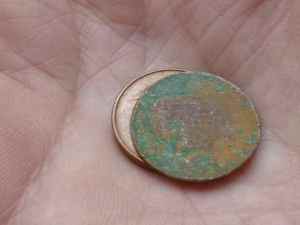
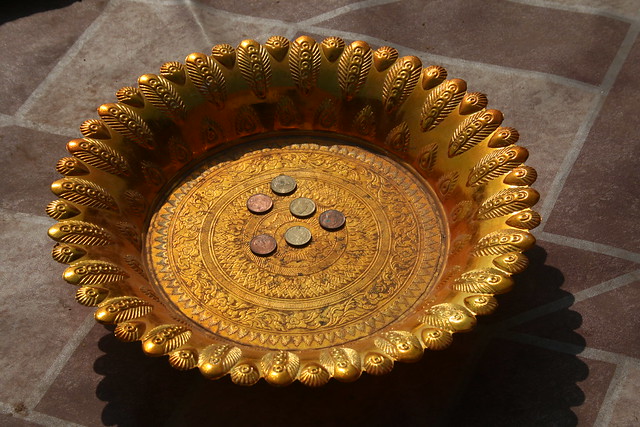
    Two coins

    How about talking about it with your family! Gather a Bible and a fist full of coins (the more the merrier). First read the story together in Mark 12:41-44. Then gather everyone around the computer and scroll down only far enough to expose a speech bubble and its question.

    Time Out. Talk about…A speech bubbleWhy do you suppose Jesus was watching people give their offerings?
    No right or wrong answer to this one. Did you know the subject Jesus taught the most about was money? It’s almost as if Jesus were sitting there, waiting for a teachable moment!
    Time Out. Talk about…A speech bubbleThe teachable moment arrives when a widow gives her offering. What is a widow?

    A widow is a woman whose husband has died. Most women in Jesus’ day didn’t work. Widows had to be taken care of by their family. It is likely that this woman didn’t have anyone to support her as, Jesus seemed to know that she was poor.

    Time Out. Talk about…A speech bubble Jesus had watched rich people drop lots of coins into the offering box. (Since all money was coins it would have made a lot of noise going in!) Yet Jesus said that the poor widow had put in more than all the others! How can her gift be larger than what the richer people gave?

    Here’s where your coins come into play. It’s probably not a significant pile of cash, but let’s just say: you are rich! Look at all the money you have! You’ve got plenty!

    Pick up two coins. Since you are rich do you suppose you would notice if you had two coins less? (Probably not.)

    Hold just the two coins and put the other coins away. Now you are poor! You have only two coins! What happens if you give away these two coins?

    This is what Jesus meant; the rich people gave a lot because they could afford to do so; they had plenty left over. But the widow gave even though she was poor. She put in everything she had. She gave all she had to live on!

    Time Out. Talk about…A speech bubbleIf the widow gave everything, where did she expect her next meal to come from?

    The women had the chance to give a gift. She gave all she had, trusting that God would take care of her!

    Jesus is not saying we have to give everything we have. He is saying that the amount of the gift isn’t really important but the attitude in which a gift is given is important. Jesus wants us to trust God to provide for our needs! Let me tell you: It’s not easy trusting God like that! But you know what? It makes me giddy when I do and he provides! (Ask me about it.)

    When we begin to share abundantly, then we make room in our lives for God to bless us abundantly.

    What can help you to live as though you believe in God’s abundance?

    — Carol


    Photo credits: Click here for info on banner photo (not visible in readers or email).
    Other photo: from my archives.

    Time, talent or treasures

    It’s a familiar part of the worship service.

    collection plate

    The Giving of Our Tithes and Gifts to God

    Also known as “the Offering” or “the Collection.” At FUMC there is beautiful music to accompany this portion of worship. In the summer time it’s usually a soloist (or two or three) contributing their symphonious instrumental sounds. And hey! They are giving a gift to God!

    That’s the point of our Rotation this month about the Widow’s Offering – to define an “offering” as gifts given to God and to discover that offerings can be time, talents, or money.

    Ready for some family discussion about our story?

    Gather kids around the computer and scroll down only far enough to expose a speech bubble and its question…

    Time Out. Talk about…A speech bubbleWhat happens in this story?

    Read together Mark 12:41-44.
    Did you catch all of the details? It’s a short story isn’t it!

    Time Out. Talk about…A speech bubbleWhat was Jesus doing?

    Jesus was sitting in the Temple, the place where Jewish people came to worship. He was watching people give their offerings.

    Time Out. Talk about…A speech bubbleWhat is an offering?

    Offerings are gifts to God. Right off the bat we think of an offering as money; it’s what we put into the plate that gets passed around at church. Money is an important part of what we give in our offerings but our gifts can be more than just money!

    Time Out. Talk about…A speech bubbleWhat are other examples of giving gifts to God?

    There are many ways that people give gifts to God! An offering can be our time and our talents as well as our money. In church when we receive the offering, there are musicians or singers who share their gifts with us. The ushers are giving their time and leadership to collect the money we raise for God’s use. Other people oversee the use of the money that is collected. People who are teaching Sunday Cool classes, people singing in the choir, those who take turns in the nursery – all of these people are making a gift of themselves to God!

    Of course this is just the start of the list; then there are people who give of themselves outside of the worship service.

    kids at work on Appalachia mission trip Youth on Kenya trip Fish Fri

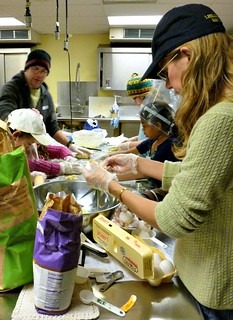
    Kids on a Mission trip to Appalachia. Youth on a Kenya Mission trip assisting with the school’s feeding program. Kids & adults in the kitchen during a Fish Fri event.

    Time Out. Talk about…A speech bubbleBrainstorm ways that kids can give gifts to God.

    For a list of activities where kids can get involved in offering their time see this list for summer 2011. (Updated: sorry, this list is no longer available.)


    Photo credits:
    Collection plate by rubber bullets, who licensed his/her photos under: Creative Commons Attribution-Noncommercial-Share Alike 2.0 Generic.
    Mission trip photos by various FUMC church members, used by permission.

    Are you seeing ads? They are not from me! They are placed by WordPress, who otherwise offers a free platform from which to share lots of good-ness. If you see an inappropriate ad, please report it to support@wordpress.com. Include the URL, the date/time the ad appeared, and a screenshot of the ad.