Communion Questions

This Sunday is the start of a new month! This means that Communion will be served at FUMC in Ann Arbor, MI. The Cool Disciples worship with their families this Sunday.

Do you prepare your kids for a worship service that includes Communion?

What words do you use?

Try out some of these:

  • We celebrate Communion to remember Jesus. What do you suppose we should remember about Jesus?
  • I wonder how bread and juice help us remember Jesus?
  • Communion is based on the Last Supper that Jesus shared with his disciples. I wonder what the disciples were thinking when Jesus said, “This is my body which is given for you?”
  • I wonder why Jesus used bread and wine for us to remember him, and not other food items from the Passover meal that they were sharing? (Like roasted lamb, bitter herbs, etc.)
  • I wonder what Jesus would like for us to think about when we take Communion?
  • At most meal times we eat food so that we can have strength. I wonder how receiving Communion gives us spiritual strength?
  • Note: Don’t worry about having definitive answers to your pondering!

    Even Charles Wesley acknowledged the mystery surrounding Holy Communion when he penned his hymn O the Depth of Love Divine

    O the depth of love divine,
    the unfathomable grace!
    Who shall say how bread and wine
    God into us conveys!
    How the bread his flesh imparts,
    how the wine transmits his blood,
    fills his faithful people’s hearts
    with all the life of God!

    As you prepare for worship, what will you share with your kids about Communion?

Been in a shipwreck lately?

A beached shipwreck

Have you been in a shipwreck lately? I mean of course, a figurative shipwreck.

The kids are driving you bonkers… The car needs extensive repairs… Or someone you know received a dire diagnosis…

What can comfort you?

It can be hard, can’t it?

Kids can experience shipwrecks too.

A friend moves out of town… A new school is looming on the horizon… Or there is sibling strife…

What can comfort your kids?

Sure, you’ll be there to give them a hug when needed. But what will they use as comfort inside?

What sort of self-talk will get used, in a shipwreck when you’re not around?

A recent Bible story our kids encountered at Vacation Bible Camp was about Paul in a shipwreck; a literal shipwreck! Read the story in Acts 27. Paul received comfort from God, before, during and after his shipwreck.

Will our kids seek comfort from God in the midst of their shipwrecks?

We hope that they will, but it takes some practice.

God’s word is comforting.

Spend time teaching your children to search for comfort in God’s word – the Bible.

The key is to put God’s word into their long-term-readily-available-brain-storage. (Often known as “learning by heart.” Call it memorization if you must, but perhaps not in front of your kids!) Make this a regular (and fun) activity – at bed time or at dinner time or at breakfast… any time. Just make time.

Why not start with the Bible Buddies – those little plastic characters that the kids receive at VBC. Look at them closely. There’s a Bible verse printed on each one! Tuesday’s verse was:

Open quote markYour promise revives me; it comforts me in all my troubles.

That’s from Psalm 119:50.
If that seems too complicated, try this version:

Open quote markWhen I am hurting, I find comfort in your promise.

What can you do to ensure that in your child’s shipwrecks, they turn to God?

a blue line

A heart with the word 'God' etched in itFor hints on ways to work at verse “memorization” see here and here and (updated) here!

Photo credits:
Shipwreck, by Katherine Hoppe, licensed on Flickr under a Creative Commons License.
Heart clip art by rygle, who has waived rights and dedicated the work to the Public Domain.

Remember when…

a family sharing a laugh

  • Remember when we went to the corn palace?
  • Remember when Jorge “left part of his car behind?”
  • Remember when mom got so frustrated she threw the apple peels at the wall?

All memories that bring smiles in our household! (Yes, even that last one!)

How often does your family tell “remember-when” stories?

On the first Sunday of every month at FUMC in Ann Arbor, MI, we tell a remember-when story. Celebrating Communion together is a remember-when story! We are remembering Jesus.

Jesus gave us instructions about remembering him at the Last Supper. This Last Supper was actually a Jewish Passover seder. A seder is a way that Jewish people remember when God saved his people from slavery in Egypt.

At this special seder Jesus gave new meaning to the bread and cup of the meal. They no longer are just reminders of what God did to save the Hebrews in Egypt, but are what God did for the entire world when Jesus died on the cross! Jesus wants us to remember him when we break the bread, and eat with one another. When we take part in Communion in church we remember how Jesus loves us.

Take time to talk about the remember-when stories of Jesus.


Photo credit: From my personal collection.

Gathering at the Table

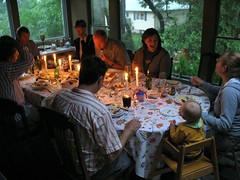
A family gathers around the table for a meal
Do you have 4th of July plans that include a gathering of family and/or friends around the table?

How about plans to join a different kind of family table?

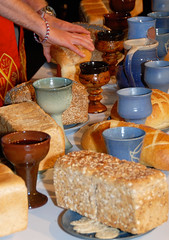
a communion table

This “gathering at the table” is another way of saying… “sharing Communion”… at the table of God’s family.

What does your child know about Communion?

How do you explain Communion?

A way to start is to relate Communion to things that your child already understands.

Children understand the concept of special meals. Describe Communion as a special meal. Relate your discussion about Communion to a recent special family banquet

At your family feast… At Communion…
Everyone was gathered together. Communion is also like a family meal. Christians participating in Communion are all members of Christ’s family
We told “remember when” stories. Jesus told his followers at their last meal together to “Do this to remember me.” Communion is a way to remember how Jesus died for us. In his death our sins (anything that separates us from God) are forgiven!
Because everyone was there, we felt thankful. Communion fills us with thanksgiving, Jesus’ death – and his resurrection – offer us to chance to be God’s friends forever!
Yum, yum. We filled up on good grub. By participating in Communion we are nourished in a different way – we can feel empowered to do God’s work in the world.

It’s a way to start the discussion!

In July (starting on July 11th) our Cool Disciples, our rising 1st through 6th graders, at FUMC in Ann Arbor, MI, will be studying about the Sacrament of Communion. Do you have questions about Communion that your kids have asked? (Or maybe that you’ve wanted to ask.) Submit them here and lets ponder together!

← Back

Thank you for your response. ✨

Join me at the family table this Sunday.


Photo credits:Robotpolisher and United Church of Canada (licensed under: Attribution-Noncommercial-Share Alike 2.0 Generic) and from my personal collection.

Cheerful giving?

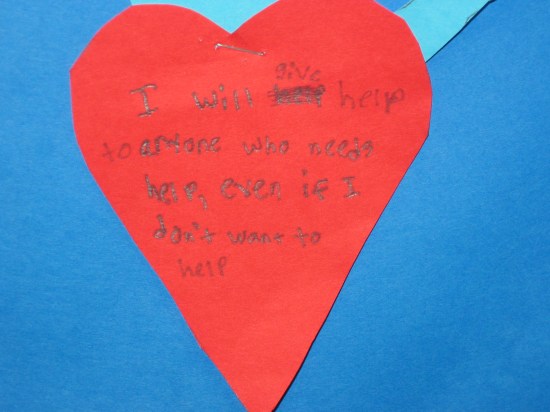
A cut out heart with words

That would be giving cheerfully!

Those words were written by a Cool Disciple, one of our rising 1st through 6th graders, at FUMC in Ann Arbor. This child had just heard the story of the “Widow’s Offering” in Mark 12:41-44. The class had discussed how people in the temple in the time of Jesus were giving gifts of coins just like people today give money to the church. They had also learned why we give an offering in worship: as a response to God’s love.   (This summer we are learning about  various aspects of worship.  In June the topic is Offering.)

But kids don’t typically have any income so how can they respond to God’s love? Delving deeper into the Widow’s Offering story teaches us that the size of an offering doesn’t matter. It doesn’t even matter what the offering is because sometimes our offering doesn’t fit into the offering plate! It’s the attitude that counts!

Each of you must give as you have made up your mind, not reluctantly or under compulsion, for God loves a cheerful giver.
2 Corinthians 9:7 (NRSV)

How do we teach giving cheerfully?

Well, we can always say: “we do it because Jesus taught us to.”  Which I suppose is one way to approach the topic… though probably not very convincing (if we are being realistic!)

Let’s face it, the only way to teach a behavior is to live the behavior. We need to be cheerful in our giving whether it’s while writing a check or making a meal for someone.

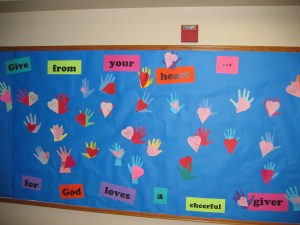
A bulletin board of hearts & hands made by the kids

Lots of hearts and hands were created by kids sharing ways that they can give cheerfully

Some ways to model giving (hopefully cheerfully!):

  • Join the FUMC Prayer Chain. Share the emails received and pray together.
  • Involve your children in preparing a meal to be given to a family in need. Even if it is just to ask them to help wash lettuce, stir brownie mix or fold napkins!
  • Donate toys they no longer play with or clothes that no longer fit. Investigate this link of organizations in our area that accept various types of donations.
  • Have any flowers in your yard or veggies in your garden? Deliver some to your neighbors (with the kids along).
  • What ways do you model cheerful giving?


Photos by Carol H.

But it doesn’t fit into an Offering plate

What do all of these various activities have in common?

  • Singing in the choir
  • Bringing in a box of cereal for the FiSH project
  • Greeting people and handing out worship bulletins
  • Leading a Sunday’s Cool workshop
  • Helping to set up Lemonade on the lawn

Answer: All of them are people making a gift to God’s church; a gift that doesn’t quite fit into an Offering plate but it is still an Offering.

A wrapped gift

Wait a minute. The Offering collected during worship is just money!

Well, yes, but an Offering can be more than money. And this is what we hope to teach kids as we start our summer Sunday’s Cool Rotations on portions of the worship service, with our June focus on Offering.

An Offering can be time, or talents, or treasures (money).

The Offering is the portion of the worship service that gives us an opportunity to respond to God and to be grateful for all we have been given.  (And God gives us lots!)  We acknowledge that everything we are and everything we have are really gifts of God. Such a heartfelt response is indeed, an act of worship!

Did you know that there is a “Children’s Offering?”

It is collected when kids go up front for the Children’s Moment. (Look for the older kids holding a basket.)

Prior to Sunday, help your child prepare a slip of paper to drop into the children’s Offering. (Though monetary offerings are also accepted. They go towards FiSH projects.) Discuss ways that they have given blessings from God. Talk about how they can respond to God’s gifts and God’s very generous love.

What will you add to the list above?


Photo credit: mrjoro
Licensed under: Attribution-Noncommercial-Share Alike 2.0 Generic

This is a test… but who is being tested?

As noted in the schedule we are doing something different for the month of May with the Sunday’s Cool Disciples. This week we’ll all be playing a game called “Are You Smarter Than a Sixth Grader?”

But wait, you ask… Isn’t the TV game show called “Are You Smarter Than a Fifth Grader?”
Well, yes and that isn’t the only thing that will be different about our game! For instance, the questions won’t be asked of the adults and we won’t use elementary school textbooks as a source for our queries. (And sorry, but the prize winners won’t receive a million dollars.)

Though I hear that everyone gets a prize for showing up, and the winning team members each receive a coupon for a free drink at the World Peace Café!

So what is the purpose of this game (besides a little fun)?

It’s two-fold: First off, to recognize our 6th graders who will be moving on to the youth program next year.   And secondly to see how much kids have learned about the Bible stories we’ve studied since September.

You mean like, this is a test?

Yes. But don’t worry, it won’t be graded. This is a test for us as educators: how are we doing with our teaching? Do kids know what we THINK they know?

For example we would expect that 6th graders who are regular attendees can…

  • Name the first four books of the New Testament.
  • Understand the meaning of the word “Gospel.”
  • Tell the basic story of Jesus’ birth, life, death and resurrection.
  • Name a couple of Beatitudes and can incorporate them as “keys” to how we should live.
  • Define a “parable.” (It’s a story that teaches with a hidden meaning.)
  • Re-tell the parable of the Good Samaritan in his/her own words.
  • Define a prophet (God’s messenger) and name a couple of prophets.
  • And the list goes on…

How about attending our “game show” this Sunday with your kids (in the Social Hall; after the Children’s Moment in church) and see if you are smarter than a sixth grader?

Are you seeing ads? They are not from me! They are placed by WordPress, who otherwise offers a free platform from which to share lots of good-ness. If you see an inappropriate ad, please report it to support@wordpress.com. Include the URL, the date/time the ad appeared, and a screenshot of the ad.

Saul: The Before Snapshot

Our Sunday’s school Cool classes in April are studying Saul/Paul’s conversion: the story of one who traveled for the purpose of eradicating Christians… but ended up being changed into someone who ended up traveling to preach about Christ!

On the road from Jerusalem to Damascus, Saul became a new person.

So how can you help your children understand why this transformation of Saul is momentous?

It helps to look at the way Saul was before his switchover. And, it helps to compare Saul to a character your child may know.

Saul: The Before Picture

Saul was a Pharisee. Pharisees were a group of Jews who believed that a redemptive relationship with God could be achieved through strict obedience to the law. Their view of “the law” was two-fold: the written law and oral laws.

The “written law” included the Ten Commandments and other God-given laws described in the book of Exodus. The Pharisees also believed that Moses had received equally binding “oral laws.” It was felt that these oral commandments helped make the written law clearer and thus, easier to follow… but unfortunately, these oral laws often made it more difficult to be loyal to God.

How does this example sound: Many types of work, such as carrying a “burden,” were prohibited on the Sabbath (Jeremiah 17:21-22). The Pharisees felt that this written law needed further interpretation; just exactly what was a “burden?” Thus was born an oral law specifying that things such as money or trinkets were in fact burdens. (Better watch what you pick up!)

Some Pharisees got so caught up in the details of their man-made laws that they lost sight of the spirit of God’s law. It’s almost as if they forgot why they were following the laws in the first place!

Jesus had not condemned all Pharisees but he did frequently argue with those whom he called “hypocrites,” reprimanding their self-righteous behavior and their strict interpretations of the law. (A few examples: Matthew 12:1-12, Matthew 15:1-20 and Mark 7:1-13).

Who does Saul remind you of?

Saul was a particularly zealous Pharisee. He loved God and tried very hard to follow the Jewish law. But somewhere along the way, he became what we might call a fanatic.
A picture of Wile E. Coyote on a drinking glass

To help explain Saul’s “before” picture, choose a character from your child’s repertoire. Wile E. Coyote, of cartoon fame, reminds me of the before-Saul. How does Wile E. Coyote feel about the Roadrunner? (He wants to destroy him!) We could say that Wile E. Coyote is a fanatic; he is focused on getting the Roadrunner! Likewise, Saul was also a fanatic. He was focused on getting Christians and putting them in jail and sometimes, he even had Christians killed.

Once you’ve got a character that your child can compare to Saul, describe a turn-around in their behavior. Have fun and ask your children to think up transformational examples. Here’s one:

Saul’s transformation on the road to Damascus is like… Wile E. Coyote starting a “Rescue Roadrunners” Facebook group.

What words and characters help you explain the before snapshot of Saul to your kids?


Photo credits:
Wile E. Coyote by Adam Dale, who licensed this photo under: Creative Commons Attribution-Noncommercial-Share Alike 2.0 Generic.

Are you seeing ads? They are not from me! They are placed by WordPress, who otherwise offers a free platform from which to share lots of good-ness. If you see an inappropriate ad, please report it to support@wordpress.com. Include the URL, the date/time the ad appeared, and a screenshot of the ad.