
The strangest things can happen around your table

What happens around your family dinner table?

a very messy eatera boy eating at a table

  • Food is served (and sometimes eaten).
  • Conversation unfolds.
  • Stories are told.
  • Things get messy.
  • Games are played.
  • Bread is broken.
  • Memories are made.

Here’s a table where I’m sure this happened…

Last Supper, 1896 work by Pascal Dagnan-Bouveret
Jesus and his disciples share the Last Supper

Well, okay. They probably didn’t play any games.
(But don’t that that stop you! See here for suggestions of games to play at the dinner table.)

What happens around your dinner table?
Are questions expressed, discussion encouraged, and disciples of Jesus cultivated?

Why not start today? Use this mini reading plan with discussion questions.

If you’d like to print out this reading plan/discussion guide, click here.
(Check out the other mini reading plans for our Rotation on the events of Holy Week here. If your kids aren’t clear about the order of the events of Holy Week, start at the beginning.)

Read Talk about or do…
Luke 22:7-15 What is your favorite mealtime gathering? What sort of preparations are required? What is served at this meal? Why do you enjoy it?
Why do you suppose Jesus “earnestly” wanted to share this meal with his disciples?
Mark 14:12-16 What is the Festival of Unleavened Bread? What is the Passover lamb? (Hint: look at Exodus 12:1-14.)
How likely do you think it would be for the disciples to find a man carrying a jug of water? (Remember this is back in Jesus’ time when water retrieving was strictly women’s work.) There seems to be a bit of secrecy to this planning. Why do you suppose that was needed? (Remember what sort of danger was Jesus in.)
Describe the details about how you would plan a secret location for a party.
John 13:1-5 Name the worst clean-up task that you can imagine. (Perhaps cleaning up after a sick puppy or washing the kitchen floor after a mishap involving a dozen raw eggs?)
Why do you suppose the disciples feet needed washing? (Hint: think about their footwear and the roads in those days.)
John 13:1-11 Why do you suppose Peter didn’t want Jesus to wash his feet? Would you want your teacher at school to wash your feet? Name someone whom you’d never want to wash your feet. Why not?
What do Peter’s feelings tell us about his relationship to Jesus?
John 13:12-17 How is washing someone’s feet an act of service? What do you suppose Jesus meant by saying that his disciples should wash other people’s feet? Did he mean literally??
Get out a small basin, some soap and a towel. Put some warm water into the basin and wash each others feet. What are you thinking as your feet are bathed?
John 13:14-15 We know what will happen to Jesus. We know how Judas will betray him, and Peter will deny him. Yet Jesus washes both Judas and Peter’s feet! Think about an act of service that you would struggle to do for someone, if you knew they were going to be mean to you in the future.
Name some acts of service we can do for others. Are these hard or easy to do?
Matthew 26:20-25 What reaction do the disciples have when Jesus drops this “bomb?” How would you have reacted?
The Bible doesn’t tell us why Judas snitched on Jesus. Some theorize that he wanted the money (John 12:4-6). Others propose that Judas was hoping that Jesus’ arrest would prompt Jesus to act more like the warrior king that the Jews had been expecting. (Or as one person has said: “Maybe Judas was throwing Jesus into the deep end of the pool, hoping he’d swim.” Quote source Have you ever wished that God would move a little faster in his plans for you? Have you ever betrayed someone’s trust? Can you describe why you did this?
Luke 22:19-20 What elements of a traditional Passover meal did Jesus turn around and give new meaning to? What is Jesus asking his disciples to do? What is he asking us to do? (Hint: reread Luke 22:19.) What are we suppose to remember – the way Jesus shared the bread and cup or what meaning it has? What meaning does it have?
Matthew 26:26-28 Do you suppose the disciples understood what Jesus was saying about his body and his blood? Would you have understood if you’d been there? How would you have felt when Jesus passed around the bread and the cup?
Matt 26:26-29
Mark 14:22-25
Luke 22:19-20
What similarities do you notice between these three accounts of this story? What differences exist? What do you think of Luke’s additional words about why we should repeat this act? (“Do this in memory of me.” When do we hear those words in church? (at Communion!)

Are memories being made around your table?


Photo credits:
At the table, by kate hiscock and a messy eater, by Matt Preston, both licensed on Flickr under a Creative Commons License. (No changes were made.)
Last Supper, an 1896 work by Pascal Dagnan-Bouveret in the Public Domain, via Wikimedia Commons.

Are you seeing ads? They are not from me! They are placed by WordPress, who otherwise offers a free platform from which to share lots of good-ness. If you see an inappropriate ad, please report it to support@wordpress.com. Include the URL, the date/time the ad appeared, and a screenshot of the ad.

Bothered & Bewildered: Stuck in a playpen?

The book Bothered & Bewildered by Ann Morisy“Bothered and Bewildered” — that’s the sermon series for Lent this year (2014) at FUMC. The idea for this theme came from the writings of Ann Morisy. That is one of her books over on the left: Bothered & Bewildered: Enacting Hope in Troubled Times.

Ann guest-lectured this past weekend in Ann Arbor. In one of her three talks, Ann spoke about bringing hope to those who are troubled and anxious — to those in a bothered and bewildered state.

 
Ah, that would be me.

I’ll admit – I’m often dazed and downright dizzy, and in the in midst of an overloaded life, I’m wondering, who me? A child of God? And why am I here?

What about you? Ever feel that way?

I’m thinking that a generous dose of uncertainty also applies to our current Rotation on the events of Holy Week. Some of the characters in our story were definitely a bit baffled.

  • Why did Jesus overturn the tables in the Temple? (Matthew 21:12-13).
  • What was Jesus talking about – “the Son of Man will be handed over…” (Matt 26:2).
  • And what brought Judas to snitch on his teacher?! (Matt 26:14-16).

Yes, I’d say that the portion of our story covered in this week’s mini reading plan (below), includes people who are troubled and anxious.

Can we relate?

To continue a previously started trend, let’s explore the concept of people bothered and bewildered during that first Holy Week. People, not unlike us, who (to borrow another Ann Morisy viewpoint) fear stepping outside of the playpen.

a child chews on the edge of a playpen

Do playpens even get used any more?

Those places where we placed a small child to keep them out of harms way while we were otherwise occupied? Keep the thought of a playpen — a safe place — in mind as you use this mini reading plan with discussion questions around the family dinner table. Or wherever your family (or your friends!) gather together. Use the chart below to read and talk about this particular portion of our story… in stages… over the coming weeks. Or print it out.

(Check out the start of the mini reading plans here.)

Read Talk about or do…
Matthew
21:8-11
A bit of a review: Why is the crowd all worked up; who is coming into town?
Why were they shouting words of praise – Hosanna!?
What sort of king did they expect Jesus would be? What hint should they have taken from Jesus’ choice of a mode of transportation?
How do you suppose the sight of this parade makes the people think: perhaps it would be safe to leave our playpens?
Matthew
21:12-13
Why do you suppose Jesus turned things upside down in the Temple?
Imagine you were a money-changer in the Temple; what would you have thought? Imagine that you are someone who needed to buy a dove to offer as a sacrifice in the Temple. How do you feel being turned away? (Sorry there are no doves; that man let them all loose when he was overturning tables.)
Matthew
21:12-13
What about this event bothers you? What questions do you have? If you were there would you feel like you were in need of a playpen of safety and security, or a playpen full of challenges? What do you suppose Jesus is trying to tell us about prayer and worship?
Matthew
21:12-16
Why do you suppose the chief priests and the teachers of the law were so upset about kids making noise in the Temple? This is just one example of how they seemed to always butt heads with Jesus. Jesus came to earth to help put the world right again, but he used ways that were different than what people expected. What way do you suppose a “take-charge” type of king would have used in this instance to right the unfair practices at the Temple?
Matthew
26:1-2
A review: What did the festival of Passover celebrate? (Hint: look at Exodus 12:1-14.) What does the word “crucified” mean? (killed on a cross) Why did Jesus allow himself to be killed (he could have run away)? (It’s okay if you don’t have a definitive answer to this question. Discuss it anyway!)
Matthew
26:3-5
What festival were the religious leaders talking about? (Hint: look in verse 2.) What sort of playpen were they setting up for themselves to avoid a backlash of protest from “the people”? Why do you suppose they were worried about what others thought?
Matthew
26:14-16
Which disciple tattled on Jesus? (Judas Iscariot)
What was the bad plan that Judas made? Have you ever made a “bad plan”? What happened? Was forgiveness necessary? Do you suppose that Jesus forgave Judas?
What sort of playpen would you retreat to if you made a really bad plan? Or would you think to choose to run to Jesus instead?

Are you ready to continue with the next in our series of mini-reading/discussion plans?

-------


Photo credits:
Youngster in a playpen by Ross Belmont, licensed under Creative Commons BY NC-SA 2.0

How to love God

Let’s review the Ten Commandments. What was the first one?

A sign says 'Rule #1: Don't pick up the goats'

 
Well, the Ten Commandments can be hard to remember. I guess it’s a good thing that this month we are learning about how Jesus shortened them for us by giving us what is called the Greatest Commandment.

Someone once asked Jesus which of God’s rules was the most important. Jesus’ reply recorded in Matthew 22:34-40, actually had two parts. He essentially told us to

Love God, and love your neighbor.

What a minute; I don’t remember either of those as one of the Ten C. What gives?

Jesus didn’t pick from the ten; he summarized all of the commandments into two. In fact we see that this nicely divides the Ten Commandments! The first four of the ten, show us how to love God (Exodus 20:3-11). The last six show us how to love others (Exodus 20:12-17).

Love God Love Others
1.  Do not worship any god except me. 5.  Respect your father and mother.
2.  Do not make statues of gods (idols). 6.  Do not murder.
3.  Do not misuse my name. 7.  Do not commit adultery.
4.  Remember the Sabbath day. 8.  Do not steal.
9.  Do not tell lies about others.
10. Do not long for what belongs to
someone else.

 
Here is a discussion outline for your family to take a closer look at following the first portion of the Greatest Commandment: How to love God.

(For a discussion guide on talking about how to love others, look here.)

Spend time as a family (at the family dinner table perhaps) with everyone sharing one glad and one sad for the day. (Don’t try to fix anything, just listen and celebrate / commiserate.)

a blue line

Tell kids that you are going to play a game. Have everyone think of something they love (a person, a place or a thing). Also have everyone think of something that they don’t love. Then go around the table and have everyone say “I love ____” filling in the blank with something that they love or don’t love. Have everyone decide if they really do love that item. Play a few rounds. Who can stump everyone with their choices?

Ask: What clues tell us that you love something?
How do you suppose people know that we love God?
How do we show that we love God?
Make a list and post it on the fridge! Are you doing these things every day?

A list of ways to love God

Not to detract from following the Ten Commandments but if we focus on loving God, in a sense we will be living the first four of the Ten Commandments and won’t have to worry about the details. By loving God we will be automatically obeying the first four commandments!


Photo credits:
For the love of goats (a sign at a petting zoo) by Gord McKenna, who licensed this photo on Flickr under a Creative Commons License.

Are you seeing ads? They are not from me! They are placed by WordPress, who otherwise offers a free platform from which to share lots of good-ness. If you see an inappropriate ad, please report it to support@wordpress.com. Include the URL, the date/time the ad appeared, and a screenshot of the ad.

Why make commandments? Especially when you know people can’t keep them

Why did God make laws? Especially when his commandments are really tough to keep. No work on the Sabbath? When was the last time that one got followed? Why make laws when you know that people will end up breaking the rules?

I’ll give you a hint of the answer:

To make us realize our need for God’s grace.
And because God loves us.

(Okay. That was two hints.)

Crossing guard

The next time you are driving in the car with the kids, ask them why you should have to stop whenever you see a red sign of a certain-shape?

Steer them to realizing the purpose of laws: They keep people safe.

Next, ask them why they think your family has rules? (Such as: no playing in the street when there is traffic.)

Direct them to realizing that you have rules to keep them safe and because you love them!

God had the same reason for giving us the Ten Commandments: he loves us!

Wait a minute (you may say)… laws can be restricting. They make life no fun!

And this is for love?
 
A bit of backstory is needed. When God first handed out his laws, the intent may have seemed as though it was to bring order to an unruly bunch. The newly freed Israelites were at a point where they needed:

  • To recognize who God was,
  • To remember God’s past provision,
  • To recall God’s covenant with their forefathers (and foremothers),
  • To learn how to honor God, (How to stay in love with God!)
  • To establish a new life together learning how to live (and how to act) as God’s people.
Hmm. Those reasons for laws still apply to us today!
The  words of Exodus 19:25

 
It’s time for a bit of discussion at the family dinner table. (Or wherever your family is gathered together.) If needed, cover this over several days.

This family discussion guide can be printed! Click here.

  Bring out a toaster, or a hair dryer, or other small electrical appliance that has a cautioning label on the cord. Have your family read the warning tag. Ask them why do you suppose the manufacturer placed it there?

  Recall your earlier conversations in the car (or ask those questions now).

Why did God want to give his people laws? (Accept all replies.)
Then perhaps offer some answers:

A.  Because they were misbehaving left and right! They needed laws! (Nope.)

B.  Because God felt like being in charge! (Nope.)

C.  Because God loved them and wanted his people to be safe!  

  Read together Exodus 19:3-6.

 
What does this passage tell you about how God feels for his people?

Pay close attention to verse 6:

Open quote markNow obey me completely. Keep my covenant. If you do, then out of all of the nations you will be my special treasure.
 

God continually seeks a connection with humanity!
God looks on all of us as his treasured people!

Let that sink in. (I’m awed.)

When you are ready for more…

  Re-read Exodus 19:3-6. And then read 1 Peter 2:9.

 
What does God mean that we are to be his “kingdom of priests?”

In Bible times only priests could have close access to God. (A priest would
be similar to Rev. Doug or Rev. Nancy.) To be a “royal priesthood” means that everyone can have a loving relationship with God!

Ask: If God really loves us & gave us laws to keep us safe & guide us, why are his laws so hard (okay, impossible) to keep? (allow all replies)

What do you feel like doing when something seems hopeless?
(You might want help, right!?)

God’s laws make us aware of the seriousness of sin.

(Sin is whatever we do, or don’t do, that pushes God, or other people away.)

God is pained by our sin but is always willing to forgive us when we ask.
Our inability to keep God’s laws helps us to see how much we need God!

Ask: Do you suppose that if you could perfectly follow the Ten Commandments that you’d win extra special points with God? (nope!)

God sent his son, Jesus, to take the punishment for our sin and to establish a new way for us to enter into a relationship with God.

A relationship based on love!


Photo credits:
Kids crossing by jeweledlion. Exodus 19 by thekmochs. (All photos licensed on Flickr under a Creative Commons License and found via photopin.)
Toaster and other clip art from the public domain via WPClipart.com.

Are you seeing ads? They are not from me! They are placed by WordPress, who otherwise offers a free platform from which to share lots of good-ness. If you see an inappropriate ad, please report it to support@wordpress.com. Include the URL, the date/time the ad appeared, and a screenshot of the ad.

In this new year, I have a wish for you

Happy New Year!

I hope that your new year will be filled with peace, and prosperity,
and encounters with the presence of God.

Oh shucks, that’s not my real wish.

I mean, yes, I really do desire all of that for you,
but here’s what I’m honestly hoping for…

That your family spends time together
incorporating stories from the Bible into your everyday life.

I’m hoping that when your child invites a friend over for dinner and this friend hears your family making sacred connections with the secular, and they question your child about this behavior, your kid proudly says, “this is what we do.”

How can you get to this point?

Read together the Bible. (Use a story Bible if your kids are young – here’s a good one: The Jesus Storybook Bible.)
Ask a question that start with the words “I wonder…”
Listen carefully to everyone’s replies.
Repeat.

For example, to prepare for our upcoming Rotation on the Ten Commandments, review the story of Abraham and Sarah. Read Genesis 12:1-4, and 15:1-5, and 17:1-9.
Then ask:

  • I wonder if God’s promises to Abraham ever came true?
  • I wonder what an everlasting covenant is?
  • I wonder how this story ties to the Ten Commandments?

Refer to this post if you’d like more discussion questions.

What can you do today, to practice what you hope to achieve in the coming year?


Photo credits:
Click here for info on banner photo (not visible in readers or email).
New Year’s greeting from 1910, by Puzzler4879 under a Creative Commons License on Flickr.

Are you seeing ads? They are not from me! They are placed by WordPress, who otherwise offers a free platform from which to share lots of good-ness. If you see an inappropriate ad, please report it to support@wordpress.com. Include the URL, the date/time the ad appeared, and a screenshot of the ad.

Who was doing the seeking?

In our current Advent Rotation, we are learning about the wise men, who upon discovering an unusual new star, traversed from afar, looking for the new king. (In those days an unfamiliar star = a royal event; all great kings had a star associated with their birth.)

Arriving in Jerusalem these magi created quite a commotion with their inquiry…

A photo of the Milky Way Galaxy with the words from Matthew 2:2

These wise men were on a determined hunt for this new king. We don’t know how far they had traveled, or what sort of difficulties they came up against; they persevered.

But who was seeking whom?

Who got these magi started on their quest?
Who put the star up in the sky?
Who re-hung the star after their stop in Jerusalem? (Matthew 2:9)
Who guided them to find Jesus?

This seeking seems to be going both ways! Seeking Jesus is a beneficial practice, but what about considering that Christ also seeks us?

How would it benefit us to notice signs of God leading us to Jesus?

A friend offers assistance at the right moment.

A child asks a pointed question.

A word heard, sparks thoughts.

If we’re not looking, will we notice?

Talk with your family about God seeking us. Here are some questions to guide your discussion. Perhaps ask a few questions during a car ride. For an easy to print out version, click here.

Star clipartRead: Matthew 2:1-2.
Ask: What questions do you suppose the wise men asked before they started their journey? (How far will we have to travel? Will the star continue to guide us?)
Why do you suppose the magi left everything to go looking for Jesus?
I wonder how the star had that much pull in their lives?
Can you imagine God in his wonderous power, hanging a bright star as a sign to the wise men?
What was God hoping these wise men would do?
What has been your “star” leading you to Jesus?

Star clipartRead: Matthew 2:1-8
Ask: When Herod heard about the magi asking about “one born king of the Jews,” he called together the chief priests and religious teachers. What did he ask them?
What was their response?
How do you suppose Herod really felt about this “new king?”
How come these religious leaders didn’t act interested in Jesus?

Star clipartRead: Matthew 2:1-12
Ask: When the wise men saw Jesus, what did they do?
Do we worship Jesus like the magi did?
What is different?
We could say that the wise men were “wise” because they went looking for Jesus. How would we describe a not-so-wise person? (Too busy to look? Not willing to try hard enough?)
How could you help someone become “wise?”
Contemplate how the magi packed for their trip. How does a wise person “pack” for Christmas? (Plenty of patience?)

God loves you. He seeks your love in return!

Photo credits:
Our Milky Way Galaxy original photo by C. Malin of ESO, made available for use under a Creative Commons 3.0 License. Altered image to add Bible passage, by Carol Hulbert at Flickr.
A slightly altered (coloration, size) clipart star, from the Public Domain via wpclipart.com.

Become the blessing

Gather the family together and tell this story. Be prepared to stop for questions.

Once upon a time there was a man named Abram who heard from God. “I want you and your wife to be a part of something really big. Pack up and move far from here, and raise up a great big family; generation after generation! I promise to bless you richly, to give you much goodness! And in turn, you will bless the world!” (Genesis 12:2.)

Do you suppose that Abram often thought about those numerous descendants — the ones God had promised to him? I can just imagine him chuckling to himself as he watched the sheep, “When those grandchildren come, I’ll tell them all about the altar I built at the great oak tree in Moreh” (Genesis 12:6-7). “I’ll tell them how I didn’t see how, with all of those Canaanites around, the land would ever be ours! Ha!”

Have the adults in your family ever thought about their grandchildren-yet-to-be-born?
What about the kids; have you ever thought about your grandchildren?

I am sure there were times when Abraham’s doubts about God’s plan spilled over in frustration. I can imagine him grumbling to his childless self as he tended to the goats, “The Lord God can bless me all to pieces, but it won’t do any good. Copious kin! I don’t even have a son! I’m too old.” (Genesis 15:1-5).

Then there probably were times Abraham (God had given him that new name as a sign to remember God’s promises) wondered about “blessing the world.” As he leaned back his head to adequately view the marveling display of glimmering stars overhead, he wondered to himself, “What did God mean by that? I will be blessed… so that I can be a blessing? How can I be a blessing?”

Have you ever wondered how you can be a blessing?

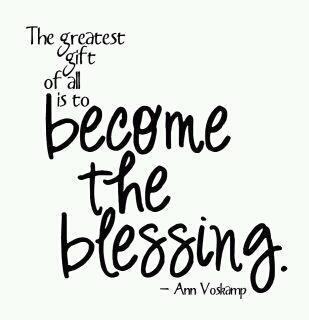
"The greatest gift of all is to become the blessing." A quote by Ann Voskamp.

We share God’s promises; they belong to us.

What are we doing to bless others?
Our family? Our friends? Our neighbors? The homeless man on the street? The store clerk? Our grandchildren (the one’s way off in the future)?

Abraham and Sarah teach us to respond faithfully to God’s call, even when it doesn’t make sense; even when our trust wavers. The payoff is great. (God promises it will be full!) God can’t wait to bless us! And in turn, God wants us to enrich the lives of others; it’s part of God’s plan to bless the whole world!

Photo credits:
Click here for info on banner photo (not visible in readers or email).
The quote above is from Ann Voskamp’s book
One Thousand Gifts. The word art was created by Deb Chitwood.


Are you seeing ads? They are not from me! They are placed by WordPress, who otherwise offers a free platform from which to share lots of good-ness. If you see an inappropriate ad, please report it to support@wordpress.com. Include the URL, the date/time the ad appeared, and a screenshot of the ad.

Take time to travel through the story

A public domain image: Abram Called to be a Blessing
(In Canaan) the Lord appeared to Abram and promised:
“I will give this land to your family forever.”
Abram then built an altar there for the Lord.
(Genesis 12:7)

The story of Abraham and Sarah winds it’s way through several chapters in Genesis, so here is a reading plan that breaks it down into manageable chunks. Print out this plan and over the course of several days (weeks!), have your family read the story together. Included are activities and questions to go with each reading!

a girl readingIf you’d like to print out this reading plan/discussion guide, click here.

Read in Genesis Talk about or do…
12:1 If God called you to suddenly move to a not-named spot, would it be an adventure, or something to avoid? Would you go? What would you pack?
12:1-5 Abram faithfully goes! He doesn’t know where he is headed! (The Bible can look in hindsight and tell us that he went to a land called Canaan.) Someone’s actions reveal their character. What type of person is Abram? What would you like your actions to reveal about you?
12:1,4 Have each person take a turn at being led while blindfolded. Talk about how this felt. (Trust was required!) How is our walk with God sort of like a blind faith walk?
12:4-7 Hey, wait a minute! But God said he’d give Abram this land and yet the Canaanites seem to have gotten there first. Yet what does Abram do? (Hint: 12:7 – he hears a repeated promise of land & builds an altar to worship God.) Name a time when your expectations didn’t meet what happened. How did you react?
11:31, 12:1 See if you can find on a map, all the places where Abram went. (Try this one.) Can you figure out how far Abram and Sarai traveled? What is the longest trip you’ve ever taken?
12:1-3 What does it mean to be blessed? (Ans: that you’ve received something good.) What does it mean to be a blessing? As Thanksgiving approaches, collect a list of your blessings. Everyone write or draw a blessing. Place them in your box you made in the Art Workshop! (or save them up if you haven’t visited Art yet.)
12:1-7 God has both made commands and promises to Abram. What has God asked Abram to do? What are his promises? Why does the promise to make Abram into a great nation (which requires lots of offspring) seem like a farfetched dream? (Hint: 11:30) What outrageous promises have you received?
13:14b-18 God is reminding Abram of the promises he has made. Abram used altars he built out of rocks to remind himself of encounters with God. Go on a walk and gather a few stones. Take them home & build a table-sized “altar.” Periodically restack the stones. Remember God is always with you.
15:1-7 Abram doesn’t bottle up his feelings! He tells God about his doubts. When have you doubted God? (It is okay to share your doubts with God!) What reminders of his promises has God given you?
15:5 Plan a star gazing night. What do the number of stars represent for you?
15:18a, 17:1-4 What is a covenant? (Look up the definition in your Bible dictionary.) A covenant is like a special agreement including a promise. What examples of covenants (special promises) can you think of? Write a family covenant that everyone can participate in. Bonus Q: What does the little “a” mean, after the 18?
17:1-9 How old is Abram? (99!) Look back at 12:4 to see how old Abram was when our story started. How many years has Abram waited for God’s promises? Why do you suppose God waited so long to fulfill the promise of a son? What can we discover in waiting for God’s promises?
17:3-5, 15 Caregivers: provide the story of how your child’s name was chosen. If you could change your name, what would you change it to? What if your name change signified a change in relationship with God?
17:7-9 What does God mean when he says that this is an “everlasting covenant?” What does this mean for us? Hint: check out 17:7 (it’s our key Bible verse). Develop a family cheer using the words: “God is our God!”
18:1-15 Who are these three visitors? What do you make of the way Abraham treats them? How do you treat visitors?
17:15-17, 18:10-15 Why do Abraham and Sarah laugh? Tell about a time you laughed at an inopportune time. Speculate about what makes God laugh.
21:1-3 What does this story teach you about God? What long-awaited event has brought you the most joy?
Bonus questions: How are Jacob & Esau related to Abraham? How about Joseph? Draw the family tree.


Photo credits: Click here for info on banner photo (not visible in readers or email).
Abram worships God in thanks for God’s promises, by Providence Lithograph Company, circa 1906; in the Public Domain via Wikimedia Commons.