For Lent: Add one small thing

Coffee and chocolate

We are in the season of Lent. Have you heard the standard question?

Open quote mark What are you giving up for Lent?

Rather than giving something up…

what about adding something?

Just one small thing, every day?

If you’ve been around these parts you have read what I have to say about blessing your child(ren) and/or yourself. And about how…

  • Offering a blessing for someone means you see them as very valuable.
  • Blessings are words that communicate your child’s (and your) high value to God.
  • They are special words that your child (and you) can take with you into the world.

I’d like to suggest that the small thing you add for Lent would be to bless your child(ren) and/or yourself. But I know that that can be hard to start. (For those of you who already practicing blessings… Bravo! Keep it up.)

For those who haven’t yet started, may I suggest a small something for you to add for Lent?

Give yourself a blessing.

Here is one to try. This blessing was written especially for you. It is based in part on 2 Corinthians 13:14, in the Message translation. Print it out if you’d like, here.

Fill in the blank with your name. Post it on the bathroom mirror or the fridge. Go ahead, speak these words to yourself; out-loud if you’d like! Every day.

Add one small thing for Lent.

Open quote mark _______ the amazing grace of Jesus, the extravagant love of God, and the intimate friendship of the Holy Spirit, are always with you. Go, be a child of God, reflecting God’s love to all those around you.

Lenten blessings!
— Carol

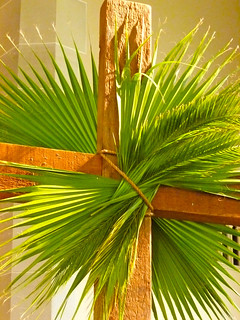
A cross decorated with palm branches It’s Lent! Here are some resources for the season:

Lenten activities for your family.

Short spiritual practices to try during Lent.

A way to tell the Easter story using plastic Easter eggs.

--------------

Photo credits…
Coffee & chocolate by Andrew Crookston, licensed under Creative Commons (CC BY 2.0).
FUMC’s palm-covered cross from my archives.

Why is it called Ash Wednesday?

Ash Wednesday is approaching.

Your family is invited to the Ash Wednesday service at 7 PM at FUMC at the downtown location…

Yes, kids are invited to attend.

Which means they would get something out of it.

Are you squeamish—for your kids—about the part with the ashes? (You know, the part of the Ash Wednesday service where the pastor using ashes, marks a cross on your forehead.) Okay, I’ll admit that back in the day, I was.

The sign of the cross in ashes on a forehead

Time Out. Talk about…A speech bubble

What is it with the ashes on Ash Wednesday?  What is that all about? And what is “Lent” anyway?

Here are some details to share with your family. Print out a copy of this discussion guide here.
(Why not a cheat sheet to have with you when you talk about Ash Wednesday/Lent?)

Even if you don’t plan to attend the Ash Wednesday service, this is still important material to look over and share. (And don’t feel bad if a family discussion doesn’t happen until Thursday or even Saturday next week! Or whenever!)

  • What is Ash Wednesday? It is the first day of Lent.
  • What is Lent? Lent is the 40 days before Easter. (For the fact-checker, Sundays are not counted.) It marks the time period when we “prepare” ourselves for Easter. This preparation can be a deeply personal event, or it is okay to share your thoughts with others if you feel like doing so.
  • What are we preparing for? It is not about stockpiling lots of chocolate bunnies! It’s about asking ourselves tough questions like how much do we invite God into our daily lives? What are ways to foster a closer relationship with God? (Because God would really love to be your close friend!) It’s about putting our hearts and minds in order, so that when Easter finally arrives, we are ready to celebrate—to shout Alleluia!
  • Why do we celebrate Easter? It’s an important holiday because of what happened on the first Easter. Jesus was crucified on a cross. But rather than this being the end, the cross is a way of showing us the full extent of God’s love. In Jesus’ suffering on the cross he demonstrates a love that will not give up! The happiest news: After three days Jesus rose from the dead! Jesus showed us that God’s love and forgiveness is more powerful even than death.
  • What is the significance of Ash Wednesday? Since it starts off Lent, it specifically reminds us of our need for the whole point of Easter: we all make mistakes. We all sin. (Sins are anything we do that separates us from God; that pushes God and/or other people, away.) We all need forgiveness, over and over again! At the Ash Wednesday church service we hear that it is okay for us to admit we aren’t perfect; we can let go of what has happened in the past.
  • Why ashes? Ashes are produced when something is burned. It means that something has “died.” In Bible times when people were very sad or sorry, they put ashes on their heads and dressed in “sackcloth”—very scratchy clothes. (Read about such an instance in Esther 4:1.) It was a symbol of how bad they were feeling. When the ashes are placed on your forehead the pastor will say, “The old has died.” Your response can be to say, “The new has come.”
  • Why ashes, in the sign of a cross? It is a symbol of your need for God’s love and forgiveness. Because the ashes are marked in a cross this says: “There is hope. Though I have messed up, I am marked as a child of God. I will try, during Lent, to live closer to God.”

Even if your family doesn’t attend the Ash Wednesday service or if your child balks at getting marked with ashes, how about following the following routine during bedtime prep:

As your child washes their face, place your hand on their shoulder and say… God washes away all of your past mistakes. God loves you and promises to help you live as a child of God.

By following this simple step…

You have just blessed your child!

Click on a box if you would like to…
A check-box Satisfy your curiosity about why you should bless your child.
A check-box View other suggested blessings.

--------------


Photo credits…
Forehead with ashes by mtsofan, licensed under Creative Commons (CC BY-SA 2.0).

Can written words expose hidden, heartening truth?

I contributed the following on Good Friday to the 2019 “PictureLent” daily devotional series, written primarily for adults. PictureLent is a ministry of the Rio Texas and the Michigan Conferences of The United Methodist Church.

Each day’s devotional is based on a word found in the Lectionary scripture, which for Good Friday was John 19:14-22.

My word was “Write.” Here is my devotional. I hope that you find meaning in it. May Easter be a restorative time for you.


The daily word is “write”?? Where does that word show up in the story of Jesus’ crucifixion?

A slow re-reading reveals the answer:

Pilate wrote a sign and put it on the cross. It read: ‘JESUS OF NAZARETH, THE KING OF THE JEWS’   (John 19:19, ICB).
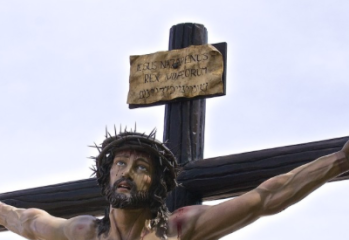

Showing the placard on the cross above Jesus' headDid you know that it was customary at a crucifixion to attach a placard above the condemned person, with their name and their crime?

This makes sense. Romans performed crucifixions in public locations as a deterrent.

To ensure that everyone could read an edict, it was composed in the three major languages of the time—Hebrew (Aramaic), Greek, and Latin. Those observing would want to know what sorts of activity to avoid!

Written words proclaim Jesus’ identity: The King of the Jews.

John’s gospel reports that this phrasing caused consternation among the Jewish Temple leaders, who protested to Pilate. They didn’t want Jesus labeled as their King, giving the impression that this claim was in fact acknowledged.

They told Pilate: “Don’t write, ‘The King of the Jews.’ But write, ‘This man said, I am the King of the Jews’” (verse 21b). Pilate’s answer: “What I have written, I have written!” (verse 22).

It was as if Pilate issued a proclamation of the gospel: Here is your King!

Follow this thought: Perhaps Pilate was constrained by the size of the piece of wood. What if he had a bigger piece? There could have been so much more to write! But Pilate was also limited by his understanding. With our post-Easter view of the situation we would add more, writing:

Here is your suffering King. (But see how this means he understands your suffering?) Don’t worry, death will not be the end; it will be a new beginning! You can live free from the hurt and pain of your past! You are forgiven! All is grace. Welcome to the new you!

What words do you wish could be written about who you are – this new you?

Undertake another exercise with me: Imagine you have died. (Don’t worry; it was painless.) Your family and friends have gathered together to write your obituary. In the manner of Pilate’s defining epithet, what would you like them to write—not what do you think they might write about you—but what truths do you long to hear?

For me, I would hope they could write:

Creative Carol, a survivor, a life-long learner, one who embodies a meaningful picture of Jesus for others, who bravely points out God-present, and always with us.


Many of us lack healthy self-worth. Today, let the cross change you!

Who do you aspire to be?
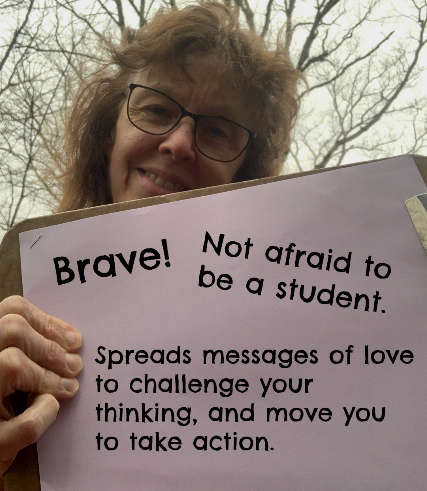
Me with 'who I am' words written on a clipboard

Surprise: God already sees you that way!


A Short Prayer:
Nurturing God, the words that you use to describe us are so different than the ones we use on ourselves! On Good Friday, when darkness and death take center stage, may we be reminded that our old ways of thinking can change. Help us to see ourselves with the same delight and expectation with which you see us. Amen.

An Action Challenge:
For friends and family that you encounter today, consider what sign would be placed over their head.
Name a positive trait you see in them. Tell them about it.

Discussion/Reflection Questions:
1. Who is Jesus to you? What would you write on the sign above Jesus’ head?
2. Do the obituary exercise. (Don’t worry about the exact sentences; just write key words.)
3. Write some of these better-feeling thoughts about yourself on a piece of paper. Take a selfie holding your new words. Share on social media tagging #pictureLent

--------------

Photo credits…
Placard above Christ by Luciano Ramos Solari from Pixabay, released under Creative Commons CC0 1.0 Public Domain.
Selfie with defining written words, copyright from my archives.


Messy ashes mark a messy life

Ash Wednesday is next week. Put this on your calendar: 7 PM, Ash Wednesday service at the downtown FUMC church. Mark this as a family event. Your kids need the experience.

I don’t mean that they need experience in worship.

They need to experience the marking process.

Ash Wednesday is an invitation for us to confess the messes we’ve made in our lives. That is what the marking of ashes on our foreheads means: Yes God, we admit it. We need your forgiveness. And thankfully forgiveness is possible!

Official U.S. Navy Imagery - Ash Wednesday aboard USS Abraham Lincoln.

Why would it be important for children to attend and participate in an Ash Wednesday service where ashes are applied to foreheads?
  • To see all of those big people whom they look up to, getting marked with a cross of ash. Picture this thought process: Hmmm, making mistakes and messing up is something that everyone does! I too can be forgiven!
  • To feel the marking of simple strokes of a pastor’s thumb in the shape of a cross on their forehead — the cross reminding them of what Christ did for them.
  • To hear the words spoken by the pastor, which may be something about how the old has died; words that can be scary but not when tied to the gift of Resurrection. I can let go of what has happened in the past.
  • To experience the sense of belonging; they too are marked. I am part of the family of God!

Click here to print out a free, one-page questions/answers sheet on Ash Wednesday and Lent. Use it to discuss these topics prior to or after the Ash Wednesday service.


--------------

Photo credits…
Receiving ashes aboard the USS Abraham Lincoln, by Benjamin T. Liston. This image is in the public domain.

How I survived All Saints’ Day with help from an impenetrable fog

The day’s first light disclosed a thick, soupy fog. My initial thought:
Drat! Another bleak, dreary day; so common in autumn around these parts.

The weather matched my mood.

A foggy day on the lake

How appropriate, I thought, for this to be my window-view…

On the day we celebrate “All Saints’ Day” in church – an event that I wasn’t sure I could handle.

But then…

(surprisingly)… upon closer scrutiny of the dark greyness…

I discovered…

amiable beauty in this somber landscape!

Curious coloration.
A softness to edges.
An almost mysterious misty-look.
Peaceful.

So what is All Saints’ Day (United Methodists? Celebrating Saints?)
and how does it relate to an impenetrable fog with uplifting elegance?

--------------

First, All Saints’ Day…

  • Actually occurs on November 1st but is celebrated on the first Sunday in November.
  • Got started for the Western church, around the 4th century, initially honoring those who had died, who had led holy, laudable lives for Christ. (Think of the capital-S-real-stuff Saints.)
  • Later expanded to include everybody – dead or alive! Anyone who has shared their faith; who has leveled the path before us. Often referred to as the great cloud of witnesses.
  • For United Methodists, “saints” are different than those in the Roman Catholic tradition. In the FAQ about what United Methodists believe, it clarifies our tenets on this matter.
  • Includes in particular remembering those who have died in the past year who were members of the congregation, and… well… those who were close to you who have recently left this earth.

The latter point ties the fog to the memory of saints.

I lost both my parents this past summer. Five weeks apart. I wasn’t ready to face (again) a remembrance of so-close, lost saints. (Are we ever?)

It has been hard. Sort of like being in a deep fog.

But then I remembered… As he receives the Ten Commandments, Moses goes up the mountain and “approached the thick darkness where God was.” Exodus 20:21.

Darkness can contain the presence of God.

The fog this morning was a reminder. In what could be seen as dreary darkness, when I looked closer, I found reason to give thanks for beauty. God was with me in my darkness.

--------------


Photo credits:
An as-it-was, un-retouched photo from my archives. Shared at Flickr; licensed under a Creative Commons (BY NC-SA 2.0).

Want an easy habit for 2017 that will bless your kids?

the sun rises over Lake Superior

As the sun rises, are you ready for the start of a New Year? Are all-systems-go in the annual building of resolutions? How about just one more easy habit to take on for 2017 – one that I guarantee will generate good-feelings in your child.

AND, this intention only takes about 30 seconds. And, it’s flexible: it fits into your morning, or your evening routines, or whenever. What could be better!

What is this simple practice?

Bless your children.

Blessings are simply saying good things to your kids, on behalf of God. It’s giving them a daily stamp of approval! Like swearing on a Bible, you state truthful words; language your children desperately need to hear.

Easy instructions: Get started today! Trace with your finger, the sign of the cross either on their forehead or on their hand, while saying their name and something up-lifting about the new year ahead. Try this…

'You are a very special person, created by God to do good in the world. May you eagerly approach the New Year, open to change and excited by new beginnings.
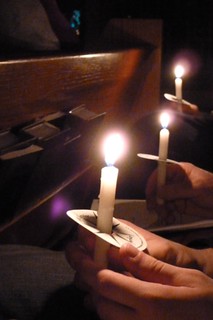
Tomorrow, either repeat the same words or use something else.

Want to know a secret?

You can even use these affirming words to bless yourself!

(I’m thinking that I’ll start off the new year doing just that.)

Whatever words you use, start an easy, new habit and bless your child every day.

-------


Photo credits:
A sunrise over Lake Superior by Sharon Mollerus, who licensed this photo on Flickr under a Creative Commons License.

Hidden inside the ordinary, will you see God-alongside?

Christmas eve worshipAs you gather with your family and/or friends, ponder this question:
What was your favorite part of the Christmas Eve worship service?

I’ll bet you get a variety of answers.

My unofficial poll included the music offerings, and when all the lights are turned off and Silent Night is sung by candle light.

The telling of the story didn’t make our list.

I wonder if we have become so familiar with the story of Jesus’ birth, that we forget to be amazed?

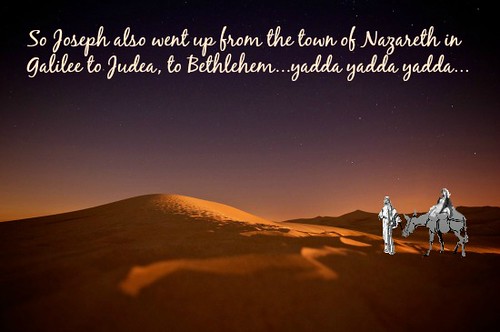
Mary and Joseph travel to Bethlehem

I spent Christmas Eve too sick to attend worship. Home alone, in bed, I decide to read the story. I’m glad I did. Functioning as the only component of “worship” that I had, it allowed for deep contemplation.

I was reminded of the wondrous, amazing aspect of Christmas.

What’s that you say?

As explanation, I’ll use a phrase often heard in this season:

The Incarnation

Star of Bethlehem Nativity

The Incarnation is a concept that leaves me awestruck. (And also feeling a bit jumbled – reminding me that sometimes we have to live in the mystery.)

Incarnation is a big word that comes from Latin, meaning “the act of being made flesh.” It’s what God did in the birth of Jesus. Somehow, mysteriously, Jesus is both fully God and fully human!

In Jesus, God is with us!

The prophet Isaiah had described our coming Savior as Emmanuel. What a perfect title for Jesus, because “Emmanuel” means “God with us.” It’s the very thing we need and look forward to the most: the presence of God himself! Jesus wasn’t born just to save us from our sins; God came to be with us.

God loved us so much that he chose to come into the world in the actual person of Jesus. We find this expressed in John 1:14, which paraphrased reads…

The “Word” was made flesh and moved in with us.

The Adoration of the Shepherds, a painting by Gerard van Honthorst, 1622

Even more amazing (if that is possible)… God joined us, not just in human form but as a tiny, helpless baby! What are we to make of this news? Knowing what we know, what will we do?

Who would have looked for God as a baby in a manager in a stable?

If the way we live shows what we believe, should we be actively looking for God among us?

What does God with us look like today?

Richard Rohr calls it, “hidden inside of ordinariness.”

The Incarnation

A humdrum home for animals, equipped with a feeding trough. Where will God-with-us show up next?

Have you observed God, hidden, yet present with us, in the ordinary?

Let’s look for Emmanuel! Here are a few searching suggestions:

  • Go for a drive at night, and be dazzled by the neighborhoods festooned in Christmas lights.
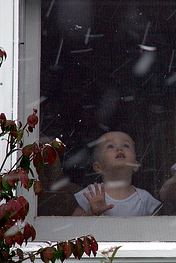
  • If it snows, go outside and catch flakes on your tongue. (Or spend time studying the rain drops rolling down the window pane.)a child ponders the first snow
  • Lay on your backs under your Christmas tree and silently gaze upward, pondering the beauty and perhaps the scent of pine or spruce.
  • Watch and notice when your child seems in an attitude of awe. (A moment of wonder is often characterized by quiet stillness rather than enthusiastic activity.) Silently join them in their observation.
  • Where will you find God?

May you experience God with you — in whatever ordinary awesomeness he arrives.

a blue line

Photo credits:
The first photo is from my archives.
Mary and Joseph travel to Bethlehem was created by moi from an Unsplash.com image by Tim de Groot. The figures were adapted from wpclipart.com; the words are the start of Luke 2:4, NIV.
Star over Bethlehem by Garrett W. offered on Flickr under a Creative Commons License.
Birth of Jesus is a portion of “The Adoration of the Shepherds,” a 1622 painting by Gerard van Honthorst; from Wikimedia, in the Public Domain.
Babe in a manger by Rapolas; from Pixabay, in the CC0 1.0 Public Domain.
First snow by Joe Thorn, offered on Flickr under a Creative Commons License.

Are you encircled by an uplifting, nurturing, cloud of saints?

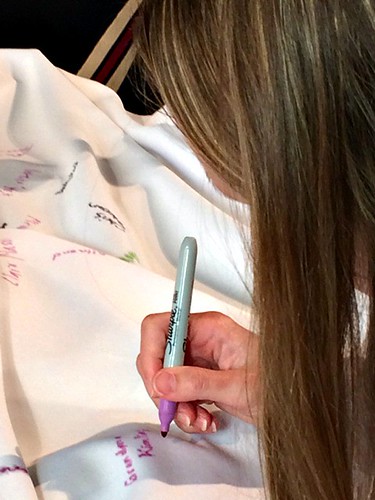
On All Saints Sunday we  wrote on a tablecloth the names of saints in our livesThis weekend during worship at FUMC, we celebrated All Saints Day.

As always happens during this day of remembrance, we think about the “saints” – those who have contributed to the spiritual journeys of people whose lives they have touched.

On All Saints Day we recognize those from our church who have died over the last year; a bell tolls with the name of each saint that is read.

 
But people don’t have to be dead to be called a saint! Anyone who personifies God’s extravagant love, or serves others tirelessly, or who nurtures and inspires us, is a saint!

They represent the face of God in our lives.

So to remember all of these saints in our lives, we wrote their names on a tablecloth. Since it was a Communion Sunday, we were invited to make note of our saints as we came up to share bread and juice in community.

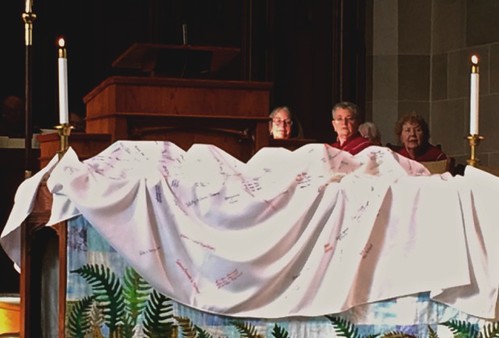
I like how after Communion had been served, the pastors took the tablecloth and laid it over the Communion elements. It sort of looked like a cloud.

The tablecloth covers the Communion elements

We call our saints “a cloud of witnesses.” Isn’t that a wonderful metaphor? Can you picture yourself protected and supported by a puffy cloud?

I hope we see more of this tablecloth in the future.

The tablecloth is set up for the 2nd service
The tablecloth is ready for the 2nd service on Sunday. A lot of saints are noted!

a blue line


Photo credits: Photos are from my archives.