Helping kids get more out of worship

This weekend the children will join us in worship. Help them prepare for this time, not by packing up a few books or an iPhone to keep them happy/distract them, but by spending a few minutes talking about the Bible passage they’ll hear. Reading those verses would be a good way to go about this task. But make it more fun by using this idea at the family dinner table. (Or wherever your family is gathered together.) It’s a knock-off of the card game “Spoons.”

Kids playing a game of spoons

Gather enough spoons for everyone. (Unlike the real game of Spoons, everyone should have a chance to grab a spoon.) To avoid arguments, make sure everyone is equidistant from the pile!

Get out a Bible. (If you’ve got readers, one for everyone to follow along is an even better idea!) Set the stage by saying that this weekend is family worship and you’d like to read the Bible passage that will heard. But you won’t just be reading the story; you’d like to involve everyone. Point out the spoons and tell everyone to grab a spoon when they know the answer to a question. (Note: To print out these questions, click here.)

The first question is:

  • In what Testament in the Bible do we find stories about Jesus?

(I’ll bet someone blurt out the answer without grabbing a spoon!) Allow the first spoon-grabber with the correct answer (the New Testament) the privilege of finding the gospel of Mark in the Bible. Or make it another question as to how to quickly find the New Testament. (Kids in 3rd grade and up should know the answer.)

Announce the next spoon-grab:

  • Whenever you hear the number “twelve” in the story.

Start reading Mark 5:21-43. “Twelve” is mentioned in verse 25. Ask the first spoon grabber to tell you where this story takes place.
Answer: Verse 21, on a beach. (Ask someone else if the first one to grab doesn’t know the answer.)

Continue in this pattern — announcing the next spoon grabbing opportunity — before picking up where you left off reading. Here are a few more chances at the mad dash. (You may wish to reduce the number of questions asked for younger children)…

  • What the woman who had suffered for 12 years, did to receive healing from Jesus.
    Answer: verse 27, touched Jesus’ robe.
    Additional question to ask the “winner” (or just to ask everyone): What does this tell you about this woman? (Accept all reasonable answers. One possibility: she had great faith.)
  • What Jesus does in response to the woman’s healing.
    Answer: verse 30, asked “who touched my robe?”
    Additional question: Given the crowded situation (read verses 31-32), making it hard to figure out who had touched him, why do you suppose Jesus wanted to know? (Accept all reasonable answers. A couple of possibilities: Jesus cares about people; Jesus wanted to teach others about having faith.)
  • What the messengers said.
    Answer: verse 35, the news that the daughter of Jairus was dead.
    Additional question: Jesus had been on his way to heal this girl (may need to re-read verses 22-24), do you suppose the interruption with the woman who was bleeding, caused Jesus to miss the opportunity to save this girl? (Accept all replies.) How do you suppose that made Jairus feel?
  • What Jesus told Jairus when he heard the news.
    Answer: verse 36, “Don’t be afraid. Have faith.”
    Additional question: When have you been afraid?
  • What happened at Jairus’ house.
    Answer: verse 42, Jesus raised the girl from the dead!
    Additional question: Jesus had heard the news that the girl had died. Why do you suppose he went to Jairus’ house anyway? (Accept all responses.)
    What lessons can this story teach us? (A possibility: We can trust God no matter what happens).
    I wonder what lesson Pastor Doug will focus on this weekend?

Report back on how this went with your family. Do share!


Photo credits:
Click here for info on banner photo (not visible in readers or email).
A rousing game of spoons by woodleywonderworks, who licensed this photo on Flickr under a Creative Commons License.

A birthday party! With red cake!

This weekend is Memorial Day weekend. It is also time for a birthday party—with red cake!

Red Velvet Cupcakes

Who’s birthday is it? And why red cake?

It is the birthday of the church! The church is another year older. (But who is counting after close to 2,000 years.) We also call this day “Pentecost” because the event that marked the start of the Christian church coincided with the Jewish festival of Pentecost.

What was this church-starting event, and why red cake?

The “event” was the coming of God’s promised helper or advocate, the Holy Spirit. Fifty days had passed since Jesus had been resurrected after the first Easter. Jesus’ followers were gathered together in Jerusalem, in the “Upper Room”—allegedly the same spot where the Last Supper had occurred. Jesus had told them, prior to his ascension to heaven, to wait in the city for the Holy Spirit. (Read about it in Acts 1:4).

Open quote markSuddenly there was a noise from heaven like the sound of a mighty wind! It filled the house where they were meeting. Then they saw what looked like fiery tongues moving in all directions, and a tongue came and settled on each person there.    Acts 2:2-4

Fiery tongues? That sounds scary! Is that why the red cake?

Yep, the color red is associated with Pentecost as it illustrates the “fiery” nature of this event. As frightening as it sounds, it likely was not scary for the original participants. Strange and mysterious? Yes!

The writer of Acts says that the Spirit looked like tongues of fire and sounded like wind. I’ll bet it was hard to describe! Regardless of how it looked or sounded, the early followers of Jesus were lit “on-fire” as they felt empowered by the Holy Spirit to proclaim the good news about Jesus.

So what does this mean for us today, besides some red cake?

Celebrations serve as reminders. God offers us the Holy Spirit. We may not sport flames but we can rest assurcd in the knowledge that God is with us, helping us to become disciples of Jesus and to do his work in the world.

Enjoy some red cake while you discuss Pentecost with your family!

--------------
Photo credits…
Red Velvet Cupcakes by vmiramontes, licensed on flickr under CC BY 2.0.

Something in Common: Youth Worship and The Runaway Bunny

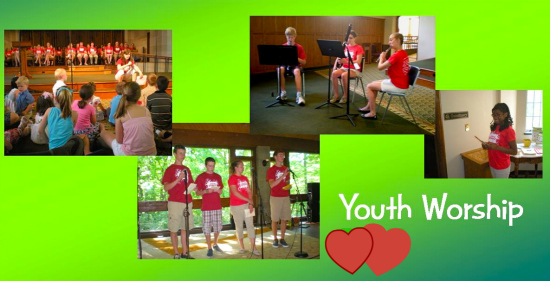
This weekend we’ll get to watch our Youth lead us in worship. Youth Worship is a spring tradition! It’s alway lively! How can it not be, when worship is led by gobs of 7th-12th graders!

photos from Youth Worship in 2012

Youth Worship always has a theme to it. This year’s subject is Grace.

Help your kids to get more out of this worship by talking about the concept of grace ahead of time. (And debriefing about it afterwards.) What is grace?

Grace is someone saying: “I love you anyway.”

Ask your child(ren) if they could say “I love you anyway” in response to some of these situations:

  • When someone doesn’t want to play with me.
  • When someone uses something of mine without asking, and then breaks it.
  • When people laugh at me when I make a mistake.
  • When someone gets me in trouble for something I didn’t do.

It is hard isn’t it!

This is what God’s grace is; God saying, “Even though you messed up, I love you anyway. It is a gift from me to you. There is nothing you can do to pay me back.”

Want another way to teach about grace? Use a popular storybook.

Cover of the book The Runaway Bunny by Margaret Wise Brown

This story starts off…

Open quote markOnce there was a little bunny who wanted to run away.
So he said to his mother, “I am running away.”
“If you run away,” said his mother, “I will run after you. For you are my little bunny.”

This bunny invents all kinds of scenarios where he runs away from his mother. But, no matter what, his mother assures him that she will run right after him.

It’s just like that with us and God.
How have you noticed God loving you no matter what?

a blue line


Photo credits:
Book shot from Amazon.
Youth group photo collage used with permission.

Are you seeing ads? They are not from me! They are placed by WordPress, who otherwise offers a free platform from which to share lots of good-ness. If you see an inappropriate ad, please report it to support@wordpress.com. Include the URL, the date/time the ad appeared, and a screenshot of the ad.

Games at the dinner table

Who likes to play games? How about playing a game around the family dinner table? (Or wherever your family is gathered together.) After all, dinner table games can lead everyone into dialogue. And what could be better than a family talking!

Want to know how to bring up Biblical topics in your family time?

A game is a great way to have your conversation include faith stories. How about a game of Concentration? Only preparation necessary is to print out the these cards. (Have your kids cut them apart as part of their dinner-prep duties.) At an appropriate time, spread out the cards picture-side down. Everyone takes a turn to see if they can turn over two cards that match. Who ever finds a match, says something about the image on the cards.

Bread and wine Bread and wine

Did you know that playing this game sometime this week can help your child to prepare for the big Cool Disciples review game this coming weekend? On Saturday evening and Sunday morning, we’ll be playing a large-group game to review the Bible stories we’ve covered since September. It will be sort of like the old TV game show “Who Wants to Be a Millionaire.” This game is always loads of fun.

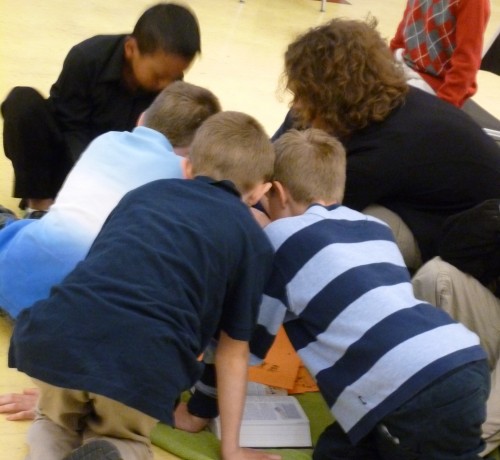
A group of kids works together to determine an answer
A shot of last years 3rd graders formulating their answer.

Here are the stories we’ve covered since September 2011:

  • The Lord’s Prayer (Matthew 6:9-15, Luke 11:1-4)
  • Psalm 23 (Psalm 23:1-6)
  • Mary and Martha (Luke 10:38-42)
  • The Story of Jesus’ Birth (Matthew 1:18-23, Luke 1:26-38 and 2:1-20, Matthew 2:1-15)
  • Moses: Bulrushes to Burning Bush (Exodus 1:1 – 4:17)
  • Moses: Plagues and Passover (Exodus 5:1-6:13, 7:1-12:42)
  • The Last Supper (Luke 22:7-20)
  • Nicodemus (John 3:1-17)

Regardless of whether your child can take part this weekend, add an occasional game to your family dinner. Need another suggestion? Check out last years review game idea.

a blue line


Photo credits:
Concentration card images from WPClipart and Open Clip Art Library. (Images are in the Public Domain.)
Photo of playing the “big game” is from my archives.

Are you seeing ads? They are not from me! They are placed by WordPress, who otherwise offers a free platform from which to share lots of good-ness. If you see an inappropriate ad, please report it to support@wordpress.com. Include the URL, the date/time the ad appeared, and a screenshot of the ad.

Etch the words into your heart

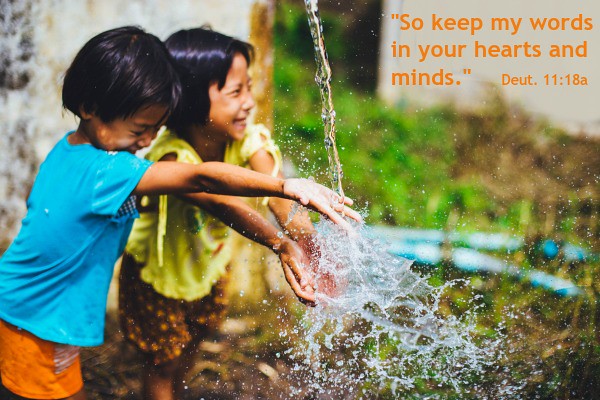
Water stories?

In this Bible verse from Deuteronomy 11:18a, Moses is admonishing the Israelites to always remember what God has done for them.

'So keep my words in your hearts and minds.


As our kids learned earlier this year, God provided freedom from slavery in Egypt. Moses goes on to instruct the Israelites to teach their children about these liberation stories.

Teaching these stories is still today a priority for us as parents/caregivers. But not only the specific stories of Moses; we also need to ensure that our children grasp the reality of God’s love. You’re probably already doing this task through many avenues:

  • Reading and telling Bible stories,
  • Praying with your kids,
  • Teaching service to others,
  • Naming instances you see in the world of God’s love and grace, etc, etc.

Here’s another way:

Encouraging the memorization of scripture.

And the perfect spot to start: John 3:16. (Read it in different Bible versions here.)

A heart shape with God written in it

Etching God’s words of love into our children’s hearts.

This is not memorizing like you would learn facts for a test. This is a different sort of learning, for a different purpose. Tell your children: “We are keeping God’s word in our heart.”

That’s right, I said we. Because you’ll want your kids to do as you do. It will be a much more powerful lesson if you are working on this as well.

Learning God’s words by heart makes it instantly available when you need it. Your mind can pull them up faster than a smart phone, right?

How to go about this task? Here are some ideas:

  • Refer to this past post for hints. (No sense in repeating myself!)
  • Start ’em young: Age 2 has been suggested. (But it’s never too late to start! Though it does get harder with age.)
  • Say it differently: Try a fun way of saying the verse. Use a cowboy voice, cheerleader style, opera style, referee style, or baby style. What other ways can you think of?
  • More games: If you have a dry-erase or a chalk board, write out the verse. Then erase one word and say the verse with the missing word. Continue until all the words are gone. Don’t have such a resource? Arm your child with a stack of Post-it Notes. Write out the verse on a sheet of paper and use the Post-it’s to cover up the verse a word at a time.
  • More songs: Try this one on YouTube to learn John 3:16-17. Search for other verses to find songs.
  • Catch them on video: Once your child can say part of a verse, video them. I’ll bet they’ll like watching themselves, and saying the verse with themselves!
  • After you’ve mastered John 3:16, learn verses based on the alphabet. Try these ABC Scripture cards.
What are your hints for etching God’s word upon our heart?

-------


Photo credits:
Water stories by Abigail Keenan, via Unsplash.
Heart clip art by rygle, via Openclipart.org.
Both licensed under CC0 1.0 Public Domain.

I want directions!

a weather vane points NW

Some days don’t you just want definitive directions?

Why is it so hard to understand the words and workings of Jesus?

And just how are we to explain the mysterious nature of God to our literal-thinking, want-a-definitive-answer, continually questioning kids? This sort of frustration happened in Jesus’ time as well.

Nicodemus came to Jesus with questions. He had high expectations but he left his visit even more puzzled. Jesus had told him: One needs to be born from above (often translated as “born again”) in order to see, or experience, the kingdom of God (from John 3:3). How can an adult be born a second time? Nicodemus didn’t get it. Do you?

So what are we to say when our kids ask a tough question?

Use this phrase: “Sometimes we have to live in the mystery.”

Go ahead; practice saying it:

“Sometimes we have to live in the mystery.”

Ambiguity is a fundamental part of our faith journey. If we knew with absolute certainty all of the answers, we wouldn’t bother to experience anything new! It is important to cherish the questions and the wondering.

Jesus rarely gave a straight answer when questioned. It is said that he only directly answered three of the 183 questions asked of him! So when your kids ask you a tough question, explain as best as you can and when you don’t know anymore say, “Sometimes questions about God and Jesus don’t have clear answers. Sometimes we have to live in the mystery.”

Then, of course, your kids will want to know what you mean by “live in the mystery.” Explain this concept by using a technique that Jesus often employed: storytelling. Try telling a story that has a bit of frustration in it; something where the ending leaves you with more questions. Something like this:

You are visiting a far-away country where the language is different from your own. Conversation with the locals is downright impossible. Thankfully you find a place to stay by looking for that international symbol for lodging – a picture of a bed. Because you are somewhat adventurous in your eating habits, you order food in a restaurant by pointing at what someone else is having. Sometimes it works. Sometimes it doesn’t. There are daily frustrations. You try to buy cheese at the local market, but nothing looks like the cheese you want! You don’t know how to describe cheddar. You leave the store empty-handed. Later, back in your home country you think of your time in that foreign place and you wonder what you were to have learned from your adventure. You don’t know. Sometimes we have to live in the mystery.

I’m struggling to live in the mystery. How about you?

-------


Photo credits:
Weather vane by 23am.com, who licensed this photo on Flickr under Creative Commons (CC BY 2.0).

Using a salad bowl to spark family stories

“Do this to remember me.”
Love, Jesus

Communion chalice and bread

Remember the time… Jesus told us to remember?

You have it memorized. It was during that dinner that Jesus had with his disciples. You know. The last one. The one where Jesus invented Communion. Now every time we share the bread and the cup we remember what Jesus did for us.

What do you suppose would happen if we stopped telling stories to our children? Pretty soon, they’d forget! When the very first Passover occurred, God instructed Moses to tell the people to not forget this event. Every year on the anniversary of the first Passover, they were to tell their children the story of God’s intervention and their freedom from slavery in Egypt. (Read about this command in Exodus 12:24-27).

Are we finding enough occasions to tell our stories? How about around the family dinner table? Here’s an easy way to make sure that telling our stories happens.

Let’s make a salad!

Zoe made Bunny Salad

Not that kind of salad. But our “recipe” does call for a salad bowl!

Before dinner take some slips of paper and write on them storytelling prompts. Things like…

  • A summer story
  • A school story
  • I was embarrassed when…
  • A celebration or holiday
  • An adventure
  • A food story
  • A family joke
  • My first memory
  • I was afraid when…
  • i knew God was involved when…
  • I trusted God when…
  • A question I’d like to ask God
  • Add your own ideas!

Mix up all the pieces of paper in the salad bowl and place the bowl on the table during dinner. At the appropriate time, have each family member take a turn drawing a slip from the bowl and telling a story.

Jesus was celebrating a remembering-Passover-supper when he gave us new instructions to remember a different sort of event: Jesus’ death for us. May we never forget to tell the whole story!


Photo credits:
Click here for info on banner photo (not visible in readers or email).
Chalice and bread by James Emery and Zoe made bunny salad by Michael Newton, both licensed on Flickr under a Creative Commons License.

Are you seeing ads? They are not from me! They are placed by WordPress, who otherwise offers a free platform from which to share lots of good-ness. If you see an inappropriate ad, please report it to support@wordpress.com. Include the URL, the date/time the ad appeared, and a screenshot of the ad.

Family Lenten activities, part 2

Lent is the 40 days (minus Sundays) leading up to Easter. A long, long time ago Lent was the period in which new converts to the church prepared for baptism. They learned about what it meant to be a Christian before becoming a member of the church community. It was basically “spring training” for disciples!

baseball - spring training!

Lent is a great time for your family to take a serious look at your calendars. It’s all about focus. Is there time for being a disciple of Jesus? For including Christ in your lineup? (An hour a week at church isn’t enough!)

Time Out. Talk about…Ask…A speech bubble
What can our family do? We’d like to spend some of our time together warming up our faith.


Last week I had given you ideas for family activities to try out during Lent. If you missed that it’s here. (These activities are not time-sensitive.) It seems only proper to provide more activities to help everyone be a “utility player!”

Ready to “take the field” for Lent?

  • Practice gratitude: Set up a place for praises. In a noticeable location, place a stack of papers and a pen near a basket or a bowl. (Or post a list on the refridge; or give everyone their own journal.) Encourage everyone to draw or write about things that make them grateful. Once a week, ponder your collection. For more ways to transcribe thanksgiving, visit here.
  • Celebrate: Life is a precious gift from God! Work in the habit of celebrating this in some small way, every day! Perhaps start off your day in song (“This is the day” would be a good choice. I often woke up my kids with this one.) Or perhaps change the words to the Superman table grace, adding in “Thank you God, for giving us life.” Re-writing this could be a fun, dinner table activity!
  • Serve others: pick one way to offer your time to someone else from this incredible list. (Includes ideas such as creating “snack packs for Ronald McDonald residents” but did you know they are still collecting pop tabs?
  • Practice solitude: First introduce the concept of breath prayer. Then, designate a signal for when it’s time to gather back together. Next, for an age-appropriate amount of time send everyone to opposite corners of the house. When the “time-out” is up, discuss your experience.
  • Give something up (Fasting): Rather than fasting food try giving up a word. How about the word “no” – try it and see what happens! (Remember that an alternate for the word no can be “let’s think about that.”)
  • Prayer: Make time for prayer every day. Visit here for ideas.

--------------

Photo credit:
Spring Training by Michelle Riggen-Ransom, licensed under Creative Commons (CC BY 2.0).