The hidden meaning behind the parable of the sower?

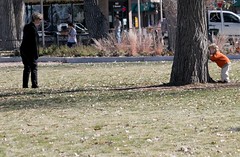
Anyone for hide and seek?
 
a child playing hide and seek

Why did Jesus use parables to teach things in hidden ways?
Time Out. Talk about…A speech bubble what is a parable?

In this parable (this story that teaches a special lesson with a hidden meaning) do you suppose Jesus was trying to tell us how to plant seeds?
 
No, this story is more than a description of farming practices. But what is the hidden meaning?
Time Out. Talk about…A speech bubbleWhat do you suppose the hidden meaning is?

Did you see this parable as describing the degree to which people accept God? The seed can be considered the message of God’s forgiveness, salvation and great love for us. The various kinds of soil in the story represent the hearts of those who hear of this message.

The four soils represent us!

That’s right, us — at various stages in our life, and even within one day. This talk of your “heart” means the deepest level of yourself; how we respond to the good news about Jesus.

Time Out. Talk about… A speech bubbleReview the four types of soil presented in this parable. How does each soil describe a person’s reaction to God?

Share your thoughts by leaving a comment.
Need a review of the parable? Watch the video in this post.

How are you preparing your heart for the seed Jesus is sowing?


Photo credits: Click here for info on banner photo (not visible in readers or email).
Game of hide and seek by Makelessnoise licensed under: Attribution-Noncommercial-Share Alike 2.0 Generic

Family dinner games for the Parable of the Sower

The cover of the book: The Family Dinner

So what games have you been playing at the dinner table?

Playing games is what makes eating dinner together fun! (And memorable.) The book The Family Dinner has this to say about the goal of game playing at supper…

To lead everyone to great family stories and good conversations.

And if that conversation tends toward talking about issues of faith… all the better.

Here’s some games you can play that tie in with our current Rotation for the Cool Disciples at FUMC in Ann Arbor, MI.

  • What would you plant? Take turns telling what each family member would like to grow if you had a large garden.
  • Take it up a notch… assuming you could grow anything (such as colors of paint, or types of cars) what would each person like to try growing and why?
  • Play “Fortunately/Unfortunately” – one person starts off telling a story with a good or fortunate occurrence. Start off with: “Once upon a time, a farmer had good weather so he decided to plant some seeds.” The next person adds to the story with an unfortunate event, for example: “Unfortunately his bag for the seed had a hole in it.” The next person remedies the situation with another fortunate event, such as: “Fortunately, this farmer had a neighbor who had an extra bag.” Etc., etc. Back and forth with fortunate and unfortunate episodes.
  • Review the four different types of soil in the Parable of the Sower and note what happened to the seed on each soil. Go around the table and have everyone add one line to a modern-day story that conveys the same meaning. (How about a story about learning to ice skate?)

Have fun!

For more on making family dinners a priority, read here.


Photo credits: Click here for info on banner photo (not visible in readers or email)
licensed under: Attribution-Noncommercial-Share Alike 2.0 Generic
Book cover – from my archives. (I took a picture of this book when I had it out of the library!)

Are you seeing ads? They are not from me! They are placed by WordPress, who otherwise offers a free platform from which to share lots of good-ness. If you see an inappropriate ad, please report it to support@wordpress.com. Include the URL, the date/time the ad appeared, and a screenshot of the ad.

Cultivating the soil

Spring is coming! It will soon be time to plant seeds! I’ve been enthusiastically planning my garden; dreaming of lush lettuce and tasty tomatoes. I love growing veggies and flowers!
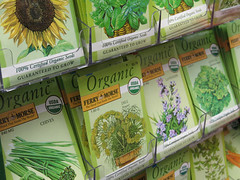
Packages of seeds - flowers & herbs

Spring is a great time to talk about sowing seeds, so this month the 1st – 6th graders (the Cool Disciples) at First United Methodist Church (FUMC in Ann Arbor, MI), are studying a Rotation on the Parable of the Sower.
You can read this parable in Mark 4:1-9.

Time Out. Talk about…What is needed for a seed to grow? A speech bubble

Soil, sun, water, love… Did you know that there is something else that needs growing, that takes just as much care and attention?

Cultivating the soil of a thankful heart.

How does one nurture such a garden? Here’s one idea: Keep a list. Take up a notebook and start a list of the things for which your family is grateful. Jot a thankful every day, perhaps at the family dinner table. (Make putting out the journal be a part of setting the table!)

Time Out. Talk about…What are you thankful for today? A speech bubble

Here are a few from my gratitude journal.

590. Chickadees, waiting for the feeder to be filled.
594. Friends, both old and new.
597. Sunshine (after several days of gray.)
601. Drawer dividers for organizing.
605. Textures on tree bark.
607. A husband who is a great cook.
613. Opportunities for my children that allow them to stretch their wings.

How does your garden gratitude grow?

Where did my list making start? Click on this button…

Button to access the web site: A Holy Experience.

Photo credits:
Click here for info on banner photo (not visible in readers or email).
Seed packages by LollyKnit from Flickr, licensed under: Attribution-Noncommercial-Share Alike 2.0 Generic
Button from A Holy Experience.

Daniel and the lions – a story told with pictures

We’ve just finished our Rotation on Daniel and the lions. Show this post to your kids. Can they tell you the story? Discuss the questions too. Enjoy!

The other administrators in King Darius' court, ponder what to do about DanielDaniel seemed to pray a lot; what sort of strength did prayer give him?
Why do you suppose the king’s other administrators were jealous of Daniel?

When have you done something that you’ve been proud of, but it made someone else jealous?

 
King Darius thinks about a new lawWhat do the other administrators decide will be the only way they can trap Daniel?

How do they persuade the king to accept their idea?

If you were Daniel, how would you have reacted when you heard about the law?

 
Daniel is caught praying!We knew this would happen! Daniel did too. Why do you suppose he prayed in front of an open window where he was sure to be caught?

Why do you suppose he was willing to risk his life to continue praying to God?

When is a time that you’ve had to stick up for your belief? What happened?

 
King Darius finds out about what he's done to DanielHow did the king feel when he found out that Daniel would have to be sent to the lions’ den?

Do you suppose some of Daniel’s faith in God had rubbed off on the king? (Read Daniel 6:16)

 
Daniel is thrown into the den of lionsDo you suppose that in the lions’ den Daniel asked God to get him out, or to get rid of the lions?

But that wasn’t what God did! What happened to the lions?

Does God always answer our prayers in the way we’d like?


God saved Daniel!
God saved Daniel!

-------


Photo credits:
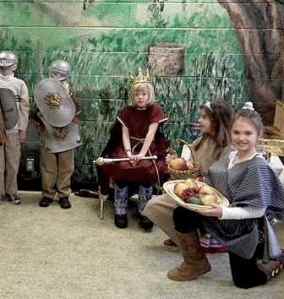
Photos by Evans Koukios. Used by permission.

A Family Dinner “Game”

A way to talk about faith with your kids is to make family dinner a priority.

But don’t just eat. Play games.

That’s right. To extend your time together as a family, add a “game” to the end of your meal. Here’s a game suggestion that ties to our current Rotation on Daniel and the lions. Make the story come alive! Tell the story dramatically, involving everyone at the table. All you need is a Bible.

Find Daniel 6:3-23. (If you want an easy to read version click here.) One person can be the story teller and everyone else… the characters in the story. To make it easy, there doesn’t have to just be one Daniel and one king – everyone can be Daniel and everyone can be the king. And everyone gets to be lions!

Daniel In the Lions

The reader can create voices for the different story characters. How would the bad guys sound? Sort of whispery? (You do this when reading regular books to your kids; why not apply it to reading the Bible.)

For example, in verse 11 it says…
'
Some of the other royal officials went to where Daniel was staying. They saw him praying and asking God for help.

Ask your family to pretend to be the bad guys. How would they act when they discovered they’d trapped Daniel! Encourage everyone to use their body to tell the story. (The bad guys were probably giving each other high-fives. Yes! We caught him in the act!)

Perhaps she is a lion?
How did Daniel look when he was praying? How did the king react when he heard what he’d done to Daniel? How did the lions look before Daniel was thrown into their den? How did they look when Daniel was among them? (Mouths closed!)

Finish up your “game” with a prayer. (It’s what Daniel probably did.)

-------


Photo credits:
Daniel with lions a photo of a painting by Robert Edward Weaver (c. 1952), is licensed under Creative Commons CC BY-SA 3.0, via Wikimedia Commons.
Kid being a lion by Nathan, who licensed this photo on Flickr under a Creative Commons CC BY 2.0 License.

Look! The Lamb of God!

Asking questions is good. Encourage the asking of questions, even if you don’t know the answers!

A faith that quits questioning, quits growing.

+++++—Rev. J. Douglas Paterson in his “What If” sermon series
+++++“What If Having Questions Were More Important Than Having
+++++ Answers?” (2/6/11)

Here are a couple of questions… but first a bit of background. Our story about John the Baptist is found in all four Gospels. The Gospel according to John (a different John than John the Baptist) includes a picture metaphor.

One day John the Baptist saw Jesus coming toward him and yelled out, “Look, the Lamb of God.” (John 1:36)

Lambs

So if having questions is a way to grow…

Why did John the Baptist call Jesus “the Lamb of God”?

In Jesus’ time, lambs were offered (twice a day) as a sacrifice for people’s sins. An animal’s life — to pay the penalty for sin. Calling Jesus the “Lamb of God” meant that Jesus would take the place of a lamb; Jesus would die to take away our sins.

How did John the Baptist recognize that Jesus was the Messiah?

Wonder together! What questions have your kids asked about this story?


Photo credits: Click here for info on banner photo (not visible in readers or email).
Lambs by A. Roger Davies, who licensed this photo on Flickr under a Creative Commons License.

Dinner table conversation?

“atA little while back I’d suggested that a way to talk about faith with your kids was to make family dinner a priority. (Click on “family dinner” to read that post.)

Sometimes getting conversation going at the table can be tough, especially for older kids. Here’s an idea:

Before dinner glance at this brief post from “HuffPost Family Dinner Downloads.”

HuffPost? What’s that?

In the words of the editors…

'Every Friday afternoon, just in time for dinner, our editors highlight one of the most compelling news stories of the week — stories that will spark a lively discussion among the whole family.

This particular HuffPost Family Dinner Download happens to be about eating healthy and about one particular retailer (amazingly enough) agreeing to help with that effort especially for folks with limited incomes. Lots of room for various discussion – there are even questions provided to spark conversation!

But where is “faith” in this discussion?

Glad you asked? To tie your discussion to our current Rotation at at FUMC, bring up the question: What did John the Baptist eat?

The answer: locusts and wild honey! (Matthew 3:4) Yum?

Here are some other questions to discuss:

  • Do you suppose people thought John was strange? Why do you think that?
  • Do you suppose that his strange diet (and his strange clothes) were what drew people to him?
  • Oh, so why else did they want to listen to what John the Baptist had to say? And what was it he was saying/doing?
  • John the Baptist baptized with water. What are some ways water gives and sustains life in the world?
  • Why is water a symbol of what God does for us at baptism?

If your children have been baptized, tell them about it. If they haven’t been baptized, discuss baptisms they’ve seen. Enjoy your family dinner!

-------


Photo credits:
Dinner table photo by vizzzual-dot-com, who licensed this photo on Flickr under a Creative Commons License.

John the Baptist preached prepare! Any preparation for us?

A camelJohn the Baptist was an odd character. He lived in the wilderness (in the desert valley of the Jordan River, north of Jerusalem), wore wilderness clothes (camel’s hair) and ate wilderness food (locusts). Even though he led a strange life-style, people still flocked to hear him, which was good, because John had an important, God-appointed job…
A locust

To get people ready!

In between munching on locusts dipped in honey (was that for added flavor?) John told people to “Repent, for the kingdom of heaven has come near” Matthew 3:2. Hundreds of years earlier the Prophet Isaiah had predicted, “Someone is shouting: Clear a path in the desert! Make a straight road for the LORD our God” (Isaiah 40:3). That someone was John the Baptist, making straight roads for God.

The phrase “making straight roads” has an interesting background. When a king planned to tour his dominion, a crew would be sent out ahead to fill in any potholes and knock down any hills in the way! Nothing will impede the way of the king!

John’s make-way, readiness call was referring to peoples behavior. They needed to change their thoughts and actions and return to following God. “He went into all the country around the Jordan, preaching a baptism of repentance for the forgiveness of sins” (Luke 3:3). Repentance can mean to feel sorry for our choices. But John the Baptist wanted people to do more than just apologize for sins; he was also asking them to prepare their hearts for the Lord.

What about us?

Do our hearts need preparation? Jesus is always seeking us out; wanting to have a close, personal relationship with us. He needs our hearts and minds ready to accept that relationship!

What do we need to do to welcome God into our hearts? Discuss these ideas with your family.

  • We think of prayer as talking to God, but it’s also about listening. What are ways to help us quiet ourselves as we prepare to listen for God?
  • Do we feel as though we need to be in a certain location? What would be a small way to recreate that location at home?
  • What can distract us from God? How about TV or sports or sleeping in on Sunday mornings? What will help us remove those distractions?
  • What about “boulders” in the way? Is there some other way we feel we should be spending our time? Is there some past experience that keeps you from letting God in?
  • Can what we expect of God be a hinderance? What are your expectations of God? Perhaps what is needed is to get to know God better?

What are your thoughts on preparing the way for God?
Share them by commenting below. (There’s nothing to join and your email won’t be shown!)


Photo credits (all from Flickr): Banner photo (not visible in readers or email) by Pink Sherbert Photography. Camel by xikita. Locust by Peter Rowley.All licensed under: Attribution-Noncommercial-Share Alike 2.0 Generic