What mountain are you climbing?

Running up the hillWhat mountain are you climbing these days?

Does it feel like it’s a long, uphill climb?

Or is it a “mountain top” experience?


Everyone would like to be happy. Most of us spend the majority of our lives searching for happiness – climbing this “mountain” or the next…

Or maybe it’s that one over there?

One day Jesus went up on the side of a “mountain” and gave us the Sermon on the Mount. His sermon starts off with what we call the Beatitudes. The Beatitudes outline what sort of people receive blessings – gifts bestowed by God which bring us supreme happiness.

Ahh, the “mountain” we ought to climb?

According to the Beatitudes those who receive God’s blessings are…

  • Those who are poor in spirit.
  • Those who mourn.
  • Those who are meek…

What do you think of the start of Jesus’ list? Does it include character traits that you thought were important?

Or were you surprised?

The meek? The weak and defenseless? Aren’t the meek ignored and trampled underfoot?

And those who mourn? Can we really be “blessed” when bad things happen, causing us to mourn?

The Sermon on the Mount would have shocked those who first heard it; as it can us today. It is about intentionally living life with God’s values.

It might require running up a different hill.

Sometimes it helps to understand what Jesus meant. The way Jesus used “meek” translates from the original Greek, as “gentle,” “considerate,” and “courteous.” Therefore, those with an attitude of meekness are humble people; they are patient, they don’t need to be first, they restrain their anger, they have a servant attitude. The meek also humble themselves before God – they accept God’s guidance in all things. God is in charge.

Are you teaching your kids to climb up the “Meek Mountain?” How can they do this without being seen as weak?

  • Humble people are gentle with others and nonviolent.
  • A humble person wouldn’t brag about how far she could kick a ball but would use her talents to teach someone else.
  • Humble people know where they come from; they are open to God’s leading in their life.

Taken together the Beatitudes give us a framework for living – attitudes to acquire in order to become faithful disciples leading to blessings beyond measure!

What mountain are you climbing?

-------


Photo credits:
Running up a hill by Alisha Vargas, is licensed on Flickr under Creative Commons (CC BY 2.0).

The Beatitudes – workshops we’ve used

Rotation Model logoWhen you’ve been using the Workshop Rotation Model for Sunday school as long as we have (15+ years!) you find that stories are repeated – at least every 6 years. (Six grades cycling through each Rotation… every six years is a totally new group of kids. Time for some do-again!)

In April 2017 we are about to revisit The Beatitudes, last done in 2004 and 2010. The schedule of which workshop your child will visit in the coming weeks, can be found on this page.

In a look at the past, here is what we did in each workshop for The Beatitudes Rotation, in preceding years:

  • In the Art Workshop (2010) students will imagine themselves in the crowd that participated in Jesus’ Sermon on the Mount. They will create renditions of themselves that will then be cutout and displayed on a mural. Stay tuned to see everyone at the Sermon on the Mount! (To ensure that everyone has a chance to be in our creation, two Art workshops will run concurrently, one for younger grades and one for older.)
  • In the Cooking Workshop (2010) students will discuss how Jesus’ teachings seem contrary (upside-down). Create mini Pineapple Upside-Down cakes to take home to share with their family. (And hopefully to further talk about the up-side down nature of Jesus’ words!)
  • In the Drama Workshop (2010) students will use sign language to discover a different way to express the Beatitudes. Discuss how can we apply the Beatitudes to our lives in the “Kingdom of God.”
  • In the Games Workshop students will explore living as Jesus taught while playing as game pieces on a life-size game board.
  • In the Video Workshop (2010) students will view the live-action video, The Visual Bible: Matthew showing Jesus teaching the Beatitudes.

Why are we doing different workshops?
There are several reasons including:

  • Our focus for a Rotation has changed (we’ve gained new understanding!)
  • We know our kids. We know what will, and won’t work with them.
  • We’ve got a new idea for a workshop!

-------


Photo credits:
Rotation Model logo, used with permission, has been slightly altered.

Been in a shipwreck lately?

A beached shipwreck

Have you been in a shipwreck lately? I mean of course, a figurative shipwreck.

The kids are driving you bonkers… The car needs extensive repairs… Or someone you know received a dire diagnosis…

What can comfort you?

It can be hard, can’t it?

Kids can experience shipwrecks too.

A friend moves out of town… A new school is looming on the horizon… Or there is sibling strife…

What can comfort your kids?

Sure, you’ll be there to give them a hug when needed. But what will they use as comfort inside?

What sort of self-talk will get used, in a shipwreck when you’re not around?

A recent Bible story our kids encountered at Vacation Bible Camp was about Paul in a shipwreck; a literal shipwreck! Read the story in Acts 27. Paul received comfort from God, before, during and after his shipwreck.

Will our kids seek comfort from God in the midst of their shipwrecks?

We hope that they will, but it takes some practice.

God’s word is comforting.

Spend time teaching your children to search for comfort in God’s word – the Bible.

The key is to put God’s word into their long-term-readily-available-brain-storage. (Often known as “learning by heart.” Call it memorization if you must, but perhaps not in front of your kids!) Make this a regular (and fun) activity – at bed time or at dinner time or at breakfast… any time. Just make time.

Why not start with the Bible Buddies – those little plastic characters that the kids receive at VBC. Look at them closely. There’s a Bible verse printed on each one! Tuesday’s verse was:

Open quote markYour promise revives me; it comforts me in all my troubles.

That’s from Psalm 119:50.
If that seems too complicated, try this version:

Open quote markWhen I am hurting, I find comfort in your promise.

What can you do to ensure that in your child’s shipwrecks, they turn to God?

a blue line

A heart with the word 'God' etched in itFor hints on ways to work at verse “memorization” see here and here and (updated) here!
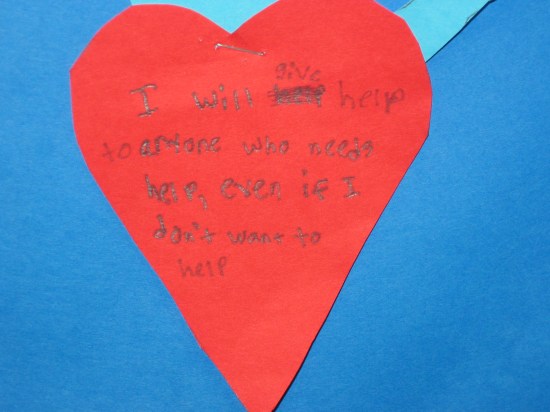

Photo credits:
Shipwreck, by Katherine Hoppe, licensed on Flickr under a Creative Commons License.
Heart clip art by rygle, who has waived rights and dedicated the work to the Public Domain.

Cheerful giving?

A cut out heart with words

That would be giving cheerfully!

Those words were written by a Cool Disciple, one of our rising 1st through 6th graders, at FUMC in Ann Arbor. This child had just heard the story of the “Widow’s Offering” in Mark 12:41-44. The class had discussed how people in the temple in the time of Jesus were giving gifts of coins just like people today give money to the church. They had also learned why we give an offering in worship: as a response to God’s love.   (This summer we are learning about  various aspects of worship.  In June the topic is Offering.)

But kids don’t typically have any income so how can they respond to God’s love? Delving deeper into the Widow’s Offering story teaches us that the size of an offering doesn’t matter. It doesn’t even matter what the offering is because sometimes our offering doesn’t fit into the offering plate! It’s the attitude that counts!

Each of you must give as you have made up your mind, not reluctantly or under compulsion, for God loves a cheerful giver.
2 Corinthians 9:7 (NRSV)

How do we teach giving cheerfully?

Well, we can always say: “we do it because Jesus taught us to.”  Which I suppose is one way to approach the topic… though probably not very convincing (if we are being realistic!)

Let’s face it, the only way to teach a behavior is to live the behavior. We need to be cheerful in our giving whether it’s while writing a check or making a meal for someone.

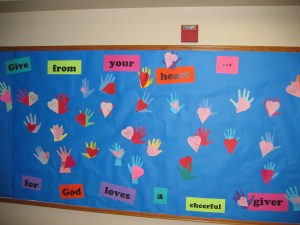
A bulletin board of hearts & hands made by the kids

Lots of hearts and hands were created by kids sharing ways that they can give cheerfully

Some ways to model giving (hopefully cheerfully!):

  • Join the FUMC Prayer Chain. Share the emails received and pray together.
  • Involve your children in preparing a meal to be given to a family in need. Even if it is just to ask them to help wash lettuce, stir brownie mix or fold napkins!
  • Donate toys they no longer play with or clothes that no longer fit. Investigate this link of organizations in our area that accept various types of donations.
  • Have any flowers in your yard or veggies in your garden? Deliver some to your neighbors (with the kids along).
  • What ways do you model cheerful giving?


Photos by Carol H.

Saul: The Before Snapshot

Our Sunday’s school Cool classes in April are studying Saul/Paul’s conversion: the story of one who traveled for the purpose of eradicating Christians… but ended up being changed into someone who ended up traveling to preach about Christ!

On the road from Jerusalem to Damascus, Saul became a new person.

So how can you help your children understand why this transformation of Saul is momentous?

It helps to look at the way Saul was before his switchover. And, it helps to compare Saul to a character your child may know.

Saul: The Before Picture

Saul was a Pharisee. Pharisees were a group of Jews who believed that a redemptive relationship with God could be achieved through strict obedience to the law. Their view of “the law” was two-fold: the written law and oral laws.

The “written law” included the Ten Commandments and other God-given laws described in the book of Exodus. The Pharisees also believed that Moses had received equally binding “oral laws.” It was felt that these oral commandments helped make the written law clearer and thus, easier to follow… but unfortunately, these oral laws often made it more difficult to be loyal to God.

How does this example sound: Many types of work, such as carrying a “burden,” were prohibited on the Sabbath (Jeremiah 17:21-22). The Pharisees felt that this written law needed further interpretation; just exactly what was a “burden?” Thus was born an oral law specifying that things such as money or trinkets were in fact burdens. (Better watch what you pick up!)

Some Pharisees got so caught up in the details of their man-made laws that they lost sight of the spirit of God’s law. It’s almost as if they forgot why they were following the laws in the first place!

Jesus had not condemned all Pharisees but he did frequently argue with those whom he called “hypocrites,” reprimanding their self-righteous behavior and their strict interpretations of the law. (A few examples: Matthew 12:1-12, Matthew 15:1-20 and Mark 7:1-13).

Who does Saul remind you of?

Saul was a particularly zealous Pharisee. He loved God and tried very hard to follow the Jewish law. But somewhere along the way, he became what we might call a fanatic.
A picture of Wile E. Coyote on a drinking glass

To help explain Saul’s “before” picture, choose a character from your child’s repertoire. Wile E. Coyote, of cartoon fame, reminds me of the before-Saul. How does Wile E. Coyote feel about the Roadrunner? (He wants to destroy him!) We could say that Wile E. Coyote is a fanatic; he is focused on getting the Roadrunner! Likewise, Saul was also a fanatic. He was focused on getting Christians and putting them in jail and sometimes, he even had Christians killed.

Once you’ve got a character that your child can compare to Saul, describe a turn-around in their behavior. Have fun and ask your children to think up transformational examples. Here’s one:

Saul’s transformation on the road to Damascus is like… Wile E. Coyote starting a “Rescue Roadrunners” Facebook group.

What words and characters help you explain the before snapshot of Saul to your kids?


Photo credits:
Wile E. Coyote by Adam Dale, who licensed this photo under: Creative Commons Attribution-Noncommercial-Share Alike 2.0 Generic.

Are you seeing ads? They are not from me! They are placed by WordPress, who otherwise offers a free platform from which to share lots of good-ness. If you see an inappropriate ad, please report it to support@wordpress.com. Include the URL, the date/time the ad appeared, and a screenshot of the ad.

Saul/Paul: noticed any changes lately?

a spring flowering treeSpring is a great time of year to talk about change! Every day brings new changes in God’s creation. Have you noticed buds ready to burst forth into blossoms? How about trees; yesterday they were just branched silhouettes! And doesn’t it seem like if you stood still, the grass would grow greener beneath your feet?

It is thus appropriate that discussing change is a part of our April 2010 Rotation (for our 1st – 6th graders at FUMC in Ann Arbor, MI). Our Bible story for this month comes from the New Testament book of Acts (in Acts 9:1-22).

We’ll be studying the revolutionary transformation that came about in a man known by two names: Saul and Paul. Saul’s life was turned around when he met Jesus.

stain glass windows depicting the conversion of Saul/Paul

Saul/Paul’s conversion is an event that is remarkable for its dramatic impact and profound results. Saul started off determined (and violent!) in his quest to squelch Christianity, which at the time, was beginning to spread. A meeting with the risen Messiah transformed him; he became a courageous, dogmatic advocate of Jesus as our Lord and Savior! (And a traveling missionary who braved ship wrecks, imprisonment, beatings, and death threats.)

Studying the change that occurred in Saul/Paul leads us to questions for ourselves:
  • What does the presence of Jesus in our lives look/feel like? Is it as obvious as a bright flash of light or subtler? What ways does God use to get your attention?
  • How does being in the presence of Christ change me?
  • Do we change just once, the initial time we meet Jesus or are we continually changed as our relationship with Jesus deepens?
  • How do we seek out this sort of change?
  • After Saul met the risen Jesus he was a changed man. His life was totally different. How do others know that I am a follower of Jesus? What in my life is evidence of it?

Just a few questions to get some discussion started in your family.

And be sure to catch church this weekend because… Rev. Gil Miller is set to preach on the story of Saul using Acts 9! His sermon is titled “Saintly Sinners.” I wonder what we'll learn?


Photo credits:
Flowering tree: Lightgate-Imagery.com
Stainglass:TheRevSteve’s
All licensed under: Attribution-Noncommercial-Share Alike 2.0 Generic

Are you seeing ads? They are not from me! They are placed by WordPress, who otherwise offers a free platform from which to share lots of good-ness. If you see an inappropriate ad, please report it to support@wordpress.com. Include the URL, the date/time the ad appeared, and a screenshot of the ad.

Saul/Paul’s Transformation – Workshop Schedule

During the school year, each Rotation for our Sunday’s Cool Disciples (what we call Sunday’s school for our 1st – 6th graders at FUMC in Ann Arbor, MI) includes six workshops.

In April 2010, we’ll be studying the story of the Transformation of Saul/Paul. Read this story in Acts 9:1-22. Here is the schedule for this Rotation…

{The schedule has been removed, as it is no longer applicable.}

What’s happening in each workshop?

  • In the Art Workshop kids start off talking about how transformations are happening at a rapid rate! Buds are becoming blossoms, tadpoles are changing into frog… and artists transform supplies into art. Use all of their creativity to transform ordinary clay.
  • In the Cooking Workshop they’ll discuss changes that can occur on our outsides and on our insides. Then they’ll change ordinary ingredients into a tasty surprise snack.
  • In the Drama workshop hear about how Saul/Paul was changed on the inside by Jesus. He looked the same but believed and behaved in different ways. Enact a conversion story.
  • In the Games workshop we’ll play a quiz game to see how much of the story they know. Get ready to be the first to ring the bell! We’ll be running two games workshops each week – one for older kids, and one for younger kids. (Exception: on the 11th we’re expecting a lower enrollment with everyone out on break.)
  • In the Video workshop kids will hear the Bible story while viewing pictures that depict the story in an unusual way. Then watch portions of the animated video from Nest Entertainment, Saul of Tarsus. Discuss how getting to know Jesus can change us.

Are you seeing ads? They are not from me! They are placed by WordPress, who otherwise offers a free platform from which to share lots of good-ness. If you see an inappropriate ad, please report it to support@wordpress.com. Include the URL, the date/time the ad appeared, and a screenshot of the ad.

Have you filled a bucket today?

Updated to reflect newly available publications.

Child at the beach filling a bucket
I learned something new at a family program at FUMC in Ann Arbor, MI.

I learned how to be a “bucket filler.”

Even though this interactive presentation on bucket filling was right after the Easter egg hunt, this wasn’t instruction on how to garner the most chocolate eggs in your Easter bucket basket.

No, this event was about something far more important.


Here’s what I took away:

  • Work to keep my bucket full (by filling other people’s buckets)
  • Don’t be a “bucket dipper”
  • And keep my bucket lid close at hand.

So what’s all this talk of buckets?

It’s all based on the concept that everyone carries around an invisible bucket where we store our good thoughts and feelings about ourselves.

When your bucket is full, you feel great.

When your bucket is empty, you feel lousy.

When we are kind and do nice things for someone, we fill their bucket. In the process of doing “bucket-filling, the gratifying side-effect is that our own bucket gets replenished!

This is a great way to teach kids (even young ones) about the importance of being loving and considerate of other people. To keep your own bucket full you need to either receive scoops of love from someone or ladle love upon someone else.

Jesus told us to be a bucket filler: “Love your neighbors as much as you love yourself.” (Luke 10:27). I’m all for full buckets!

But, don’t be a bucket dipper!

What is not good is “bucket dipping.” When someone acts mean, in the things they do or say (or even simply ignores us!) they dip into our bucket, hijacking some of our happiness.

For kids, this describes bullies, but it also can describe the daily goings-on in our households. How about: “My bucket is being dipped when you don’t pick up your toys as I’d asked.” Or, “I see that both of your buckets are being dipped when you and your sister are arguing.”

What’s with the bucket lid?

This event turned out to be so much more than just another way of looking at the Golden Rule. The presenter from Bucket Fillers, Inc. empowered us to deal with bucket dippers by putting a lid on our bucket! What a refreshing way to visualize protecting your feelings—for kids of all ages.

As I have thought about this bucket concept, it occurred to me that God wants to fill to overflowing, all of our buckets!

Open quote markFrom the fullness of his grace we have all received one blessing after another. John 1:16

God needs us to do the work of filling each other’s buckets. I have just one question…

A bucket full of blessings

-----

Some Bucket-filling Resources:

The book Have You Filled a Bucket Today?This is a great book to introduce bucket filling to your kids; for all ages (even adults!)


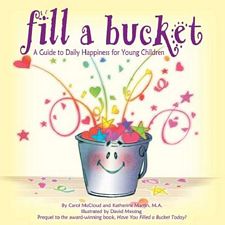
The book: Fill a bucketThis one is great for ages birth to 5.


Book - Growing Up with a Bucket Full of HappinessA chapter book for ages 9 and up.


Book - Baby's Bucket BookBoard-book for ages birth to age 2.

Baby’s have buckets too!


To purchase the above books and other products visit Bucket Fillers, Inc.


Photo credits:
Beach photo offered by RJ Bejil, who licensed this photo under a Creative Commons License.

Graphic: “Have You Filled a Bucket Today?” – used with permission from Bucket Fillers, Inc.
Book covers – Not affiliate links (I get nothing for pointing you to the organization Bucket Fillers, Inc. Just trying to point you towards resources.) but these covers do link to the publishers’ web site. This, in my mind, keeps this in the category of fair use for educational purposes.