Holy ground

A well-used sneaker

Our current Rotation on Moses is so full of areas for contemplation. We can’t do it all in 45 minutes of Saturday or Sunday’s Cool! Here’s a topic which is not touched on but is still important. Ask these questions at the family dinner table. (Or wherever your family is gathered together.) To print out a one-page family discussion guide go here.

Moses met God at the burning bush. God’s first instruction to Moses was: take off your shoes. (Okay, he called them sandals.)

“Do not come any closer,” God said. “Take off your sandals, for the place where you are standing is holy ground.”   Exodus 3:5

“Holy,” in this instance, means “set apart,” “specially recognized” or “declared sacred.” What made this spot holy for Moses, was the presence of God. Anywhere we meet God can be considered holy!

Ordinary desert dirt became holy ground.

When you hear the words “holy place” what do you think of? What/where are
the holy spots in your life? Mention a holy place and right away our thoughts go to chapels, churches and cathedrals. Think of our church sanctuary. The word sanctuary means “safe place” or “holy place.” Churches are places designed for us to have an encounter with the holy. The next time you are waiting together as a family for worship to begin, talk quietly about what parts of the sanctuary help it to feel like “holy ground.”

At home, where can you talk to God? Discuss how any space can feel like holy ground, an acceptable spot to meet God! Anywhere we talk to God can be considered a “holy place;” it’s not that a space needs to be holy before God will enter! How do you prepare yourself to enter holy ground?

Do you suppose there ought to be a special “holy spot” in your home that
reminds you that God is near? What should that space feel like? Look like? Spend time arranging such a holy place – a bench or a chair or windowsill. Encourage everyone to spend quiet time in this holy location.


Photo credits:
Empty shoes by Jérôme, who licensed this photo on Flickr under a Creative Commons License.

Are you seeing ads? They are not from me! They are placed by WordPress, who otherwise offers a free platform from which to share lots of good-ness. If you see an inappropriate ad, please report it to support@wordpress.com. Include the URL, the date/time the ad appeared, and a screenshot of the ad.

A Blessing: celebrate God with you

A young boy runs into someone's arms

God used a burning bush to speak to Moses. I don’t know about you but I’ve never encountered a burning bush; at least not one of the caliper that Moses described. I have, however, encountered God reaching out to me in other ways: Through the Bible, through books, through other people, through nature… God is always waiting for us to notice his intersection into our lives. Isn’t it wonderful? Something to celebrate! Use this blessing with your child(ren).

Say your child’s name and…

May everyday be a celebration of God’s presence with you.


Click on a box if you would like to…
A check-box Satisfy your curiosity about why you should bless your child.
A check-box View other suggested blessings.


Photo credits: Click here for info on banner photo (not visible in readers or email).
Into Your Arms by Darrel Birkett, who licensed this photo on Flickr under a Creative Commons License.

What does “God at work” look like?

Moses and the burning bush

Moses’ story, from his birth to his experience with the burning bush, is rich in content, and opens numerous chances for discussion. One of our targets for this Rotation is to help kids recognize God “at work” in the lives of Moses and other story characters. A second objective is to apply the concept of “God at work” to their own life. Great topics for families to discuss!

What does God at work look like in this portion of our story?

Read the scripture together as a family. Since it’s a long story, use the following chart to read and talk about our story in stages, over the course of several days. (If you’d like to print out this reading plan/discussion guide, click here.)

Read a passage and then ask where you see God making his presence known. I’ve provided some suggestions. Feel free to comment on other ways you notice God taking action.

Read Discussion points. How is God at work in the lives of story characters?
Exodus 1:1-7 Fulfilling God’s promise to Abraham to have as many descendants as the stars in the sky (Genesis 15:5).
Exodus 1:8-21 What are two Hebrew midwives able to do?
Exodus 1:22-2:4 Imagine the trust in God necessary to hide your child in a basket in the river!
Exodus 2:5-6 Just at the right time, Pharaoh’s daughter decides to take a bath.
Exodus 2:7-10 Miriam showed some courage. And Moses gets the best of two worlds – being raised as a youngster by his family (and being seeped in Hebrew culture) and life in Pharaoh’s palace.
Exodus 2:11-15 What good ends up coming from this bad? (It does require knowing the rest of the story.)
Exodus 2:16-25 Moses lived in Midian for 40 years. I wonder what sort of “learning” Moses needed to acquire during that long time in the “wilderness.”
Exodus 3:1-4 God is starting his rescue plan! I wonder what would have happened if Moses hadn’t said, “Hmm, that’s unusual. I’d better go and look at that.”
Exodus 3:5-12 This one is obvious: God speaks to Moses!
Exodus 3:13-15 Pagan gods never revealed their name because disclosing a name was like giving away power. But our God is a personal God; he has a name!
Exodus 4:1-9 God gives Moses concrete examples of his power. I wonder how Moses will feel when God doesn’t seem so close at hand?
Exodus 4:10-12 God really wants Moses to do this job. I wonder why Moses is so hesitant?
Exodus 4:13-17 What does God give Moses to remind him that God will be with him?

What are ways that you see God at work in your life?

-------


Photo credits:
Burning bush by the Providence Lithograph Company [Public domain], via Wikimedia Commons.

Break down the Moses story into study-able chunks

Moses as a baby is discovered by Pharaoh's daughterThe stories about Moses are sizable! They cover 40 chapters in the Old Testament book of Exodus! How should they be taught?

Using the Workshop Rotation Model, we have chosen to teach Moses in sections, beginning first with a Rotation that covered the early years: Moses’ birth and his float among bulrushes — to his burning bush experience as an adult.

Then we followed up with the sequel — a Rotation about Moses and the plagues on the Egyptians! We had conveniently planned these Rotations so that we could follow up what happened in the last plague (Passover!) with a Rotation on the Last Supper.

Read the first part of our story in Exodus 1:1-4:17. Yep, it’s a big story. Break it down; read a bit of it every night at the dinner table. Hey! That makes me think that I need to post a family reading plan. Stay tuned! Here it is!

For prosperity, here is what we did in each workshop for our Rotation on Moses – Birth through the Burning Bush.

(We used these Workshops in January 2012 and in January 2018 — we repeat stories every six or so years. )

  • In the Art Workshop (2012 & 2018) students created a variation of the ancient Jewish art form of micrography to create a burning bush scene. (Micrography uses very small writing to create shapes and designs.) Focus on the burning bush portion of the Moses story
  • In the Cooking Workshop (2012 & 2018) students heard the story about Moses from a portion of a video, What’s in the Bible, Vol. 2 Let My People Go. Then they made something to take home to tell the story of Moses – edible baby Moses baskets.
  • In the Drama Workshop (2012) students participate in enacting the burning bush portion of the story. (Watch for a possible video clip?)
  • In the Games Workshop (2012) students will play a review game modeled after Cranium, focusing on events in our story. This game involves using a life-sized game board!
  • In the Storytelling Workshop (2012) students will hear the story via a “visitor” posing as Moses from Bible times. (I hear he’s been growing his beard to look the part!)
  • In the Video Workshop (2012 & 2018) students watched portions of the animated video Nest Entertainment: Moses, enjoy popcorn (can’t have a movie without popcorn!) and learned story details.

Why are we doing different workshops for the different times we’ve taught this story?

There are several reasons including:

  • Our focus for a Rotation has changed (we’ve gained new understanding!)
  • We know our kids. We know what will, and won’t work with them.
  • We’ve got a new idea!

Explore more about Rotation Model goodness!

-------

Photo credits:
Illustration from an old story Bible, via Wikimedia Commons, is in the Public Domain.

A blessing: in pursuit

Make sure to remind your child that God is active in his pursuit of them with his goodness and mercy (his loving kindness). What can our response be?

To turn around, and actively pursue his presence!

“a

Here is a blessing to match these thoughts:

Say your child’s name and…

Jesus does not stop in his job to provide you loving kindness. May you turn right back around and crave friendship with Jesus.


Click on a box if you would like to…
A check-box Satisfy your curiosity about why you should bless your child.
A check-box View other suggested blessings.


Photo credits:
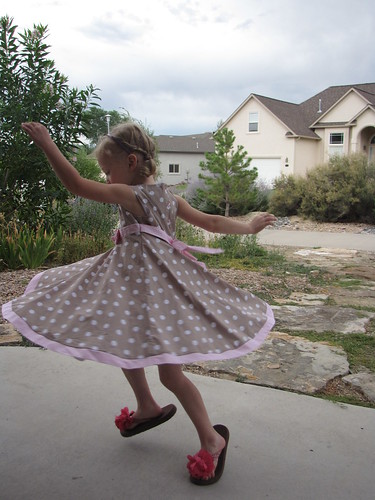
Twirling girl by Karah Levely-Rinaldi, who licensed this photo on Flickr under a Creative Commons License.

Are you seeing ads? They are not from me! They are placed by WordPress, who otherwise offers a free platform from which to share lots of good-ness. If you see an inappropriate ad, please report it to support@wordpress.com. Include the URL, the date/time the ad appeared, and a screenshot of the ad.

A blessing: goodness and mercy are pursuing you

The good shepherdAt the end of Psalm 23, Psalmist David is really raving about the benefits of living under the care of a “Good Shepherd.”

 
'Surely goodness and mercy shall follow me all the days of my life.  Psalm 23:6

Goodness and mercy, follow me?

What?

The Old Testament was originally written mostly in Hebrew. In it’s eventual translation to English (via Greek and Latin) something got lost. Peeking at the Hebrew version (along with an on-line Hebrew lexicon for translation!) we see that the word “follow” in this case was “radish,” meaning to pursue or to chase!

Can you see it?

God’s goodness and loving kindness, actively pursuing you!

One kid chases after another on a beautiful beach with a Hawaiian sunset

Bless your child with these words, saying their name and…

God’s loving kindness is chasing after you.

Don’t you wish that for your kids? I sure do!


Click on a box if you would like to…
A check-box Satisfy your curiosity about why you should bless your child.
A check-box View other suggested blessings.

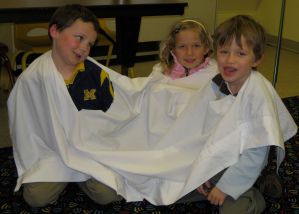
p.s. In the Games Workshop this month as our Cool Disciples have studied Psalm 23, they’ve played a relay race game called “Follow me to the Lord’s House.” Here are team members getting ready to race to the Lord’s House, dressed as a sheep with “goodness and mercy jingle bells” around their ankles! Fun!

In the games workshop for Psalm 23, members of a team become one SHEEP.

--------------

Photo credits:
Good Shepherd by waldryano.
Scene of a chase by Lance Shields.
Both photos licensed under Creative Commons (CC BY 2.0).
Bottom photo copyright Robert Langdon from our program at Green Wood. Used with permission.

A blessing: personalized

We can’t constantly be with our kids. Psalm 23 can steel us. Without fail, God is with our children. So say a blessing for your child that reassures them that God is always with them and strengthens and protects them.

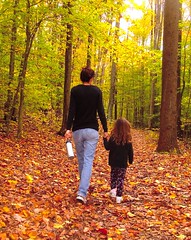
A mother and a child walk in the woods

Say this to your child (inserting their name in the blank):

The Lord is ___’s shepherd.


Click on a box if you would like to…
A check-box Satisfy your curiosity about why you should bless your child.
A check-box View other suggested blessings.


Photo credits: For info on banner photo (not visible in readers or email) click here.
Mother and child by Ross Griff, who licensed this photo on Flickr under Creative Commons License

Are your kids bonding with their Holy Shepherd?

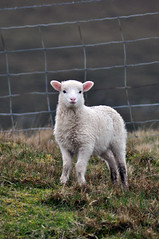
a cute little lamb

New here? Easily read future posts by subscribing over on the right. Enter your e-mail address to have posts sent directly to your inbox. Or click on the orange RSS icon to subscribe in a reader. Thanks for visiting.

Lambs look so cuddly don’t they? (Yes, dirt and all.)

My favorite stuffed animal as a child was a lamb. Yep. Serious loving. If that sheep could have talked it probably would have said, “Stop squeezing me so tight!”

Psalm 23 gives us the words of a different lamb doing some talking.

This lamb is describing the care of a watchful, loving shepherd.

He lets me rest in green meadows;
he leads me beside peaceful streams.

Psalm 23:2, The New Living Translation

The author David (of David and Goliath fame) wrote Psalm 23 over 3,000 years ago, painting a tranquil portrayal of life lived under a close relationship with God. Trusting. Loved.

Are your kids fostering that sort of a relationship with God?

Help ensure they do by talking about Psalm 23 around the family dinner table. (Or wherever your family is gathered together.) If you’d like to print out the following Family Faith Companion Guide click here.

  • Play a couple rounds of the game Twenty Questions. Point out that in order to figure out what the object is, you need to gather clues that help you describe something.
  • Say: The Bible gives us a description of what our relationship with God can be like. Let’s read that passage. Be thinking about what sort of picture you get when you hear these words.
  • Get out a Bible and read Psalm 23. (If your child is in 3rd grade or up, ask them the clue for quickly finding the book of Psalms.) Or check it out on-line: here.
  • Ask: What do those words describe to you?
    What would it mean to a sheep to have a green pasture and still water?
  • Say: That sounds like one very contented and trusting sheep! David’s words describe what God can be like for us! Protective. Caring. Always watching over us.
  • Ask: Do you suppose those words describe your relationship to God?
    How does God take care of you?
    What are your quiet waters?
    How do you get there?
  • Say: Sheep are covered in scratchy wool. That wool can get bugs and stickers in it and sheep don’t have arms to reach and scratch.
  • Ask: Have you ever had itchy bug bites?
    Do certain situations or things that people do, sometimes irritate you?
  • Say: When we have troubles, we need our shepherd-God to help us so that we can find rest and enjoy our lives!
  • Close with a short prayer. A suggestion: Lord, thank you for being our protecting shepherd. Help us to turn to you, our friend, trusting in your care so that we can reach green, restful pastures. Amen.

How did this work? Share about your family devotional time.


Photo credits: Click here for info on banner photo (not visible in readers or email).
Little lamb by Chris Rice, who licensed this photo on Flickr under Creative Commons License