Does your family play games together? Why not use a game as a way to open up conversation about faith topics. How about at the family dinner table? (Or wherever your family is gathered together.) You can do this!
Play the “Face Game.” That’s where someone calls out an emotion — such as mad, or sad, or over-the-top-glad — and everyone has to make the face that was named.
With each emotion named, ask this follow-up question: What could happen that would cause you to make that face?
When the “scared” emotion gets named, and everyone has shared something that causes fear, ask these additional questions:
Why do you suppose that your Sunday’s Cool classes this month have compared Goliath to a problem that you’ve faced?
How would it look like if you used faith in God to face your fear?
David’s experience protecting his sheep helped him to know that he could face Goliath. What would help you to have a stronger faith in God?
Games are a great way to open up to faith conversation with your family. Give it a try.
Photo credits: Faces are in the Public Domain, offered via Pixabay.com.
Are you seeing ads? They are not from me! They are placed by WordPress, who otherwise offers a free platform from which to share lots of good-ness. If you see an inappropriate ad, please report it to support@wordpress.com. Include the URL, the date/time the ad appeared, and a screenshot of the ad.
David vs. Goliath? How was it possible that little David won the battle?
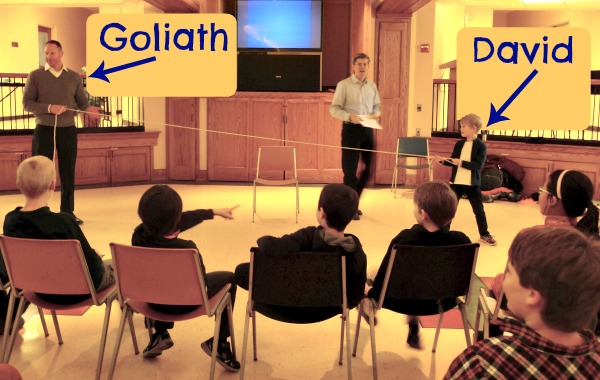
It was a little guy vs. a BIG Giant! Sort of like the tug-of-war we set up last week.
We wanted kids to realize how unlikely it was that David could have won against Goliath. One little guy was a piece of cake for “our Goliath,” just as it should have been for the real Goliath.
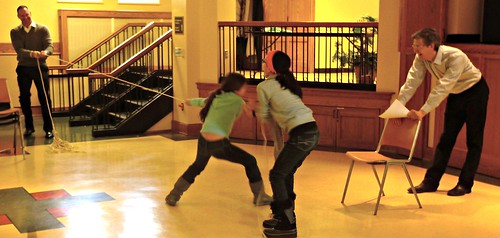
Two kids even tried to beat him. Nope. Couldn’t do it. I realize that David didn’t face Goliath in a game of tug-of-war but… how did David pull this off?
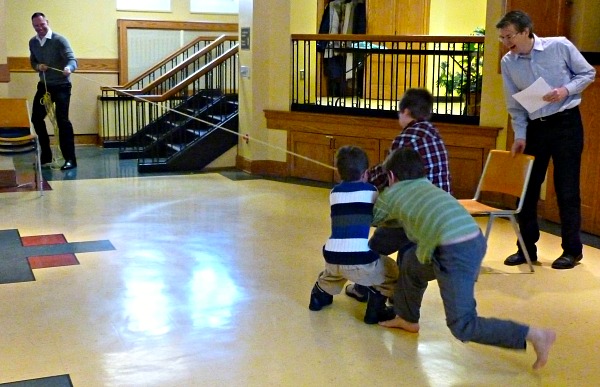
Meanwhile, tnree tried. Goliath didn’t even break a sweat.
So ask these questions in your family get together: How did David do it?
All of the other Israelites, including King Saul, were terrified of Goliath. No one else had enough courage to fight him. Why do you suppose David volunteered to fight Goliath? (Read David’s reasoning in 1 Samuel 17:37).
David trusted that God would be with him, I wonder how he came to believe that?
Why did David go into battle without any “protective” armor of the heavy-duty metal sort? (Read David’s answer in 1 Samuel 17:39).
Just because it didn’t feel right!!? David must have had some sort of super-weapon. His slingshot must have been the extra-whiz-bang-model! (Read about it in 1 Samuel 17:40). What! It wasn’t! What did David take with him into battle besides the 5 smooth stones and a slingshot? (Get a hint: 1 Samuel 17:45-47).
He had faith! He knew he could defeat Goliath by trusting in God and relying on God’s power! Let’s look at the way David thought of God: Read Psalm 23. (To David, God was a shepherd that took care of all of his needs.)
What lesson do you take away from this story about David’s faith and trust in God?
It’s Lent! Here are some resources for the season:
Are you seeing ads? They are not from me! They are placed by WordPress, who otherwise offers a free platform from which to share lots of good-ness. If you see an inappropriate ad, please report it to support@wordpress.com. Include the URL, the date/time the ad appeared, and a screenshot of the ad.
Our current Rotation story covers several chapters in Esther. Start with part one of our reading plan (covering chapters 1 – 3 in Esther) breaking the story into manageable chunks so that you can review it a little bit over several days. And here is part two, covering Esther, chapters 4 – 10.
Start off your discussion time by asking family members to tell the story up to where you last left off. Why not use a fun way to do this! Watch the first part of our story in this video. (If you are reading this in an email click here to view the video.)
Or use one of these ways to retell the story:
Begin the story with one sentence such as “Our story starts off with King Xerxes having a big party.” Let each person add one line to the story until you are caught up on the story.
Pictionary style: Take turns drawing parts of the story (and guessing what is being drawn!) Then put the pictures in story order.
Tell the story with inaccuracies and let them correct you — especially fun for the younger ones!
Note: Some portions of our story are rather graphic, especially for younger kids. For example, people are hanged or impaled on poles, depending on which version of the Bible you are reading. To be on the safe side, ahead of your family reading time, plan to skim a passage to check out what you may need to adjust in your reading.
Read in Esther
Talk about or do…
4:1-7
What is sackcloth? (A definition). Can you imagine sitting on a heap of ashes? What do you suppose the advantage is of such public display of sorrow? How do you show sadness? Discuss other outward signs of inward conditions? Adults: You’ve heard it said that we need to help our children name their emotions but what about naming our own emotions? Do you ever do that? I’ve learned it’s important to say to myself: Right now, I am doing _____ (frustration or depression or whatever), now what can I do?
4:8-11
Does your child’s classroom ever use “talking sticks?” Why does it appear to work? Name an instance when you feel “unsafe” talking. For me it was speaking up in class as a child! Oh, if I could have imagined someone holding out a gold scepter as a sign of my acceptance! What “gold scepters” do we need to display to others?
4:8-14
What is Mordecai’s challenge to Esther? Esther was in a pickle. If she went to the king, she could be killed. If she did nothing, her people would be wiped out. Name a stuck sort of situation you once found yourself in, where no matter what you did seemed like trouble. Focus on the later portion of verse 14: “And who knows but that you have come to your royal position for such a time as this?” Sometimes the stories of our lives don’t make much sense. Can you imagine a “such a time as this” situation as an opportunity to serve God? Has such a situation ever occurred? (Adults: This is important sharing time!) How can you remember to think of each “right where you are this minute” situation, as to how you can possibly be Jesus to someone else?
4:15-17
What is a “fast?” (Refraining from eating food.) Esther’s calling for a fast, was essentially asking all of the Jews to pray for her. Name some situations where prayer has helped you do something hard. How is it helpful to know that others are praying for you? God used an ordinary woman named Esther to save his people (who happened to be Jesus’ ancestors!) Do you suppose that God could use you to do something special? How does it change your life to know that God has something special planned for you to do?
chapter 5
Whew! King Xerxes held out his scepter to Esther! Esther chose to have faith in God and to take her chance at approaching the King. Discuss the athletic shoe company’s campaign to: “Just Do It.” How does such a saying apply to this story? Are the happenings in this story, and in our lives, coincidences or the special workings of God? (Room for lots of debate!)?
chp 6
Ah, the book of records comes into play! Who did Haman think that the king was talking about when he asked, “What should I do…?” How did this make Haman feel to have to do all of these lavish things for Mordecai? (verse 12) How can thinking of ourselves as better than others, get us into trouble? What is one thing you can do to help you amend this sort of character trait in yourself?
chp 7
This is a good time to play a game or two of “Hangman” using names or phrases from the story. For older children: How can you seek justice in a situation where you currently see injustice? What can you do if justice is not served?
chp 8
God provides not only for Esther and Mordecai, but for all of the Jewish people. How do the people respond? (They rejoice!) In what ways can our response to God be rejoicing? Have you ever thought of going into worship with an attitude of rejoicing?
9:20-10:3
(Note to adults: skipping all of the killing!) What is something that your family can commemorate and celebrate (beyond the typical birthday and graduation)? How about the day you were baptized? Or is there something that God has done for you that you would like to remember? What are some ways you could celebrate it?
Are you seeing ads? They are not from me! They are placed by WordPress, who otherwise offers a free platform from which to share lots of good-ness. If you see an inappropriate ad, please report it to support@wordpress.com. Include the URL, the date/time the ad appeared, and a screenshot of the ad.
Your home is the primary learning lab for your child’s faith growth.
That’s right. In your home.
Not what they get at church once a week.
Not what they get from Vacation Bible Camp once a year.
(Though those things certainly can help.)
At home.
But, have no fear! Why not use the following “reading plan” to lead your family to deeply discuss our current Rotation story, which winds it’s way through several chapters in the Old Testament book of Esther.
Read (and talk about!) our story over several days. Try it at the family dinner table or wherever your family gathers together with a few spare moments.
This reading plan needs some map work. As a kid, I loved maps! Don’t be too quick to point out places on a map. Let kids work at finding them. This looking helps cement concepts in their brain! (Such as how far it was from Susa to Jerusalem.)
Read in Esther
Talk about or do…
1:1-2 (chapter one, verses one and two)
Do some map sleuthing. Start with a map of the world. See if they can find Michigan! Name an African country for them to find. (How about Kenya! A bunch of folks from our church will be headed there soon.) Have them find Egypt and Israel. (Clicking on a country brings up a map of that country.) Now go to this map and note the outlines of the Persian Empire. Where was the home base of King Xerxes? (verse 2). Find Susa on the map above. Bonus points: Today what country was Susa in? (Check back with the world map).
1:1-8
King Xerxes (what a fun sounding name! It’s pronounced: Zurk-seez) gave some parties! How long was one of his galas? (verse 4) What’s the longest “party” you’ve ever attended? I’m putting the word party in quotes because perhaps it’s time for the adults to tell the kids about that days long event they’ve attended in the past. What about Art Fair in Ann Arbor – that counts as a party of sorts. Have you ever been to Art Fair more than one day in a row? It’s time to tell stories about special events!
1:9-22
This queen’s name is pronounced: VASH-tee. What did Vashti do that got her banished from the kingdom? What do you think of the kings advisor’s reasoning? Do you think Queen Vashti’s action was insulting to everyone? Discuss how roles in families have changed!
2:1-10
[Adults: Read this chapter ahead of time to plan to use substitutions for some words.] Here’s another character with a strange sounding name: Mordecai is pronounced: mor-di-KI. Why do you suppose Esther hadn’t told anyone about her family origin? Look back at the map above. The homeland of Esther and Mordecai’s Jewish family was where Israel is today. (Find Jerusalem on the map.) Do you know how Jewish people ended up in Susa? (Read about the exile.)
2:11-18
How do you suppose Esther felt about being removed from her home with no choice in the matter? How do you suppose she felt about a year’s worth of “beauty care?” About winning this beauty contest? Everyone seems captivated by Esther’s beauty, but beauty, all by itself, doesn’t cause people to like you! It also takes… what? (your character and your actions!) Do you see yourself as a “beautiful” person? (God does!)
2:19-23
[Adults: Be prepared to perhaps change the wording used in this passage.] What plot did Mordecai stop? Why do you suppose it is significant that this event was recorded in “The Book of the History of King Xerxes’ Reign?” Does anything ever happen that you wish could be written down so that you could refer to it later? Just for fun, try writing down the events of one day.
3:1-6
What behavior made Haman so angry? As second-in-command to King Xerxes, Haman held a rank that required everyone to bow down to him. Does the story tell us why Mordecai wouldn’t bow down to Haman? (Not really!) We know that because Mordecai was a Jew who only bowed before God, he would have refused to bow down to Haman. How does this sort of loyalty make you feel? Is there anyone (or anything) in your life that asks you bow down to it? Bonus question: Which of the Ten Commandments was Mordecai following?
3:7-15
What does it mean to “cast lots?” (basically, to roll dice!) How did Haman surreptitiously persuade King Xerxes to issue an edict condemning the Jews in the entire Persian Empire? Check the map of Xerxes’ empire. Compare that to the map above to discover what Jewish homeland would have been included in this order-of-death decree. (Jerusalem!)
Stay tuned. More to come!
Photo credits: Click here for info on banner photo (not visible in readers or email). At the supper table by Eric Peacock, who licensed this photo on Flickr under a Creative Commons License.
Are you seeing ads? They are not from me! They are placed by WordPress, who otherwise offers a free platform from which to share lots of good-ness. If you see an inappropriate ad, please report it to support@wordpress.com. Include the URL, the date/time the ad appeared, and a screenshot of the ad.
Ask the question most frequently asked by young children: Why?
I remember telling my kids when they were very young, a simple explanation for why we celebrate Christmas:
It’s Jesus’ birthday.
Birthdays are easy for kids to understand. On your child’s birthday, do they enjoy hearing the story about the day they were born? (Or perhaps the day they were adopted?) It follows that on Jesus’ birthday we tell over and over, the account of his arrival.
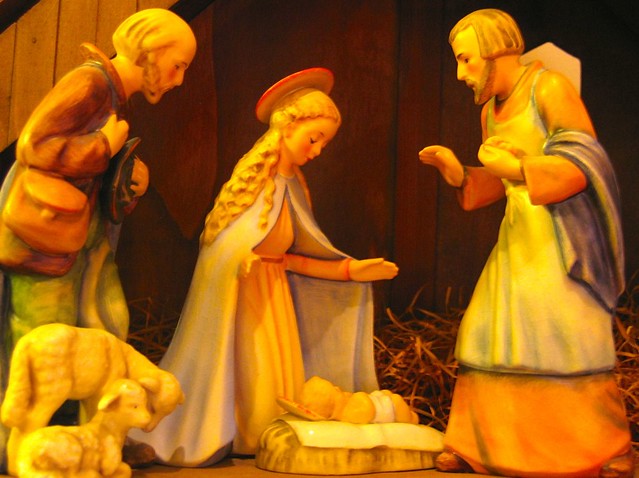
We typically hear the story from Luke – a trek to Bethlehem, rooms at capacity, a babe born amongst beasts, topped off with sojourning, wonder-struck shepherds. It always amazes me: Jesus’ first bed was an animal feeding trough, and second-string sheep-tenders were Jesus’ inaugural guests. Everyone had been on the lookout for a majestic monarch, yet God slipped into our world as a defenseless little baby.
Why did the story happen this way?
What were God’s intentions? When we dig deeper, and read in Matthew, we reveal God’s purpose:
She will give birth to a son, and they will call him Immanuel, which means “God is with us.” (Matthew 1:22-23)
Immanuel, means in Hebrew: “with us is God.” Ah! A glimpse at God’s motive.
Jesus was sent to be God with us!
Ready for some family discussion surrounding Immanuel / God-with-us?
A long time ago, God quietly came to earth via his son Jesus. Most people in those days didn’t recognize Jesus as their long-waited-for Savior. What about these days, do you suppose people recognize God-with-us today?
What are some ways that God makes his presence known to us? What can make it hard to “see” God?
How can we help others to notice God with us?
Back in Bible times it seemed that God was more overt in his communication with people. For instance, in our current Rotation on Jesus’ birth story, there are lots of “angels of the Lord.” One named Gabriel, visited Mary, whereas Joseph had two angelic visits in his dreams. And the shepherds… they got a sky-full!
What evidence of God have you seen lately?
What about that bird perched just so, on the snow-covered branch…
To me nature-happenings are a sort of message from God. He says, “Slow down. Take notice. Isn’t what I’ve created intricate and amazing? I created you too. Oh, what a beautiful job I did! Do you see that little bird? The one perched outside your window? I care about him. I care about you!”
God is with us. In what ways will you look for his presence?
Photo credits…
Photos are from my archives. Copyright Carol Hulbert.
Are you ready? Have you planned activities to engage your family in the season of waiting for Christmas?
Why Advent? The word “Advent” comes from Latin; it means “coming” or “arrival.” Advent signals that Christmas is coming; the day when we celebrate that God arrived on earth as baby Jesus. Advent gives us time to prepare to celebrate Christ’s coming. We get to focus our hearts and minds and actions, on the amazing story of God with us!
What can we do during Advent? Try some of these activities:
Bring out the Advent wreath. Remember when we in non-COVID times we’d spruce up our wreaths at church? Not happening this year! Bring it out of storage anyhow! It will work just as well. Replace the candles. Don’t worry about what color they are! Things are different this year!
Light those Advent candles. Starting on the first Sunday of Advent, and why not everyday, light the appropriate number of candles (one for each week of Advent) during your family dinner. Can’t all be there for dinner? How about over breakfast or over an after-school or bedtime snack? Or just use it as an excuse to gather together for shared family time. (Even if it’s only for 5 minutes!)
Go on a photo hunt!
Join in on the fun of Picture Advent. On the first day of Advent 2020 photograph something that says “Open.” On Monday look for “Presence,” etc. See the list of various photo ops for 2020. share your photos on the church Facebook page.
Use an Advent Calendar. There are all sorts of these to be found, though they typically count the days in December (as opposed to the weeks of Advent).
Use your Nativity set as an Advent Calendar – set up a path of numbered “stepping stones” (cut from paper?) Have Mary and Joseph slowly make their way to the stable scene.
OR, have your kids assemble a paper chain with 24 links. Print out this list of Bible verses and glue one verse to each link. Every day in December snip a link and read the Bible together.
OR, Use my favorite Bible storybook – The Jesus Storybook Bible. Read one story each day. (They all tie to Jesus; even the Old Testament.) Download a PDF of this reading plan. A sample of which is shown below. (There are multiple other, not-so-fancy versions out on the internet. Do a search.)
Plant Straw for the Manger. Fill a cup with potting soil. Place it on a sunward windowsill. Have a container of seeds close by – use grass seed or “cat grass” or wheat berries. Every time someone does something nice for someone, they get to plant a seed. Watch it grow (water regularly) and on December 24th mow it down to fill the manger in your crèche scene.
Use unexpected moments to focus on Advent themes. Find yourself stuck in traffic or in the slow lane at the store? Transform your marking-time-moment into an example of how the Israelites waited for the arrival of the Savior – for hundreds of years! What are other daily instances that remind you of peace, light, grace, joy, hope, love…?
Check this list of other Advent ideas… including Random Acts of Christmas Kindness! A fun way to put the focus on being kind to others.
What Advent activities are being arranged in your household?
Photo credits… Grass in a cup by Shardayyy Photography, licensed under Creative Commons (CC BY 2.0).
The page from The Jesus Storybook Bible Advent calendar created under fair usage. (I’m linking to their product at no benefit to myself. And you’ll for sure want one. Did I mention that it’s my favorite?)
Other photos, copyright, from my archives.
It is easy to understand why Jesus assembled a crew of special disciples. Jesus needed help!
Enter, the Super Disciples!
These were not just average, I-like-the-sound-of-what-you-are-preaching, admirers. Jesus invited his apprentice good-news-broadcasters to come, follow me; become my students.
Fairly early in his ministry, they were called to receive basic training in Super Discipleship.
These selected followers saw it firsthand: God was up to something big! Here was a belief system that changed how you looked at everything! Transformed lives! And though they stumbled at times, Jesus’ disciples ended up doing an admirable job of spreading the good news about Christ, especially once they had the Holy Spirit.
Today Jesus still needs disciples to work at transforming the world. What about us?
Are we ho-hum fans, or are we Super-D disciples of Jesus?
It shouldn’t be a surprise that we need to work at becoming the latter. How? It’s just like learning to play an instrument: we practice!
But how does one practice becoming this sort of committed disciple?
Here are some thoughts to ponder in forming a disciple-practice-plan:
Gather your family — how about around the dinner table? Read some of the stories of Jesus “calling” his disciples – fishermen, a tax collector, and others. Note that sometimes eventual followers were skeptical at first. Are we allowed to wonder at the mystery of what God is up to? You bet!
Next, discuss with your family what the difference is between an everyday follower and an in-it-for-the-long-run disciple like Peter and Matthew and James and John? How would it look if your family just “said” you were Jesus-followers vs. acted like you meant it? Would anything change or are you on that path now? Would you have to give something up? Is being a disciple of Christ one more thing to add to our to-do list? Or is it a new way of living?
According to your definition of a “Super Disciple,” tell stories of when you encountered someone like that. What was it that made that person memorable? What could you emulate? Perhaps you could invite a voted-upon Super D to share a supper with you?
Discuss which of these areas need your focus: On-going Christian education (not just for the kids!) Worshiping together as a family. Celebrating Communion together as a family. Regular Bible reading and prayer. Participation in mission to others.
As United Methodist followers of Jesus’ teachings, we are guided in our quest to be Super Disciples by what is called “The General Rule of Discipleship” which is described in The Book of Discipline of The United Methodist Church as: following Christ “through acts of compassion, justice, worship, and devotion under the guidance of the Holy Spirit.”
This means we practice being disciples by inward, life-giving means such as worship and “devotion” (prayer and Bible study), and by outward participation in God’s mission for the world: seeking justice and having compassion for others.
Pastor Nancy Lynn told us about this in a sermon she preached at FUMC on September 7, 2014, saying: “These four acts reflect that our journey of faith is personal as well as social, private as well as public, inward as well as outward. And to grow and be healthy, we need balance between them.”
A person who commits to practicing can become a Super Disciple. How are you practicing discipleship?
Do you remember that persistent question you faced from a very young age?
What do you want to do when you grow up?
I always hated that question. (Because, how did I know?)
I believe we are asking kids (and ourselves) the wrong question. Instead we should be asking…
Who do you want to become?
We are surrounded by a culture where the focus is on “appearances.” Who thinks about what a person can become? People are impressed by good looks, by how well you speak or how strong you are. How are we to help our kids combat this bias?
By teaching them to look inside.
Our current Rotation is a good place to start. In our story, David is chosen as the next king of Israel. Can you hear his family sputtering, “Him? He’s just a young boy; a lowly sheep-keeper.”
Ah, but we learn that God doesn’t look at outside qualities, he looks at our inside, at our heart.
Here’s what God tells Samuel about why David’s older brother, Eliab, wasn’t the one chosen king:
Samuel, don’t think Eliab is the one just because he’s tall and handsome. He isn’t the one I’ve chosen. People judge others by what they look like, but I judge people by what is in their hearts. 1 Samuel 16:7
What did God “see” in David’s heart?
Potential!
David is thought to have been between 10 and 15 years old when he was designated as Israel’s next king, but he didn’t take the leadership right away. David continued to care for sheep, building courage, a good leadership quality. David also wrote Psalms. We can look in his Psalms to find other seen-by-God heart characteristics.
Bring out a Bible and read the following Psalms. Try to figure out the heart quality conveyed.
Psalm 23 “The LORD is my shepherd; I shall not want…” (Potential expressed heart-quality: Trust)
Psalm 5:7 “I am filled with wonder as I bow down to worship.” (A worshipful attitude)
Psalm 139:14 “I praise you because of the wonderful way you created me. Everything you do is marvelous! Of this I have no doubt.” (Gratitude)
Psalm 5:3 “Each morning you listen to my prayer, as I bring my requests to you and wait for your reply.” (Asking for help)
Psalm 19:11 “By your teachings, Lord, I am warned; by obeying them, I am greatly rewarded.” (Obedience)
Psalm 25:11 “Be true to your name, Lord, by forgiving each one of my terrible sins.” (A repentant attitude)
Psalm 16:2 “I say to God, ‘Be my Lord!’ Without you, nothing makes sense.” (taken from The Message) (Realizing the importance of a connection to God)
God sees these qualities and possibilities in each one of us; each person is important to God. God looks at who we can become.
Discuss with your family about what heart-attitudes you see in each other. You may be surprised!
Are their qualities you need to work on adding?



 It’s Lent! Here are some resources for the season:
 But, have no fear! Why not use the following “reading plan” to lead your family to deeply discuss our current Rotation story, which winds it’s way through several chapters in the Old Testament book of Esther.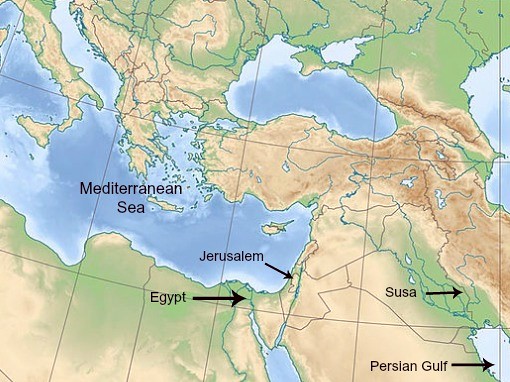
 She will give birth to a son, and they will call him Immanuel, which means “God is with us.”


 To me nature-happenings are a sort of message from God. He says, “Slow down. Take notice. Isn’t what I’ve created intricate and amazing? I created you too. Oh, what a beautiful job I did! Do you see that little bird? The one perched outside your window? I care about him. I care about you!”
 Remember when we in non-COVID times we’d spruce up our wreaths at church? Not happening this year! Bring it out of storage anyhow! It will work just as well. Replace the candles. Don’t worry about what color they are! Things are different this year!
 OR, have your kids assemble a paper chain with 24 links.



 On-going Christian education (not just for the kids!)

 Samuel, don’t think Eliab is the one just because he’s tall and handsome. He isn’t the one I’ve chosen. People judge others by what they look like, but I judge people by what is in their hearts.
  Family Faith Companion