Daniel and the lions – a story told with pictures

We’ve just finished our Rotation on Daniel and the lions. Show this post to your kids. Can they tell you the story? Discuss the questions too. Enjoy!

The other administrators in King Darius' court, ponder what to do about DanielDaniel seemed to pray a lot; what sort of strength did prayer give him?

Why do you suppose the king’s other administrators were jealous of Daniel?

When have you done something that you’ve been proud of, but it made someone else jealous?
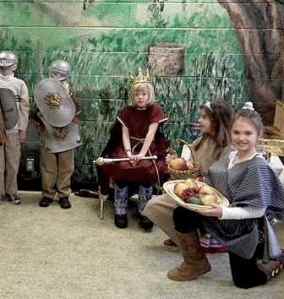
 
King Darius thinks about a new lawWhat do the other administrators decide will be the only way they can trap Daniel?

How do they persuade the king to accept their idea?

If you were Daniel, how would you have reacted when you heard about the law?

 
Daniel is caught praying!We knew this would happen! Daniel did too. Why do you suppose he prayed in front of an open window where he was sure to be caught?

Why do you suppose he was willing to risk his life to continue praying to God?

When is a time that you’ve had to stick up for your belief? What happened?

 
King Darius finds out about what he's done to DanielHow did the king feel when he found out that Daniel would have to be sent to the lions’ den?

Do you suppose some of Daniel’s faith in God had rubbed off on the king? (Read Daniel 6:16)

 
Daniel is thrown into the den of lionsDo you suppose that in the lions’ den Daniel asked God to get him out, or to get rid of the lions?

But that wasn’t what God did! What happened to the lions?

Does God always answer our prayers in the way we’d like?


God saved Daniel!
God saved Daniel!

-------


Photo credits:
Photos by Evans Koukios. Used by permission.

A Family Dinner “Game”

A way to talk about faith with your kids is to make family dinner a priority.

But don’t just eat. Play games.

That’s right. To extend your time together as a family, add a “game” to the end of your meal. Here’s a game suggestion that ties to our current Rotation on Daniel and the lions. Make the story come alive! Tell the story dramatically, involving everyone at the table. All you need is a Bible.

Find Daniel 6:3-23. (If you want an easy to read version click here.) One person can be the story teller and everyone else… the characters in the story. To make it easy, there doesn’t have to just be one Daniel and one king – everyone can be Daniel and everyone can be the king. And everyone gets to be lions!

Daniel In the Lions

The reader can create voices for the different story characters. How would the bad guys sound? Sort of whispery? (You do this when reading regular books to your kids; why not apply it to reading the Bible.)

For example, in verse 11 it says…
'
Some of the other royal officials went to where Daniel was staying. They saw him praying and asking God for help.

Ask your family to pretend to be the bad guys. How would they act when they discovered they’d trapped Daniel! Encourage everyone to use their body to tell the story. (The bad guys were probably giving each other high-fives. Yes! We caught him in the act!)

Perhaps she is a lion?
How did Daniel look when he was praying? How did the king react when he heard what he’d done to Daniel? How did the lions look before Daniel was thrown into their den? How did they look when Daniel was among them? (Mouths closed!)

Finish up your “game” with a prayer. (It’s what Daniel probably did.)

-------


Photo credits:
Daniel with lions a photo of a painting by Robert Edward Weaver (c. 1952), is licensed under Creative Commons CC BY-SA 3.0, via Wikimedia Commons.
Kid being a lion by Nathan, who licensed this photo on Flickr under a Creative Commons CC BY 2.0 License.

Look! The Lamb of God!

Asking questions is good. Encourage the asking of questions, even if you don’t know the answers!

A faith that quits questioning, quits growing.

+++++—Rev. J. Douglas Paterson in his “What If” sermon series
+++++“What If Having Questions Were More Important Than Having
+++++ Answers?” (2/6/11)

Here are a couple of questions… but first a bit of background. Our story about John the Baptist is found in all four Gospels. The Gospel according to John (a different John than John the Baptist) includes a picture metaphor.

One day John the Baptist saw Jesus coming toward him and yelled out, “Look, the Lamb of God.” (John 1:36)

Lambs

So if having questions is a way to grow…

Why did John the Baptist call Jesus “the Lamb of God”?

In Jesus’ time, lambs were offered (twice a day) as a sacrifice for people’s sins. An animal’s life — to pay the penalty for sin. Calling Jesus the “Lamb of God” meant that Jesus would take the place of a lamb; Jesus would die to take away our sins.

How did John the Baptist recognize that Jesus was the Messiah?

Wonder together! What questions have your kids asked about this story?


Photo credits: Click here for info on banner photo (not visible in readers or email).
Lambs by A. Roger Davies, who licensed this photo on Flickr under a Creative Commons License.

Dinner table conversation?

“atA little while back I’d suggested that a way to talk about faith with your kids was to make family dinner a priority. (Click on “family dinner” to read that post.)

Sometimes getting conversation going at the table can be tough, especially for older kids. Here’s an idea:

Before dinner glance at this brief post from “HuffPost Family Dinner Downloads.”

HuffPost? What’s that?

In the words of the editors…

'Every Friday afternoon, just in time for dinner, our editors highlight one of the most compelling news stories of the week — stories that will spark a lively discussion among the whole family.

This particular HuffPost Family Dinner Download happens to be about eating healthy and about one particular retailer (amazingly enough) agreeing to help with that effort especially for folks with limited incomes. Lots of room for various discussion – there are even questions provided to spark conversation!

But where is “faith” in this discussion?

Glad you asked? To tie your discussion to our current Rotation at at FUMC, bring up the question: What did John the Baptist eat?

The answer: locusts and wild honey! (Matthew 3:4) Yum?

Here are some other questions to discuss:

  • Do you suppose people thought John was strange? Why do you think that?
  • Do you suppose that his strange diet (and his strange clothes) were what drew people to him?
  • Oh, so why else did they want to listen to what John the Baptist had to say? And what was it he was saying/doing?
  • John the Baptist baptized with water. What are some ways water gives and sustains life in the world?
  • Why is water a symbol of what God does for us at baptism?

If your children have been baptized, tell them about it. If they haven’t been baptized, discuss baptisms they’ve seen. Enjoy your family dinner!

-------


Photo credits:
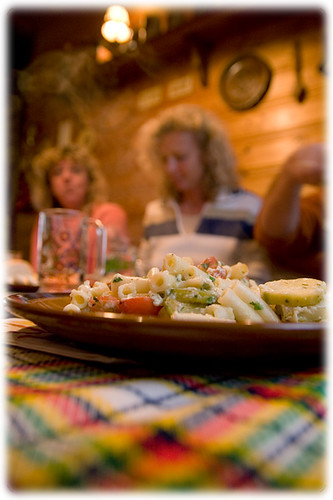
Dinner table photo by vizzzual-dot-com, who licensed this photo on Flickr under a Creative Commons License.

John the Baptist preached prepare! Any preparation for us?

A camelJohn the Baptist was an odd character. He lived in the wilderness (in the desert valley of the Jordan River, north of Jerusalem), wore wilderness clothes (camel’s hair) and ate wilderness food (locusts). Even though he led a strange life-style, people still flocked to hear him, which was good, because John had an important, God-appointed job…
A locust

To get people ready!

In between munching on locusts dipped in honey (was that for added flavor?) John told people to “Repent, for the kingdom of heaven has come near” Matthew 3:2. Hundreds of years earlier the Prophet Isaiah had predicted, “Someone is shouting: Clear a path in the desert! Make a straight road for the LORD our God” (Isaiah 40:3). That someone was John the Baptist, making straight roads for God.

The phrase “making straight roads” has an interesting background. When a king planned to tour his dominion, a crew would be sent out ahead to fill in any potholes and knock down any hills in the way! Nothing will impede the way of the king!

John’s make-way, readiness call was referring to peoples behavior. They needed to change their thoughts and actions and return to following God. “He went into all the country around the Jordan, preaching a baptism of repentance for the forgiveness of sins” (Luke 3:3). Repentance can mean to feel sorry for our choices. But John the Baptist wanted people to do more than just apologize for sins; he was also asking them to prepare their hearts for the Lord.

What about us?

Do our hearts need preparation? Jesus is always seeking us out; wanting to have a close, personal relationship with us. He needs our hearts and minds ready to accept that relationship!

What do we need to do to welcome God into our hearts? Discuss these ideas with your family.

  • We think of prayer as talking to God, but it’s also about listening. What are ways to help us quiet ourselves as we prepare to listen for God?
  • Do we feel as though we need to be in a certain location? What would be a small way to recreate that location at home?
  • What can distract us from God? How about TV or sports or sleeping in on Sunday mornings? What will help us remove those distractions?
  • What about “boulders” in the way? Is there some other way we feel we should be spending our time? Is there some past experience that keeps you from letting God in?
  • Can what we expect of God be a hinderance? What are your expectations of God? Perhaps what is needed is to get to know God better?

What are your thoughts on preparing the way for God?
Share them by commenting below. (There’s nothing to join and your email won’t be shown!)


Photo credits (all from Flickr): Banner photo (not visible in readers or email) by Pink Sherbert Photography. Camel by xikita. Locust by Peter Rowley.All licensed under: Attribution-Noncommercial-Share Alike 2.0 Generic

How to find time to talk about faith?

A dinner place setting

Talking about faith at home is important for your family, but how do you find the time to work this into your busy schedule?

Make family dinner a priority

Here’s a book to help achieve this goal: The Family Dinner: Great Ways to Connect with Your Kids, One Meal at a Time by Laurie David.

The cover of the book: The Family Dinner

Ann Arbor District Library has this book.
See if it is available!

Paraphrased from the book, here are some “rules” (they call them “simple steps”) that you can implement:

  • Everyone comes to the table, even if they aren’t hungry.
  • No electronics: No TV. No phones. No texting. (This applies to adults as well!)
  • Everyone stays at the table until dinner is over.
  • Everyone tries one bite of each food.
  • Everyone helps clean up.

Another thing they suggest is to play games at the table! (Either while eating or afterwards.) Check out some suggested “dinner table games.” (Clicking on the underlined words takes you to the most recent post in the category “dinner games.” Scroll down to see other options.)

This all sounds hard! Something may have to give in order for this to happen. But it’s important, isn’t it?

How about making it a New Year’s an any time of year Resolution?

-------


Photo credits:
Table setting by Gisela Francisco on Flickr, who licensed this photo under: Creative Commons Attribution-Noncommercial-Share Alike 2.0 Generic.
Other photo – from my archives. (I took a picture of this book when I had it checked out from the library!)

Jesus’ Birth: Mary’s story

A banner for Christmas - Mary and Joseph and baby Jesus
Have you ever noticed how two people can both experience the same event and come away with different memories? It’s the same story, but different perspectives. It can actually enrich the story! Thus, every year our Advent Rotation for our Cool Disciples (our 1st – 6th graders at FUMC in Ann Arbor, MI) takes a different focus.

Last year in December the story of Jesus’ birth was told through the eyes of Isaiah. (That’s right, Isaiah from the Old Testament; 700 years before Jesus was born!) There was the year when our story was from the perspective of the wise men. Previous to that it was the shepherds and angels. This year Mary, Jesus’ mother, takes center stage.

Who was Mary?

She was likely poor and lived in Galilee, a region of the Roman Empire, in a town called Nazareth. We are also told that Mary was “engaged to Joseph” which means she could have been a young teenager; as young as 12 years old, as this is the age at which young women were eligible for “betrothal.” God chose a poor, young girl for an important job! And what a rather unexpected job… to become the mother of Jesus!

Here are some questions to discuss…

+++++for the first part of our story (in Luke 1:26-38):

  • When Mary first saw the angel how do you suppose she felt? Was she scared, surprised or just nonchalant?
  • How did Mary react to the news that she would have a baby boy, name him Jesus, and that he would be our Savior?
  • I wonder why God would choose such a young woman to be Jesus’ mother?
  • If God asked you to do something that would be very challenging, do you suppose that you would say as Mary did, “I am the Lord’s servant; may it happen to me as you have said?” (Luke 1:38)
  • Tell about a time when you felt called by God to do something you weren’t sure about doing; were you afraid and had questions but then ready to accept God’s plan?

May you enjoy pondering these “talk time” questions as you nurture and support one another in your faith journeys!

Four Friends: Family Talk Time… and an activity!

Here’s an activity to do with your family, and questions to discuss, about our current Rotation on four friends who bring a lame man to Jesus.

Make cups of hot cocoa but leave out the sugar. Don’t say anything about your omission but allow everyone a chance to sample their cocoa.

Ask: What do you suppose is missing?
I am wondering if cocoa without sugar is sort of like our lives without Jesus?
I wonder what our lives would be like without Jesus’ love?

Pass around a sugar bowl and allow everyone to stir in to their cup, perhaps two tablespoons of sugar. After everyone has tasted their adjusted cocoa…
Ask: How does it taste now?

a boy shows his approval over hot cocoa

Ask: I wonder how adding sugar to your cocoa, is like adding Jesus’ love to your life?
How does having Jesus as your friend make life sweeter?
Say: Let’s read about a time when a man who was paralyzed (he couldn’t walk) had a sweetened life because he met Jesus.

Read Mark 2:1-12. Alternately, ask your kids to help you tell the story. Check the Bible for accuracy.

Ask: Would the man likely have been able to see Jesus without his friends help?
How has someone helped you recently and made your life sweeter?
What are ways that our helping other people is like bringing them to Jesus?
Are there other ways that we can “bring” people to Jesus by helping them?

Say: Those four friends had a lot of faith in Jesus. Jesus wants us to use our own faith to help spread Jesus’ sweet love.

-------


Photo credits:
Wonderful cocoa by woodleywonderworks on Flickr, licensed under: Attribution-Noncommercial-Share Alike 2.0 Generic