Cool Disciples Schedule: July 2011

During the heat of summer our Cool Disciples continue to explore Bible stories on Sunday mornings! Our teaching tool is the fun (yet transformational) Workshop Rotation Model Sunday’s School Cool. Summer is a bit different in that we combine grade groups. This summer we’ve also got more changes – a different choice for older students. Read more about that choice here.

For three weeks of July, we are learning about a time when some children had an exclusive audience with Jesus! Read the story in Mark 10:13-16. This story entails Jesus allowing children to come to him for a blessing.

A stain glass rendition of Jesus blessing the children

What is a blessing? Most of us when we hear the word “blessing” think of a table grace we say before we eat, as in “saying our blessings.” That is one use of the word blessing. A blessing also means a special prayer given to someone, which makes them feel good. We could say that it is a special prayer for the good of a person!

What is the blessing that Jesus desires for you?
How does it make you feel to know how much Jesus loves children and wants to bless them?

Here is the way we’ll be exploring this story for the next three weeks…

Date Workshop Activity
7/10 Art Workshop Decorate a mirror picture frame as a reminder that God loves you.
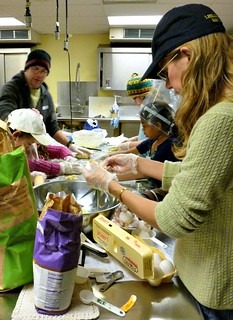
7/17 Cooking Workshop Being blessed also includes the empowerment of being a blessing to others. Make something to share at Lemonade on the Lawn.
7/24 Games Workshop Set up and go through an obstacle course with a different-sort of name: the “Don’t Let Anything Keep You From Jesus” obstacle course.


If you are in the area please join us for the fun learning at First United Methodist Church in Ann Arbor, MI


Photo credits: Click here for info on banner photo (not visible in readers or email).
Stain glass by Janine and Jim Eden who licensed this photo under: Creative Commons Attribution-Noncommercial-Share Alike 2.0 Generic.

Practicing Gratitude

When someone gives you a gift, what is the standard, considered-good-manners, expected response?

(Everyone say it all together…)

Thank You!

Unfortunately, kids aren’t born knowing how to be thankful.

Now, I know. You are well-aware of your parental requirement to teach your children manners. (Please, thank you, you’re welcome, and the rest).

How about training them to have a grateful heart?

A thankful heart shown in chalk

Need an ingress to this topic? Our June Rotation offers an appropriate Bible story. We’ve been studying the “Widow’s Offering” from Mark 12:41-44.

We’ve already learned that gifts given to God are called offerings. Our offerings can be time, talents, or money.

We’ve also learned that the woman in our story could have given everything she owned (two, small coins!) out of trust that God would provide for her needs.

What about the possibility that the poor widow gave because she was grateful?


For the widow in our story, it probably wasn’t her first time giving an offering. She was likely in the habit.

Perhaps we need to practice being thankful.

Here are some ways…

  • Set up a place for praises. In a noticeable location, place a stack of papers and a pen near a basket or a bowl. (Or post a list on the refridge; or give everyone their own journal.) Encourage everyone to draw or write about things that make them grateful. Once a week ponder your collection.
  • Write notes to your family (the lunch box, posted on the car dash, on the mirror, saying, “Right now, what are you thankful to God for?” Expect a report at the dinner table.
  • While driving around town allow a certain happenstance (every dog seen or every blue car) to spark the announcement of a grateful.
  • Use this mealtime grace: Thank you for the world so sweet. Thank you for the food we eat. Thank you for the birds that sing. Thank you, God, for everything. Follow it up with everyone naming a gratitude.
  • Write short thank-you notes to people who might appreciate a little thanks. Folks at church – such as the person who sang a solo, the person who rocked babies in the nursery, or the pastor; in your neighborhood – the person who lets you pick flowers, or always bags your groceries. The possibilities are endless!
What are your ideas for practicing gratitude?

--------------

Photo credit:
Chalk thank you by Judy Merrill-Smith, licensed under a Creative Commons (BY-NC-ND 2.0).

Giving abundantly because we trust in abundance

Kids participating with the Cool Disciples have been learning this month, about giving. They’ve learned how our offerings can be more than a monetary gift; they’ve had two chances to work at it during Sunday’s Cool! One week they helped make decorations that will be used for Vacation Bible Camp in July. Last week they made cookies to share with Alpha House. Each week they’ve listened to the story of a poor widow giving all that she had (in Mark 12:41-44). What was Jesus trying to say about this widow’s extravagant gift?

This woman was giving all that she had out of trust that God would supply all of her needs.

God is good; all the time. This is something we know inherently. But do we live as though we believe it?

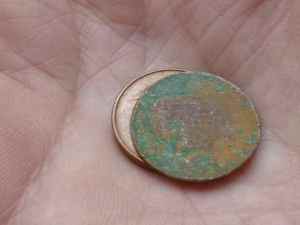
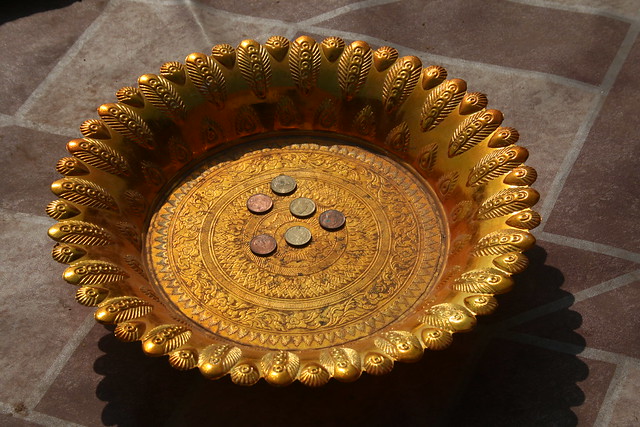
Two coins

How about talking about it with your family! Gather a Bible and a fist full of coins (the more the merrier). First read the story together in Mark 12:41-44. Then gather everyone around the computer and scroll down only far enough to expose a speech bubble and its question.

Time Out. Talk about…A speech bubbleWhy do you suppose Jesus was watching people give their offerings?

No right or wrong answer to this one. Did you know the subject Jesus taught the most about was money? It’s almost as if Jesus were sitting there, waiting for a teachable moment!
Time Out. Talk about…A speech bubbleThe teachable moment arrives when a widow gives her offering. What is a widow?

A widow is a woman whose husband has died. Most women in Jesus’ day didn’t work. Widows had to be taken care of by their family. It is likely that this woman didn’t have anyone to support her as, Jesus seemed to know that she was poor.

Time Out. Talk about…A speech bubble Jesus had watched rich people drop lots of coins into the offering box. (Since all money was coins it would have made a lot of noise going in!) Yet Jesus said that the poor widow had put in more than all the others! How can her gift be larger than what the richer people gave?

Here’s where your coins come into play. It’s probably not a significant pile of cash, but let’s just say: you are rich! Look at all the money you have! You’ve got plenty!

Pick up two coins. Since you are rich do you suppose you would notice if you had two coins less? (Probably not.)

Hold just the two coins and put the other coins away. Now you are poor! You have only two coins! What happens if you give away these two coins?

This is what Jesus meant; the rich people gave a lot because they could afford to do so; they had plenty left over. But the widow gave even though she was poor. She put in everything she had. She gave all she had to live on!

Time Out. Talk about…A speech bubbleIf the widow gave everything, where did she expect her next meal to come from?

The women had the chance to give a gift. She gave all she had, trusting that God would take care of her!

Jesus is not saying we have to give everything we have. He is saying that the amount of the gift isn’t really important but the attitude in which a gift is given is important. Jesus wants us to trust God to provide for our needs! Let me tell you: It’s not easy trusting God like that! But you know what? It makes me giddy when I do and he provides! (Ask me about it.)

When we begin to share abundantly, then we make room in our lives for God to bless us abundantly.

What can help you to live as though you believe in God’s abundance?

— Carol


Photo credits: Click here for info on banner photo (not visible in readers or email).
Other photo: from my archives.

Time, talent or treasures

It’s a familiar part of the worship service.

collection plate

The Giving of Our Tithes and Gifts to God

Also known as “the Offering” or “the Collection.” At FUMC there is beautiful music to accompany this portion of worship. In the summer time it’s usually a soloist (or two or three) contributing their symphonious instrumental sounds. And hey! They are giving a gift to God!

That’s the point of our Rotation this month about the Widow’s Offering – to define an “offering” as gifts given to God and to discover that offerings can be time, talents, or money.

Ready for some family discussion about our story?

Gather kids around the computer and scroll down only far enough to expose a speech bubble and its question…

Time Out. Talk about…A speech bubbleWhat happens in this story?

Read together Mark 12:41-44.
Did you catch all of the details? It’s a short story isn’t it!

Time Out. Talk about…A speech bubbleWhat was Jesus doing?

Jesus was sitting in the Temple, the place where Jewish people came to worship. He was watching people give their offerings.

Time Out. Talk about…A speech bubbleWhat is an offering?

Offerings are gifts to God. Right off the bat we think of an offering as money; it’s what we put into the plate that gets passed around at church. Money is an important part of what we give in our offerings but our gifts can be more than just money!

Time Out. Talk about…A speech bubbleWhat are other examples of giving gifts to God?

There are many ways that people give gifts to God! An offering can be our time and our talents as well as our money. In church when we receive the offering, there are musicians or singers who share their gifts with us. The ushers are giving their time and leadership to collect the money we raise for God’s use. Other people oversee the use of the money that is collected. People who are teaching Sunday Cool classes, people singing in the choir, those who take turns in the nursery – all of these people are making a gift of themselves to God!

Of course this is just the start of the list; then there are people who give of themselves outside of the worship service.

kids at work on Appalachia mission trip Youth on Kenya trip Fish Fri

Kids on a Mission trip to Appalachia. Youth on a Kenya Mission trip assisting with the school’s feeding program. Kids & adults in the kitchen during a Fish Fri event.

Time Out. Talk about…A speech bubbleBrainstorm ways that kids can give gifts to God.

For a list of activities where kids can get involved in offering their time see this list for summer 2011. (Updated: sorry, this list is no longer available.)


Photo credits:
Collection plate by rubber bullets, who licensed his/her photos under: Creative Commons Attribution-Noncommercial-Share Alike 2.0 Generic.
Mission trip photos by various FUMC church members, used by permission.

Are you seeing ads? They are not from me! They are placed by WordPress, who otherwise offers a free platform from which to share lots of good-ness. If you see an inappropriate ad, please report it to support@wordpress.com. Include the URL, the date/time the ad appeared, and a screenshot of the ad.

Cool Disciples schedule: June 2011

During the summer our “Cool Disciples” continue to explore Bible stories on Sunday mornings using Rotation Model Sunday’s school. What’s different about summer is that we combine grade groups. This summer we’ve also got more changes – a different choice for older students. Read more about that here.

In June, we are learning about the Widow’s Offering. Read our story in Mark 12:41-44. If you’d like to read a children’s Bible version of this story visit this site.

A Cool Disciples class from last summer.
Last summer’s Cool Disciples

Here is the schedule for the next three weeks…

Date Workshop & Activity Additional Notes
6/12 Missions Workshop: Make decorations for the church to use during Vacation Bible Camp. Wear clothes you’d don’t mind getting sloppy!
6/19 Cooking Workshop: Make sugar cookie “coins” to share with Alpha House. Click here for more info about this homeless shelter for families.
6/26 Art Workshop: Use an embossing technique – repoussé- to create an artistic coin. Repoussé is a method
of decorating metal in which the design is worked from the back of a thin piece of metal; in our case, copper.


If you are in the area please join us for the fun learning at First United Methodist Church in Ann Arbor, MI


Photo credits: Click here for info on banner photo (not visible in readers or email).
Other photo from the archives here.

Holy Week: Holy Saturday (almost there)

We’ve taken a journey through Holy Week, with questions for family discussion. Ready for one more day? It’s Holy Saturday!

Three empty crosses looking forlorn

Time Out. Talk about…A speech bubble Jesus was dead, so what happened on Saturday of Holy Week?

We don’t know for sure but probably not much. Saturday for Jewish people, was the Sabbath; a day of rest. Jesus had been buried in a tomb (a place to put dead bodies; probably a cave) on Friday, before sunset – when the Sabbath started. Working on the Sabbath was forbidden. It was to be a day of downtime and prayer. There was probably a great deal of sadness and mourning among Jesus’ followers, who were afraid and hiding out.

Time Out. Talk about…A speech bubble If the disciples had gone into hiding, who buried Jesus’ body?

If you’re not sure about the answer to this one, how about a little look-it-up-in-the-Bible practice? Find the answer in all four Gospels but how about this one: Luke 23:50-54. (Or you can click on the Bible passage to read an on-line Bible. But don’t you want to show your adults how quickly you can find the Gospels?)

Time Out. Talk about…A speech bubble Wait a minute! The guy who buried Jesus… he was one of the council who had arrested Jesus; the ones who had convinced Pilate to condemn him to death?! What is that about?

That’s right, he was a part of the Sanhedrin. John’s Gospel tells us that another member of the Sanhedrin, Nicodemus, joined in the burial process, both at great risk to their public identity.

Time Out. Talk about…A speech bubble How did only one or two people move the stone to close the tomb? Wasn’t it huge?

Right, this wasn’t your garden-sized stone! Estimates are that it weighed between one-and-one-half to two tons! But it was easy to close the tomb – gravity was employed. The circular stone was in a channel carved with a slight downward pitch towards the tomb’s entrance. (See the photo below.) To close the tomb one would have only had to remove a wedge that held the stone in place; it would then roll closed. Opening the tomb would have been another story!

A Jerusalem tomb showing how the stone would have been placed
Not Jesus' tomb, just an example. Note: the box is a step into the tomb. Notice the channel for the stone.

Time Out. Talk about…A speech bubble (No right or wrong answers here!)

  • Whom do you relate to: Joseph of Arimathea – willing to be a secret disciple, or the followers of Jesus in hiding?
  • Do you suppose the disciples in their grief wondered about the words of Jesus with regards to being killed and rising after three days? (For a couple of examples check out Mark 8:31, Mark 10:32-34, or John 2:19).

Thanks for joining us on our Holy Week series.

--------------

Holy Week: What is good about Good Friday?

How about some more family discussion on our journey through our series on Holy Week? Even though this day was full of sadness.

Remember: scroll down just until you see a “Time Out. Talk About…” question. Read the question with your group and allow everyone to share their answers. Scroll some more to see the answer. A good reason for computer time!
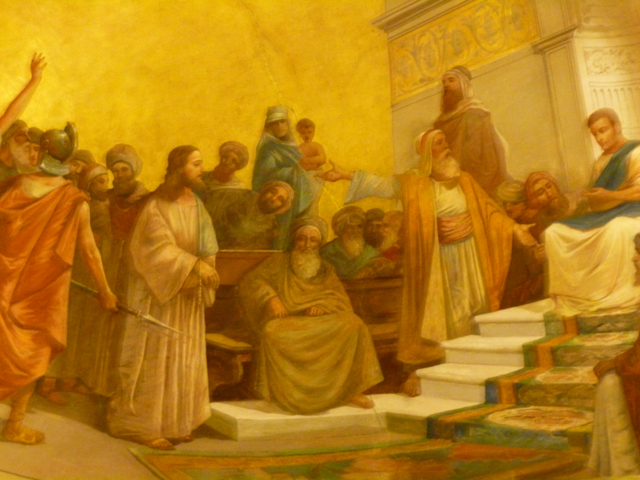
The judgment of Jesus

Time Out. Talk about…A speech bubble Why do you suppose it’s called “Good Friday?” What can be good about the day Jesus died?

an empty crossActually there is no known correct answer to this question. The Friday before Easter being called “Good Friday” could have come from the shortening of an English phrase “God’s Friday” much like the word, “good-bye” originally started off as “God be with you.”

It certainly wasn’t a good day for the followers of Jesus back when it actually happened; they had to watch him be killed.

We can call it “good” because we can look back on the day Jesus died, from our perspective of knowing what happened on Easter!

But we are getting ahead of ourselves; there are still the events that happened on Friday of the very first Holy Week. When we left off yesterday, Jesus was in the Garden of Gethsemane

Time Out. Talk about…A speech bubble Jesus was arrested in the garden, but what happened next?

Jesus had a long night. (It was late at night when he was arrested). He went through a series of trials, was beaten, whipped, spit upon, treated badly, and sentenced to die on a cross—a humiliating and cruel form of torture and execution.

Time Out. Talk about…A speech bubble But why were the people who had Jesus arrested so determined to kill him?

The simple answer: Fear. (Unfortunately fear can result in hatred.) The Sanhedrin had ordered Jesus’ arrest. The Sanhedrin was a very powerful Jewish court made up of religious leaders. They were threatened by Jesus, his message and his popularity. The gospels portray the Sanhedrin as a group most interested in preserving their own power and position.

Time Out. Talk about…A speech bubble What was it that happened with the man named Barabbas? (To hear how Barabbas is pronounced, go here.)

It was the practice at Passover to let one prisoner go free. Pilate (the Roman governor) offered to release Jesus, but the crowd demanded instead the release of Barabbas, a known robber and murderer. The gospels make it clear that Pilate did not believe that Jesus was guilty. But the crowd yelled, “Crucify him.” Pilate eventually succumbed to the will of the crowd and ordered Jesus to be whipped and then to be crucified.

Time Out. Talk about…A speech bubble What does crucified mean?

Jesus was killed by a process called “crucifixion;” we say he was “crucified.” This is where a person is either hung on a cross or nailed to a cross (the latter in Jesus’ case). It was a horrible way to die. (Thank goodness we don’t do that anymore!)

Time Out. Talk about…A speech bubble (No right or wrong answers here!)

  • Have you ever been accused of something that you didn’t do? What happened?
  • When have you seen or heard about an instance of hatred that probably stemmed from fear?
  • When have you given in to the pressure of what the “crowd” wanted to do? How did you feel about this?
  • What do you suppose happened to Barabbas? (The Bible doesn’t tell us.)

Stay tuned for the next installment of our series on Holy Week.


Photo credits:
Photos are from my archives. The painting of the Judgment of Jesus was taken in Corfu, Greece. Unfortunately I failed to note the artist.
Speech bubbles via WPClipart.com, in the public domain.