Yikes. Mistakes! (Yet Grace abounds.)

The characters in our current Rotation story on Jacob and Esau, are just like us:

Not perfect.

I am glad that the Bible includes stories of less than stellar personalities and people who flub-up big time. It makes it easier for all of us to relate to them. We can look at these characters and see reflections of ourselves. a child looking in a mirror sees a reflection

And (hopefully) learn something! How about this: Isn’t it great to know that God always loves us, no matter what; even when we screw up!

In spite of our mistakes, God doesn’t turn away.
He continues to seek a presence in our lives.

That’s the point this story makes!
So how do we talk about this with our kids?a speech bubble

Here’s an idea: There are lots of mistakes happening in this story, so use mistakes as a jumping-off point for some discussion at the family dinner table. Or wherever your family is gathered together. (If you’d like to print out this discussion guide, click here.)

Here’s how it could go: Start off by describing a mistake that you made recently.

For me it was a recent spelling mistake that I should have caught, but I hit “Reply” too quickly. Oh, and then there was speaking too quickly, and saying what I shouldn’t have said. Ouch. You get the point.

Now, ask your kids what mistakes they’ve made. (Accept all replies.)

Then ask what mistakes are made in the story of Jacob and Esau?

Pull out a Bible and re-read Genesis 25:29-34. (Or ask older kids- readers, to look for mistakes.) Then, ask some questions…

  • Do you suppose Esau made a mistake in selling his birthright for a bowl of stew?
  • What is a birthright?

In Bible times the oldest son received special privileges that were seen as very valuable; this was called a “birthright.” If there were two sons, when it came time to divide up everything, the older son would receive two portions and the second son, one. The oldest would become the “head of household” and the family spiritual leader.

Ask more questions…

  • Who was born first in our story? (Genesis 25:25, Esau)
  • But what was it that God had told their mother, Rebekah, about these twins before they were born? (If necessary, read Genesis 25:22-23.)

The younger one will be greater! This is strange because, as the birthright says, usually the firstborn is the greater. But here God is telling Rebekah that her 2nd born son (Jacob) would have the special honor of eventually being head of the family. That’s different!

  • Do you suppose that Rebekah had told her family this story?

Look for more mistakes in Genesis 27:1-38.

  • What mistakes have been made?
  • Jacob and his mom have created a big lie! Why do you suppose they did this?
  • But didn’t they remember what God had said (in Genesis 25:22-23)?
  • What do you suppose God thinks of what they’ve done? Does he still like/love Jacob?
  • What happens next? (If necessary read Genesis 27:41-43 – Jacob runs away from Esau.)
  • Would you call this a “blessing” for Jacob? (no, he had to leave his family behind!)
  • But then what happens when Jacob is running away? (If necessary read Genesis 28:10-22 – God shows himself to Jacob and promises to be with him.)
  • Jacob had made a mess, but God still wanted to work with him! Do you suppose God will do this for us?
  • God keeps on working in all of our lives despite the messes we cause! God is a loving and forgiving God!

    Close with a short prayer. A suggestion: Lord, surely you are in this place; with us always. Help us to be aware of your forgiveness and to remember that you love us. Amen.


Photo credits: Click here for info on banner photo (not visible in readers or email).
Reflection by Margaret W. Carruthers, who licensed this photo on Flickr under a Creative Commons License.

Teaching kids about worship: let them participate!

This Sunday at FUMC in Ann Arbor, MI, the kids will be participating in worship. What a great way to teach them about worship – by involving them in the service; by asking them to help lead! If your child is not taking an active part this Sunday, here are some ways to help them to get more out of the service.

  • The theme for this Sunday is: “Jesus, My Friend.” Spend some time talking about friends. Is being someone’s friend, hard work? What does it take to be a good friend?the facebook like button Does it ever involve doing something you maybe don’t like doing? Relay a story from your past friendships.
  • Talk about Jesus as being your friend. Is it easy being friends with Jesus? What if someone snubbed you or put you down, because you liked Jesus? Would you still want to be friends with Jesus then?
  • Read the scripture together that will be used in the service: Mark 10:35-45. To make it easier to understand, read it in The Message.
  • Talk about the sermon title: “James and John: Let’s ‘Like’ Jesus!” Wonder together about how Pastor Bob will develop his sermon. According to this weeks “Thursday Thoughts, we’ll be asked to speculate on whether being friends with Jesus is as easy as clicking “Like.”
  • Practice prayer. Include all of those who will be helping lead us in worship, in your prayers.
  • Practice singing some hymns. We’ll be using “Jesus Loves Me,” “What a Friend We Have in Jesus,” and “I Want Jesus to Walk with Me.” Below are some videos from YouTube that include the lyrics with the songs.

Ask your kids after the service if your preparation helped them to worship. (Report back okay?)


Photo credits:
Click here for info on banner photo (not visible in readers or email).
“Like” button by Sean MacEntee, who licensed this photo under a Creative Commons License on Flickr.

A long story requires a reading plan

Our Rotation this month is part one from the Old Testament story of Jacob and Esau. (Next month we’ll be covering part two.) A Bible story big enough to be covered over two months warrants a family reading plan! As an added bonus there are questions for discussion at the family dinner table. (Or wherever your family is gathered together.)

Is this required reading?

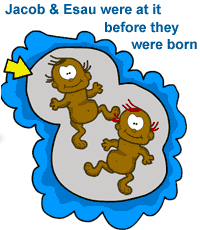
Yes! Let’s call it that! Actually, I’d hope that you are always reading together as a family, the Bible story being taught at FUMC. But this is especially necessary for a big story; a long story is hard to cover in the short amount of class time on a Saturday night or a Sunday morning. Jacob & Esau fighting in the womb

Besides, this story is intriguing! It’s got interesting characters, twin brothers in conflict, a hasty swap, scheming, disguises, and trickery. Oh, and it ends (for this month) on a cliffhanger. (What will happen to Jacob??) Consider this an excuse to start a faith dialogue in your family!

(If you’d like to print out this reading plan & discussion guide, click here.)

Read Discussion questions
Genesis 25:19-23 Can your child draw out a family tree with the characters in our story?
What sort of questions would you like to ask God?
Genesis 25:24-26 Do you know what your name means? Read the foot notes in the Bible for the twins names. In Bible times names had great meaning. What do you think of Jacob’s name meaning “deceiver?”
Genesis 25:27-28 Do you suppose that Isaac and Rebekah were wrong to have favorites?
What sort of trouble did this lead to?
Genesis 25:29-33 Have you ever been so hungry that you would trade something valuable just to be able to eat?
Have you ever taken advantage of a family member who was vulnerable in some way?
Is forgiveness necessary?
Genesis 25:34 What were the rights of the firstborn son?
(Ans: He would inherit a larger amount of property and would be leader of the family.)
Why do you suppose Esau didn’t seem to care about his birthright?
Genesis 27:1-4 We typically equate “blessing” with approval (example: I approve of your choice of a university to attend). In Bible times a blessing was very important and held great promise. How do you suppose it would have felt to have been “blessed” in such a manner?
Genesis 27:5-13 What is Rebekah suggesting?
What do you think of Jacob’s response? (Doesn’t protest too hardily!)
Why do you suppose this story (about deceit!) is in the Bible?
Genesis 27:14-17 Review what God told Rebekah about her sons – Genesis 25:23. Why do you suppose she felt as though she had to act in order for God’s plan to happen? When have you felt it necessary to be in charge?
Genesis 27:18-24 Do you get the feeling that Isaac knows he’s being tricked? Why do you suppose he plays along?
Genesis 27:25-29 Do you suppose that God approves of these actions? What does this story teach us about the power of words? Whom can you bless with your words?
Genesis 27:30-38 How would you feel if you were Esau?
What have you learned from this story?
Genesis 27:41-43 and 28:1-5 Why did Jacob run away?
What does this imply about what he has done?
Have you ever felt like running away?
Genesis 28:10-15 How do you suppose it felt to use a stone as a pillow?
What does the dream mean to you?
Genesis 17:1-8 and 28:12-15 Abram was the grandfather of Jacob. What does it mean that God repeats his promise to Jacob? Review the promises God has made with you! (Ephesians 2:8 & Romans 5:2 are a couple.)
Genesis 28:10-17 As you re-read this passage, consider how amazing it is that, in spite of what Jacob has done, God still offers grace! What does this mean for you?
Genesis 28:18-22 Have you ever been surprised by God’s presence? How have you confirmed a meeting with God?


Photo credits:
Click here for info on banner photo (not visible in readers or email).
Jacob and Esau in the womb, is an image from the Awesome Bible Stories CD, used by permission. (This software is a neat way of expanding Bible learning at home. Discover more titles here.)

A great big party, all around the table!

This Sunday is World Communion Sunday.
You might ask: What does that mean for my family?

Answer: It gives you an excuse to talk about what will take place at worship…

Christians from all around the globe…

Approaching the table…
Speaking different languages…
Wearing different styles of clothing…
to eat bread and drink from the cup…
To remember Jesus.

It’s a world-wide celebration!

But how do you talk about Communion?

A way to start is to relate Communion to things that your child already understands: compare Communion to a recent special family banquet. Try this:

At your family feast… At Communion…
Everyone was gathered together. Communion is also like a family meal. Christians participating in Communion, from all around the world, are all members of Christ’s family
We told “remember when” stories. Jesus told his followers at their last meal together to “Do this to remember me.” Communion is a way to remember how Jesus died for us. In his death our sins (anything that separates us from God) are forgiven!
Because everyone was there, we felt thankful. Communion fills us with thanksgiving, Jesus’ death – and his resurrection – offer us to chance to be God’s friends forever!
Yum, yum. We filled up on good grub. By participating in Communion we are nourished in a different way – we can feel empowered to do God’s work in the world.

Your family might also be interested in a special Communion class this Sunday. It is geared toward kids K-6th and their parents/guardians, and is designed to prepare kids to participate in the sacrament of Communion. After the “Time with Children,” families may go to the Wesley Lounge to learn about Communion and the basics of how we do it. (And to practice!) After the class, families will return to the sanctuary in time for Communion with the rest of the congregation.

If you are in the area please join us at 9:30 this Sunday at First United Methodist Church in Ann Arbor, MI.


Photo credits:
Globe-gazing by eren {sea+prairie), who licensed this photo on Flickr under a Creative Commons License.

Are you seeing ads? They are not from me! They are placed by WordPress, who otherwise offers a free platform from which to share lots of good-ness. If you see an inappropriate ad, please report it to support@wordpress.com. Include the URL, the date/time the ad appeared, and a screenshot of the ad.

Cool Disciples Schedule: October 2012

Welcome! This is the spot to find encouragement for growing faith in your family. You can do it! Easily read future posts (usually one a week) by subscribing over on the right. Enter your e-mail address to have posts sent directly to your inbox. Or click on the orange RSS icon to subscribe in a reader. Thanks for visiting.

On Saturday nights and on Sunday mornings at FUMC our “Sunday’s Cool” is a different sort of Christian education. We are a Workshop Rotation Model church. That means kids spend a month learning a particular Bible story, each week encountering a different kid-friendly multimedia workshop. In October we are starting a big story: Jacob and Esau. This is such a long story that we’ll be breaking it into two parts. (Part two will be in November.) Read part one in Genesis 25:19-34, 27:1-37, and 27:41-43.

For Sundays at the downtown location, here is the schedule of workshops for the end of September and for October…

Date Art Drama Puppets Games Cooking Video
Room 212 Room 215 Room 204 Room 211 Social Hall Pine Room
9/30 1st grade 5th grade 3rd grade 6th grade 4th grade 2nd grade
10/7 Worship and Communion with your family
10/14 2nd grade 4th grade 1st grade 5th grade 6th grade 3rd grade*
10/21 Attend worship: kids will help us to worship!
10/28 3rd grade 6th grade 2nd grade 4th grade 5th grade 1st grade

* On the 14th the 3rd graders will be having a special class on using their Bibles. Parents/guardians are encouraged to attend.

What’s happening in each workshop?

  • In the Art Workshop students will work cooperatively to create construction paper mosaics illustrating the story of Jacob and Esau. The mosaics will focus on characters and story sequence.
  • In the Cooking Workshop students will explore why Esau traded his birthright for a bowl of lentil stew, and in the process create and taste “some of that red stew.”
  • In the Drama Workshop students will enact the story and learn what happened when one brother tricked the other.
  • In the Games Workshop students will participate in a game of “Bible Baseball” – with the rules changing as the students play! What’s up with that?!
  • In the Puppet Workshop a puppet storytelling kit will be created and used to tell the story. Encourage your child to use their kit to tell the story at home.
  • In the Video Workshop students will watch portions of the video The Lion King, and explore what happens when we do things our way.

For Saturdays at the Green Wood location, here is the schedule for October. (For September 29th refer here.)

Date Workshop
10/6 Puppets Workshop
10/13 Drama Workshop
10/20 No Workshop. Worship with your family.
10/27 Video Workshop


If you are in the area please join us for the fun learning at First United Methodist Church in Ann Arbor, MI


Photo credit: Click here for info on banner photo (not visible in readers or email).

A changed way of thinking

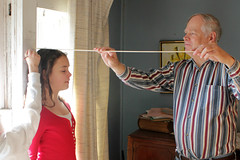
Have your kids grown taller in the last year?

measuring to see how much a child has grown taller

Ask your kids what other ways they have changed recently.

  • Gotten better at math facts perhaps?
  • Become more proficient at playing an instrument or a game?
  • Or possibly changed their mind about something?

Change can be surprising.

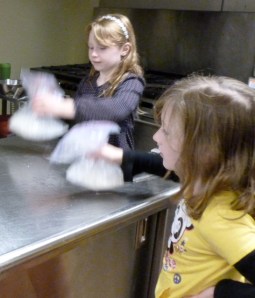
In the Cooking workshop this month, with a little "shaking up," kids have been changing ordinary ingredients into a tasty snack: individual servings of ice cream in a bag! (Actually, a lot of shaking was required.)

Making ice cream in a bag Making ice cream in a bag

Our woman at the well was a bit shaken up by Jesus’ radical way of noticing her/including her/acknowledging her. A change occurred in this woman – an “inside” change as well as an “outside” change. The outside change was obvious: She was able to over-look judgment and went running to tell others about Jesus! (John 4:28-29)

The inside change? Well, we can’t know for sure, but she likely changed the way she felt about herself; the words she used to describe herself. She was no longer a loner, a loser, someone over-looked and to be ignored.

I believe that getting closer to Jesus, changes us inside.

It’s why I write this blog! (Despite my uncertainty and the disparaging words I’ve used in my past to describe myself.)

“Living water” is what Jesus offers us: a close relationship with God – assurance that God loves us, no matter what. Over time, it can change how we describe ourselves. Can you say this?

I am God’s masterpiece!

How does knowing this change you?
Please, pass this knowledge on to your kids!


Photo credits: Click here for info on banner photo (not visible in readers or email).
Measuring by Woodleywonderworks, who licensed this photo on Flickr under a Creative Commons license.

Are you seeing ads? They are not from me! They are placed by WordPress, who otherwise offers a free platform from which to share lots of good-ness. If you see an inappropriate ad, please report it to support@wordpress.com. Include the URL, the date/time the ad appeared, and a screenshot of the ad.

What was Jesus offering? Super water?

It’s obvious. The woman Jesus met at the well is clueless. Jesus has offered her living water and she’s stumped.

You don’t have a rope or a bucket and this well is very deep.
Where would you get this living water?
John 4:11

Let’s imagine what was running through her head…

Living water?
What is he talking about?
He can’t mean water out of this well. He hasn’t got a way of getting anything out of this well!
Does he mean some sort of Super water?
Water that has a special ingredient so that I’ll never need any more water?
That would mean I wouldn’t have to trek to this well every day – and in the hottest part of the day so as to avoid those other women.
Yes, please! I’ll take some of that living water!
Who wouldn’t want some of that?!

Discuss what Jesus meant by “living water. How about playing a game at the family dinner table. (Or wherever your family is gathered together.) Call it “Building answers” or “What’s inside her head?” or some other silly title.

Open a Bible to John 4:4 or have this kid-friendly copy of the story available. Tell everyone that Jesus is surprisingly radical in this story. He has offered this woman something that at first she doesn’t understand; it sounds strange to her. (And perhaps to you too!) It would be fun to pretend that we were inside the head of the woman in this story. What do you suppose she was thinking?

Pretend you are at the well and someone, whom you shouldn’t be talking to, asks you for a drink.
What one sentence comes to mind? You’ll probably need to prime the pump on this, so go ahead and start everyone off with: Whoa! Did that guy just talk to me!?
What is the next thought that comes to your mind? Build upon what has been previously thought/said.

Let’s say the progression goes like this:
First person: Who does he think that he is?
Second person: Doesn’t he know he shouldn’t talk to me?
Third response: Maybe I’ll ask him?

Don’t feel as though this has to be a scripted exchange of ideas. It may get silly! And that’s okay. Just have fun and go with what happens. Eventually turn the responses back to speculations about what they think that “living water” is. Allow all responses.

Here’s a way to finish up your game – Say a prayer:
God, who offers us living water; we accept! Fill us full up! We picture ourselves falling back into a calm pool. The living water lifting us, supporting us; we feel very close to you. We thank you that you love us no matter what! Amen.


Photo credits:
Click here for info on banner photo (not visible in readers or email).
Water Splash by Steve Garner, who licensed this photo on Flickr under a Creative Commons License.
Are you seeing ads? They are not from me! They are placed by WordPress, who otherwise offers a free platform from which to share lots of good-ness. If you see an inappropriate ad, please report it to support@wordpress.com. Include the URL, the date/time the ad appeared, and a screenshot of the ad.

What’s the big deal?

painting by Carl Heinrich Bloch - Woman at the Well

Jesus had asked the Samaritan woman for a drink. This seems like an ordinary request. Then why the incredulous response from the woman?

You are a Jew and I am a Samaritan woman. How can you ask me for a drink?
John 4:9

Why was it so unusual for a Jewish man to talk to a Samaritan woman?

First off, in Jesus’ day, it was radical for a man to be seen talking to a woman. Heck, men didn’t even speak to their wives in public. Not only that, Jews and Samaritans didn’t mingle. Jews wouldn’t even set foot in Samaria! (They traveled the long way around, to avoid passing through Samaria.) I’d say that’s extreme dislike.

A speech bubbleHow to help your child understand how Jews felt about Samaritans?
Ask: Is there food that you really dislike? What would you do to avoid having to eat this food? Push it away on your plate? Leave the table? Leave the house?

A bit of history is needed to understand this animosity. Around 700 years before Jesus was born, Jews were forced into exile (a long way from home) by conquering nations. But some of the people in the area of what later became Samaria, were allowed to stay. They intermarried with people from other nations who were shipped into their land. Fast-forward 70 years when the exiled Jews returned to Jerusalem, they snubbed these people as a “mixed race” and started calling them Samaritans.

And now, that radical Jesus is in Samaria, ignoring cultural restrictions; again.

Why did Jesus feel that he had to go to the avoid-it-at-all costs Samaria (John 4:4)? Because Jesus knew that this woman needed some “living water.”

Jesus knew that this woman was an outsider in her community; why else would she come to the well at noon, the hottest time of the day? Yep. To avoid running into other women. We usually assume this woman was an outcast because of her string of failed relationships (she’d had five husbands). But there is another reason she’d probably had so many husbands: inability to have children. A prime reason in those days, to not be accepted.

A speech bubbleMake sure your child understands the way this woman feels.
Ask: Have you ever felt left out?
(Adult: share a time in your life when you felt like an outcast.)

So… what can this story teach your child?

Sometimes you have to be radical like Jesus.

  • Talk to the person no one will sit with at lunch.
  • Include the loner in your games at recess.
  • Stand up to actions or words that bully another.
  • Offer support to your fellow classmates.
  • Realize that your actions can make you an outsider.
  • Make a plan for how you will deal with rejection.

Encourage your child to go for the living water – the “artesian spring within, gushing fountains of endless life” (John 4:13-14).


Photo credits:
Click here for info on banner photo (not visible in readers or email).
Painting by Carl Heinrich Bloch in the public domain, via Wikimedia Commons.
Speech bubbles from public domain via WPClipart.com.

Are you seeing ads? They are not from me! They are placed by WordPress, who otherwise offers a free platform from which to share lots of good-ness. If you see an inappropriate ad, please report it to support@wordpress.com. Include the URL, the date/time the ad appeared, and a screenshot of the ad.