Cool Disciples Schedule: April 2012

Want a way to easily read future posts (one or two a week)? Over on the right, enter your e-mail address to have posts sent directly to your inbox. Or click on the orange RSS icon to subscribe in a reader. Thanks for visiting. Comments are always welcome.

On Saturday nights and on Sunday mornings at FUMC our Cool Disciples experience Rotation Model Christian education, as they learn about Bible stories and concepts through kid-friendly multimedia workshops.

In April, we are studying Nicodemus. “Nic at night” might be a way to subtitle this one, for Nicodemus visited Jesus in the dark of night. Or was it that Nicodemus himself was “in the dark”? Nicodemus had questions for Jesus.

A painting of Nicodemus visiting Jesus at night

Read about our story in John 3:1-17.

For Saturdays at the Green Wood location, here is the schedule for April…

Date Workshop Activity
4/7 A special workshop Children will sing during the worship service and then will head downstairs for a special lesson on Easter.
4/14 Science Workshop Do experiments to discover the difference between changing on the inside vs. changing on the outside.
4/21 Art Workshop Create an individual banner to help remember “the Gospel in miniature” – John 3:16.
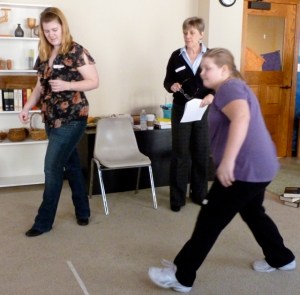
4/28 Games Workshop Play a life-sized board game to review story details.

For Sundays at the downtown location, here is the schedule of workshops…

Date  
4/1 No workshops. Enjoy Palm Sunday worship & Communion as a family.
4/8 No workshops. Enjoy Easter worship as a family.
  Games Newsroom Science Art 2 Puppets/Creative Writing Art 1
Room 211 Room 215 Social Hall Pine Room Room 204 Room 212
4/15 2nd grade 5th grade 3rd grade 6th grade 4th grade 1st grade
4/22 1st grade 4th grade 2nd grade 5th grade 6th grade 3rd grade
4/29 3rd grade 6th grade 1st grade 4th grade 5th grade 2nd grade

What’s happening in each workshop?

  • In the Art Workshop students will create individual banners to remember “the Gospel in miniature” – John 3:16. Two Art workshops will run concurrently.
  • In the Pupptets/Creative Writing Workshop students will explore the mystery behind Nicodemus’ visit. They will discuss questions they might like to ask God and create question books.
  • In the Games Workshop students will play a life-sized board game to learn story details.
  • In the Newsroom Workshop students will create and videotape commercials that sell the desirable qualities of a “New Life.” Watch for videos!
  • In the Science Workshop students will do experiments to discover the difference between changing on the inside vs. changing on the outside.


If you are in the area please join us for the fun learning at First United Methodist Church in Ann Arbor, MI


Photo credits: Click here for info on banner photo (not visible in readers or email).
A painting by Crijn Hendricksz, Christ talking with Nicodemus at night, is in the Public Domain (via Wikimedia Commons).

Learning the language of faith

When my kids were little I had a inkling that we should be discussing God and having faith-talks, but how was I to start? I didn’t remember anything from my childhood Sunday school! What was I suppose to say?

Does talking about faith with your family seem foreign?

Are you in this sort of quandary? If yes, might I recommend a seminar I am co-leading on Saturday, March 24th at the downtown FUMC church. It’s part of a workshop called Building a Better Family. Read more about it here. Register on-line here. One of the sponsors of this workshop is the preschool at our church, FUMCN, however that doesn’t mean that only parents of preschoolers need attend! It applies to all ages!

In the meantime… back to the foreign language of faith… and a motto to adopt as you face this dilemma with courage!

I’ll bet you’ve acquired a host of different “languages” along your life journey; some simple, others complex. Back when I started my first “real” job I had to learn the difference between a frappe and a milkshake. (Yeah, I was a soda jerk.) In college I drank in the language of trees and plants; I could present on the pessimistic prospects of a bushy Euonymus alatus vs. rabbits. (This was in the days before concerns about landscaping with non-natives. This plant, otherwise known as the Burning Bush, is now considered invasive in several states!)

The shrub known as the Burning Bush, in its red fall color

Later, after some soul-searching I changed careers and learned more new languages: communicating with computers. COBOL or Fortran anyone? (I guess I just dated myself).

Has your path been like mine? Acquired any new vernaculars along the way?

Since those days, my lifework has changed… again. I’m pursuing another language. It includes a burning bush… but of a different sort. This language includes words that I am often confused about like Incarnation, Annunciation and Atonement. You too?

When my children were little I’m certain that I didn’t try very hard to speak the language of faith because of uncertainty, and embarrassment and a bit of fear.

I don’t want you to repeat my mistake. So here is a motto to repeat to yourself, over and over:

Stumble if you need to.

Go ahead and make a mistake or two or more. It is a process with rich rewards… learning the language of faith… together as a family.


Photo credits: Click here for info on banner photo (not visible in readers or email).
A horticultural Burning Bush by Jennifer Murawski, who licensed this photo on Flickr under a Creative Commons License.

The Last Supper, with apologies to Leonardo

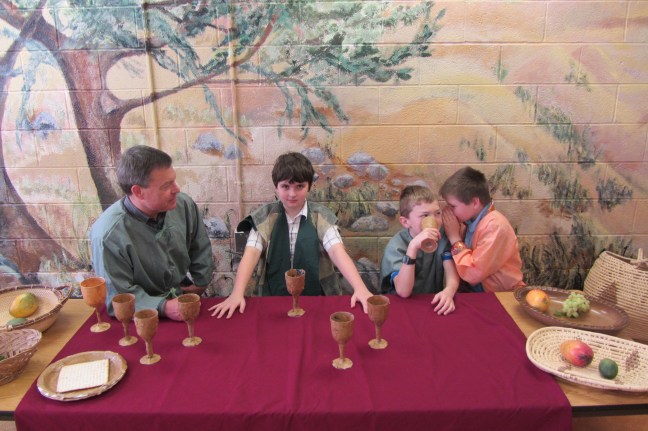
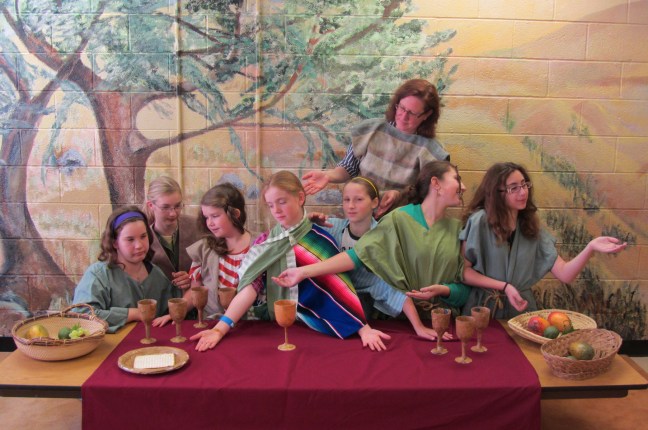
Here it is! The pictures created in our Photography Workshop for our Rotation on The Last Supper. (Just the 4th, 5th and 6th graders visited this workshop.)

The 6th Graders (and their Shepherd) create a tableaux of Leonardo da Vinci’s The Last Supper.

Students start off this workshop talking about what dinner time is typically like in their home, and what is done differently at special times, such as birthdays. Then they review the story about Jesus’ special last meal that he shared with his disciples on the night before he was killed. Something happened at this last supper that makes us still talk about it more than 2000 years later! Jesus gave his followers a way to remember him. Today, we still practice this same ritual!

The 4th graders re-enact Leonardo da Vinci’s painting, The Last Supper
There weren’t very many there that day, but the 4th Grade (plus their Shepherd) create their version of Leonardo’s painting.

What’s the process involved in creating this picture? Students are randomly assigned to portray the participants that were at the first Last Supper. They study art prints (with magnifying glasses!) of Leonardo da Vinci’s painting, The Last Supper. Then it’s into costumes and recreating da Vinci’s painting using a technique called “frozen picture” or tableaux.

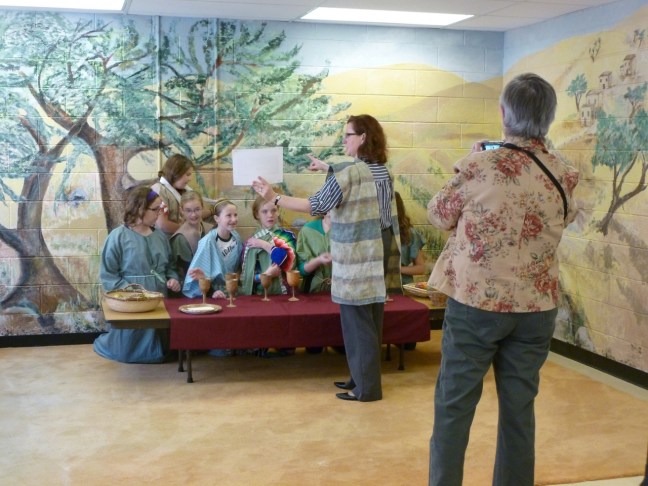
The workshop leader at work with her camera
The Shepherd gets everyone into postion and the Workshop leader snaps a few photos of the 6th graders.

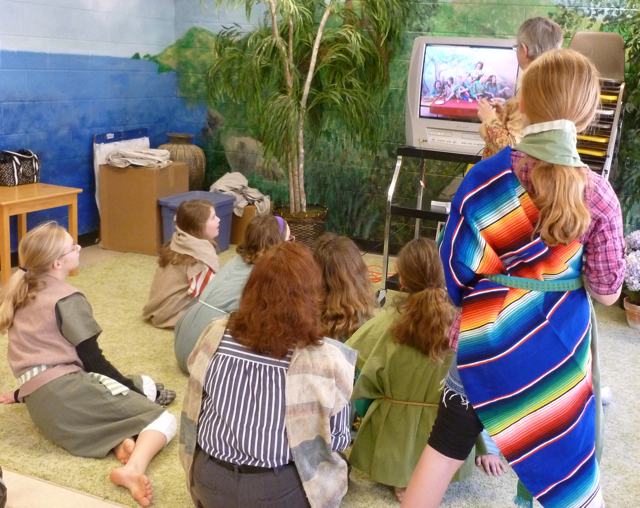
After the photos are shot, the students look at the pictures on a TV screen and choose the best shot. For further learning, the student who portrayed each disciple reads a blurb about that disciple.

students view the resulting pictures on the TV.
Which picture turned out the best?

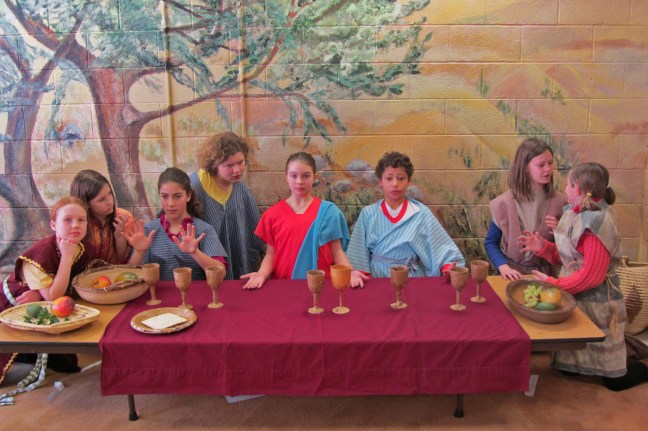
The 5th graders create a tableaux of The Last Supper
And here are the 5th Graders on the week when they visited the Photography workshop.

From notes made by da Vinci we can identify each of the disciples in his painting. From left to right it would have been: 1– Bartholomew, 2–James the Younger, 3–Andrew, 4–Judas, 5–Peter, 6–John, Jesus, 7–Thomas, 8 – James, 9– Phillip, 10–Matthew, 11-Thaddeus, 12–Simon.

For comparison, here’s a look at da Vinci’s The Last Supper

da Vinci's The Last Supper

How did they do?

--------------
Photo credits…
Photos of kids portraying The Last Supper by Alice Nuttall. Used with permission.
Leonardo da Vinci’s The Last Supper is in the Public domain, the picture shown is via Wikimedia Commons.

Our Moses workshops – pictures!

We’ve just finished up a couple of Rotations on Moses. We started in January with Moses’ birth, his trip through the bulrushes in a basket and his adult experience with a burning bush. Then in February we continued the Moses story with the plagues on Egypt and the very first Passover. (I love how this will tie into our March Rotation on the Last Supper.) Here is a review of our study of Moses, with lots of pictures!

Reviewing a story in the Bible
Each workshop starts off with reading the story in the Bible. By the third week everyone knows the story! But finding it in the Bible is still important.
(This photo from our Green Wood location.)

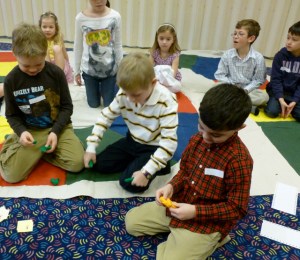
In January there was a Games Workshop using our life-sized board game. Kids played a game modeled after the board game, Cranium.
1st grade use the large game board in the Games Workshop

The game in action; pointing out the game cube First graders in the Games Workshop
See that cube thing? (At the orange arrow). That is the game die. A team tosses it and depending on the picture they roll, they have a certain type of activity that they need to do. Here the card might have said “Using Playdoh, see how quickly team members can create a pair of sandals.” Of course, meanwhile the leader was asking everyone, how sandals enter into the story.

There was a Storytelling Workshop…

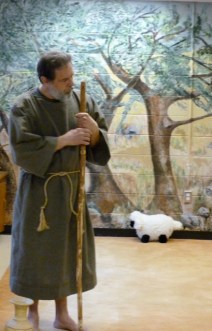
Moses visits in the Storytelling Workshop Moses at Green Wood
“Moses” visits the Storytelling Workshop downtown (for 4th-6th graders)

  And “Moses” at Green Wood.

(Okay, so it wasn’t really Moses. Just a couple of guys who did a great job portraying Moses!)

In the Drama Workshop kids acted out the burning bush portion of the story…

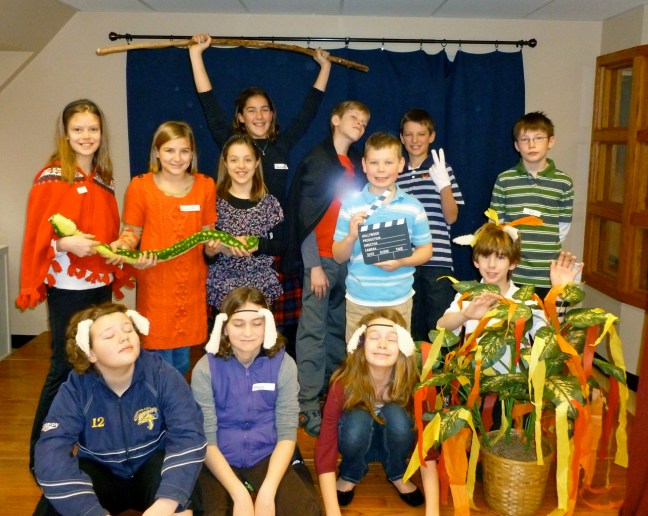
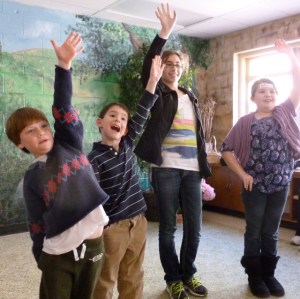
the 5th grade poses on stage at the Drama Workshop
Nice burning bush. Notice all the sheep? There were lots of props. Which ones can you name?

Meanwhile, in the “Greenhouse” (ages 3 years old to kindergarteners) they were learning about Moses as well. Here they learned about unleavened bread.

Trying unleavened bread Kids in the Greenhouse

In February it was on to the Plagues and Passover portion of the Moses story. There was a different Games Workshop. This one was Bible Bowling. Here the 1st and the 6th graders work together in teams. Teams had names like “the Gnats” and “the Frogs.”

1st and 6th graders work together in the Games Workshop A team member takes a shot at the bowling pins
Kids sure do know the answers to the questions! When the team answered correctly, they got a chance to knock down the pins.

There was a Cooking Workshop…

5th graders in the Cooking Workshop
Mixing up some unleavened bread – in a hurry!

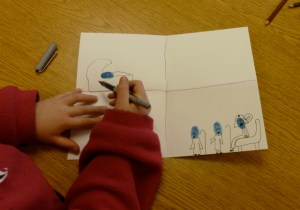
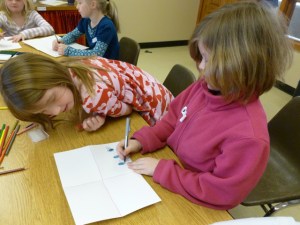
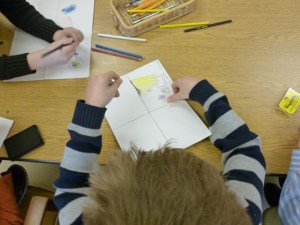
And there was an Art Workshop where kids made comics using thumbprints…

An artist at work in the Art workshop More artists
Another artist More artists
Created art work Created art work
Can you tell the story using these thumbprint drawings? What part of the story does this one tell?

What was your favorite Workshop?


Photo credits: Click here for info on banner photo (not visible in readers or email).
Other photos by Beth Pascoe, Carol Hulbert and folks at Green Wood. Used by permission.

Studying the Last Supper

At FUMC our Cool Disciples experience Rotation Model Christian education, as they learn about Bible stories and concepts through kid-friendly multimedia workshops.

In this season of Lent we are studying the story of the Last Supper. Since Easter happens annually, we get to spend time on a different aspect of the Easter story every year. In other years we’ve covered the Garden of Gethsemane, the Empty Tomb/Resurrection Appearances, Easter through Peter’s eyes, and the overall sequence of the events of Easter week.

The Last Supper is the last meal that Jesus and his disciples share prior to Jesus’ death. Read about the story of the Last Supper in Luke 22:7-20.

A frozen picture of da Vinci's Last Supper
From the Photography workshop from the last time we did this Rotation. These kids have now graduated from high school! They were in 6th grade in 2005.

Here is how we studied this story:

  • In the Art Workshop we discussed the celebratory meal that Jesus shared with his disciples. Kids decorated a glass plate; a plate to use at your next special meal.
  • In the Cooking Workshop students will help make and experience a “mini” Seder meal, the meal that Jesus’ and his disciples were sharing at the Last Supper.
  • In the Photography Workshop students will use a technique called “Frozen Picture” to experience the Last Supper (as painted by Leonardo da Vinci).
  • In the Video 1 Workshop (for 1st – 3rd graders) students will watch a video with puppets called How Can I Celebrate Passover? A Young Christian’s Introduction to the Seder.
  • In the Video 2 Workshop (for 4th – 6th graders) students will watch the live-action video The Last Supper.

This Rotation comes around again in 2018. I wonder what workshops we’ll use this year?

-------


Photo credits:
The Last Supper re-created, copyright 2005, by Alice Nuttall.

Family Lenten activities, part 2

Lent is the 40 days (minus Sundays) leading up to Easter. A long, long time ago Lent was the period in which new converts to the church prepared for baptism. They learned about what it meant to be a Christian before becoming a member of the church community. It was basically “spring training” for disciples!

baseball - spring training!

Lent is a great time for your family to take a serious look at your calendars. It’s all about focus. Is there time for being a disciple of Jesus? For including Christ in your lineup? (An hour a week at church isn’t enough!)

Time Out. Talk about…Ask…A speech bubble
What can our family do? We’d like to spend some of our time together warming up our faith.


Last week I had given you ideas for family activities to try out during Lent. If you missed that it’s here. (These activities are not time-sensitive.) It seems only proper to provide more activities to help everyone be a “utility player!”

Ready to “take the field” for Lent?

  • Practice gratitude: Set up a place for praises. In a noticeable location, place a stack of papers and a pen near a basket or a bowl. (Or post a list on the refridge; or give everyone their own journal.) Encourage everyone to draw or write about things that make them grateful. Once a week, ponder your collection. For more ways to transcribe thanksgiving, visit here.
  • Celebrate: Life is a precious gift from God! Work in the habit of celebrating this in some small way, every day! Perhaps start off your day in song (“This is the day” would be a good choice. I often woke up my kids with this one.) Or perhaps change the words to the Superman table grace, adding in “Thank you God, for giving us life.” Re-writing this could be a fun, dinner table activity!
  • Serve others: pick one way to offer your time to someone else from this incredible list. (Includes ideas such as creating “snack packs for Ronald McDonald residents” but did you know they are still collecting pop tabs?
  • Practice solitude: First introduce the concept of breath prayer. Then, designate a signal for when it’s time to gather back together. Next, for an age-appropriate amount of time send everyone to opposite corners of the house. When the “time-out” is up, discuss your experience.
  • Give something up (Fasting): Rather than fasting food try giving up a word. How about the word “no” – try it and see what happens! (Remember that an alternate for the word no can be “let’s think about that.”)
  • Prayer: Make time for prayer every day. Visit here for ideas.

--------------

Photo credit:
Spring Training by Michelle Riggen-Ransom, licensed under Creative Commons (CC BY 2.0).

Breaking down the Moses, Plagues to Passover story

Moses and Aaron before Pharaoh

We are about to embark on a follow-up Rotation on Moses. Last month we covered Moses from his birth to his encounter with God in a burning bush.

That was a lot of ground to cover in the Bible, as is part two: Plagues and Passover. But have no fear! Here is a reading plan for your family group to use, to break down this month’s story into manageable chunks. (For the part one reading plan click here.)

Might I suggest covering our story over several days? Start off with a review of God’s call to Moses. (The Burning Bush!) The next day, read about Moses and Aaron’s first encounter with Pharaoh. (See picture above.) On subsequent days you can read about each plague, as God displays his power to Egypt. Eventually you’ll read about the first Passover and about how a lamb’s blood saved the Israelites.

As an added bonus there are questions for discussion at the family dinner table. (Or wherever your family is gathered together.)

If you’d like to print out this reading plan/discussion guide (I’ve tried to squeeze it into a one-page document!) click here.

Read Discussion question
Exodus 3:1-6 Why take off your sandals? What sort of relationship to God does this imply?
Exodus 3:7-15 What does God want Moses to do?
How many different ways does God identify himself?
Exodus 4:1-17 Does Moses sound like he is whining? When was the last time you whined? Reread verse 11. Which of your perceived limitations needs this sort of talking to?
Exodus 5:1-18 How did you expect Pharaoh would react to Moses’ request? Tell about a time you asked for something and were turned down.
What can help you to keep in mind that God is with you in times of stress?
Exodus 5:22-6:8 Do you suppose Moses is ready to give up? So soon? When have you felt this way?
Exodus 7:1-7 Why do you suppose God “hardened” Pharaoh’s heart? Or did Pharaoh harden his own heart? What do you hope to be able to accomplish at age 80?
Exodus 7:8-13 How do you suppose Moses and Aaron felt when Pharaoh’s magicians made their staffs into snakes? Who (in your opinion) “won” this round?
Exodus 7:14-24 To the Egyptians the Nile River was a god. What does this say about God’s power?
Do you see “magicians” in society who try to mimic God’s power?
Exodus 8:1-15 How do you suppose it would feel to find frogs in your oven and in your mixing bowls?
Why do you suppose the magicians didn’t try to stop the frogs?
Exodus 8:16-19 Starting with this plague, the magicians were no longer able to reproduce a plague. Why do you suppose this didn’t have an affect on Pharaoh?
Exodus 8:20-32 What sort of pattern of behavior is happening? Starting with this plague, the Hebrews were unaffected. What sort of message did this send to Pharaoh? To the Hebrews?
Exodus 9:1-7 How do you suppose Pharaoh planned to recover Egypt from these plagues?
Exodus 9:8-12 God didn’t tell Moses how many plagues would happen. How is Moses likely feeling?
Exodus 9:13-35 What does the warning in verse 19 say about God? How about verse 32?
Exodus 10:3-20 If God knows that Pharaoh will change his mind, why does he keep stopping a plague when Pharaoh says he will let them go? Why does Pharaoh ignore his officials advice?
Exodus 10:21-29 The sun was a god to the Egyptians. What does this story teach you about your allegiance to the “gods” of today’s society?
Exodus 11:1, 12:1-13 Why do you suppose there are such explicit directions for a Passover feast? How does Jesus’ Last Supper relate to this story? How about Jesus’ sacrifice on the cross?
Exodus 12:21-30 In the manner of verse 26, discuss your family traditions.
Exodus 12:31-42 What sort of blessing do you suppose Moses gave Pharaoh? Have you ever received a blessing? How do you suppose the Hebrews felt as they left town in a hurry?

-------


Photo credits:
Moses and Aaron before Pharaoh by Benjamin West (1738-1820) in the Public domain, via Wikimedia Commons.

Moses: Let My People Go!

New here? Easily read future posts (one a week) by subscribing over on the right. Enter your e-mail address to have posts sent directly to your inbox. Or click on the orange RSS icon to subscribe in a reader. Thanks for visiting.

Hebrews are enslaved in Egypt
Let my people go!

Rotation Model logoOn Saturday nights and on Sunday mornings at FUMC our Cool Disciples experience Rotation Model Christian education. They learn about Bible stories and concepts through kid-friendly workshops that each focus on different learning styles.

In February 2012, we are continuing the story of Moses. Last month we learned about Moses from his watery beginning in a papyrus basket, to his dramatic experience as an adult meeting God in a burning bush. God wanted Moses to bring his people, the Israelites, out of Egypt to the Promised Land (Exodus 3:9-10).

We saw Moses reluctantly agree to lead God’s people to freedom. And this is where we pick up our story for this month. As we will see, freeing the Hebrews from Pharaoh’s grip is not an easy task. It involves frogs, and gnats, and flies! And a mysterious “passing over” with protection provided by the blood of a lamb. Read about our story in Exodus 5:1-6:13, 7:1-12:42. (It’s another long one. Stay tuned for Here is another reading plan to break it into manageable chunks!)

This is where the “Schedule” used to appear — which grades were visiting which workshops over the course of this Rotation. However it was removed as it was sort of out of date 🙂 Our current schedule of workshops, for whatever Rotation we are currently on, can be found on this page.

For prosperity, here is what we did in each workshop for this story: (Be sure to catch pictures of the action!)

  • In the Art Workshop students will create comic strips that tell the story using their thumbprints (Ed Emberley style).
  • In the Cooking Workshop students will make unleavened bread and discuss the Passover and the Israelites’ departure from Egypt.
  • In the Games Workshop students will participate in a Bible Bowling game as they learn story characters, events and story sequence. Which team will win – the Gnats, or the Flies, or the Frogs?
  • In the Music Workshop students will learn a silly song about the story. The words to B-I-N-G-O never sounded like this!
  • In the Video Workshop students will watch portions of the animated video The Prince of Eygpt. I wonder how closely the creators of video follow the story as told in the Bible?

If you are in the area please join us for the fun learning at First United Methodist Church in Ann Arbor, MI

-------


Photo credits:
Line drawing of Hebrews enslaved, from the book
The Big Picture Bible Time Line by Gospel Light. Used with permission.