All Saints Day? Tell me more.

This weekend families join together in worship for a special service where we celebrate “All Saints Day.” (Which occurred on November 1st.)

What do you picture when you hear the word “saint?”
Someone who models perfection?
Who does/did no wrong?
Who is exceptionally holy and wears a halo??

I like the definition of All Saints Day, given by Gertrud Mueller Nelson in her book To Dance With God: Family Ritual and Community Celebration

All Saints Day is the celebration of those who have contributed successfully to the creation of the kingdom.

To be a saint doesn’t imply we have to be perfect!
It just means we wear our faith on our sleeve!

an old bell on a chapel In the worship service this weekend there will be a time where we remember saints who have died in the past year. As their names are read a bell is tolled.

This special time of the service is to remember — to thank God — for these saints who have shown others the Christian walk and faith.

They wore their faith on their sleeves!

 
Time Out. Talk about…A speech bubble

Prepare your children for this portion of the service by talking about remembering. (Don’t worry if you don’t have a chance to prepare ahead of time. Talking about it after the service works too!)

  • Ask your kids what they remember about your last vacation, or a special birthday, or a visit with a friend or a relative. Invoke memories of good times! Why is it good to remember these occasions?
  • How is the celebration of Communion a time to remember?
  • Share with your kids, remembering whose example helped you on your faith journey. Didn’t grow up with these sorts of mentors? Talk about who is currently helping you build your faith. (We are allowed to stretch the definition of a saint to include those who are living!)
  • Use this as an overture to talking about who are the current mentors in your child’s spiritual journey. Whom would they like to have as their advisers? (Research shows that kids are helped to succeed in life when they have multiple non-family adults in their “camp.”)
Are you wearing your faith on your sleeve?


Photo credits:
A church bell in a chapel on the Island of Corfu, Greece, from my archives.

Are you seeing ads? They are not from me! They are placed by WordPress, who otherwise offers a free platform from which to share lots of good-ness. If you see an inappropriate ad, please report it to support@wordpress.com. Include the URL, the date/time the ad appeared, and a screenshot of the ad.

Ringy-ding-ding. God is calling.

It’s not just the phone that can call us away from something.

a phone is ringing
a phone is ringing

 
It’s the alarm clock,
the hungry family,
the laundry piles,
the boss,
the egg timer,
the ping of “you’ve got mail”...

All things that call us; demanding we turn our attention their way.

What calls have you heard lately?
Anybody heard God calling?

Abram did.

Of course things were a lot quieter in Abram’s day. (The bleating of a few sheep perhaps?) As you start a new Rotation on Abraham, you’ll be learning about how Abraham (whose name started off as Abram) heard God’s call and how he responded to that call. Here it is from the Bible…


Open quote markAbram, get up and go! Leave your country. Leave your relatives and your father’s home, and travel to the land I will show you. Don’t worry — I will guide you there. I have plans to make a great people from your descendants. And I am going to put a special blessing on you and cause your reputation to grow so that you will become a blessing and example to others.   Genesis 12:1-2


Talk about “calls” at the family dinner table (or wherever your family is gathered together). Start off with a game. Make it like the “I’m packing a suitcase” game, except in this case the first person tells something that called them away, for example, the alarm clock called them away from a dream. The next person repeats the first call and adds their own: the bell that called you away from recess. (They don’t have to be actual events that happened; the President called on the phone and asked you to come to Washington?) And so on, until someone can’t remember the list of calls!

Play again if you desire. Eventually turn towards a discussion about how many different types of calls there are on our daily lives. Ask these questions:

  • Do you suppose that there are so many calls on our lives that we can start to respond without thinking?
  • What can help us to stop and remember to prioritize which calls we’ll respond to?
  • What about God, does he call us?
  • Name some ways that God has called you in the past.
  • In what ways might God use to reach us? (through the words of a friend, a Bible passage, a song…)
  • What might keep us from hearing God’s call?
  • What can we do to help us listen for God’s call?

Ringy, ding, ding.
Check the caller-ID. It might be God calling.

--------------

Photo credits…
Phone call by Sean MacEntee, is licensed under Creative Commons (CC BY 2.0).

Discussing Joseph in Egypt, part two

Here’s a daily hint: Spend time GROWing at the dinner table.
Growing as in…

Grace (say a table grace together).
Review the days highs and lows while you eat.
Open the Bible and read just a tiny bit.
Work on applying it to life.

The “work on it” part doesn’t have to be elaborate. It’s all about…

Asking questions or doing activities
that help us to see that the Bible applies to our lives.

So if our current Rotation story is about Joseph in Egypt, how can such a long story—with numerous characters and complex plot twists—be broken down in bite-sized (dinner table-sized) chunks?

Easy! Use the following reading/discussion guide!

Joseph’s brothers arrive in Egypt. Unwittingly they bow down before Joseph! (Genesis 42:6)

Clipart - a girl points out while readingIf you’d like to print out this reading plan/discussion guide, click here.
Need a review? See part one of Joseph in Egypt here. And if you’d like to go even further back, review the discussion guide for Joseph’s “Coat” portion of the story, here.


Read in Genesis Discuss…
42:1-4 Why did Jacob have fears about Benjamin going to Egypt? Kids: Do you suppose that your parents have fears about you going places without them? What can help your parents when they are afraid?
42:5-7 Why do you suppose Joseph pretended to not know his brothers? What would your reaction have been if you were Joseph?
42:8-9 What “dreams” is Joseph talking about? (Hint: Genesis 37:5-11) How do you suppose Joseph is feeling watching his dreams come true!?
42:8-17 Why do you suppose Joseph locked up all of his brothers for three days? Describe a time when you schemed to “get back” at someone who had wronged you. Did you follow through with your plans?
42:18-23 Joseph says he “fears” God (verse 18) meaning he respects God. Where would you put Joseph’s trust-in-God-level at this point in the story? How do you suppose the brothers of Joseph are feeling: upset at their lot in life or sorry about what they did to Joseph?
Where are they on the trust-in-God-meter?
42:24-28
42:

Share in the comments how applying-it-to-life helps you to GROW your family faith!

--------------

Photo credits:
Clip art “reader” by Improulx, in the Public Domain. Slightly altered and shared at Flickr.
Joseph is governor, an ilustration by Owen Jones from
The History of Joseph and His Brethren (Day & Son, 1869) in the Public Domain via Wikimedia Commons.

Joseph in Egypt: A Reading Plan

To print out this discussion guide from a Google Doc, click here.

Our current Rotation covers part two of the Old Testament story of Joseph and his brothers. We covered part one – the “colorful” coat portion of the story – in January and February. A review of part one (with a printable discussion) is here.

Joseph is sold by his brothers

Part two concludes the cliffhanger that part one left off at – what happens to Joseph in Egypt?!? Because our story winds its way through several chapters in Genesis (39:1-5, 39:20-45:28, 46:1-7, 50:15-21) here is part one of a reading plan that breaks it down into manageable chunks so that you can all read the story over several days/weeks. Just read a passage and then discuss the associated question(s)/do the activities. Make it a habit to get out a Bible at the family dinner table. (Or wherever your family is gathered together.)

* A review question

Read in Genesis Discuss…
37:3-4 * Who was “Israel?” (Hint: It’s a name God gave someone; if stumped check out Genesis 32:28)
37:23-24 * How does this special robe end up getting Joseph into a heap of trouble?
Have you ever gotten into trouble because of jealousy? (Adults: ‘fess up time)
37:25-28 * The next thing Joseph knows, he’s headed for Egypt (and I suppose he’s not riding a camel). When has a sudden turn of events surprised you?
How do you suppose Joseph is feeling?
What do you imagine his prayers to God sound like?
39:1 Where would you put Joseph’s trust-in-God-level at this point in the story? (not so much, a little bit, still strong?)
Do you suppose it’s a good idea to prepare for the next rough situation, by strengthening your trust in God? Brainstorm some ideas for building trust. Create a list for the ‘fridge.
39:2-5 What do you suppose Potiphar saw that made him conclude: “the Lord is with Joseph”?
What would it look like if someone noticed that God was with you?
39:20 Joseph was accused of doing something that he didn’t do. Where would you put Joseph’s “trust-in-God-level” at this point in the story?
Tell about a time when you were at that place on the “trust-in-God-meter.”
39:20c-23 How do you suppose Joseph is feeling now?
What does it feel like to know that God is with you?
Bonus question for 3rd grade & up: what does the little “c” mean in “39:20c”?
40:1-8 How did Joseph come to interpret the dreams of the kings workers? (Hint: verse 7). What does this tell you about being sensitive to the needs of those around you? Speculate about where it might lead you if you notice someone’s needs today?
40:9-23
For < 3rd grade stop at verse 15
Do you suppose God speaks to us through dreams?
 What strange dreams have you had?
Why do you suppose the cupbearer forgot about Joseph? Where would you put Joseph’s “trust-in-God-level” at this point in the story?
41:1-16 Two years have passed! Do you suppose Joseph wondered where God was?

What do you suppose Pharaoh’s dreams mean? Why do you suppose none of Pharaoh’s “magicians” could tell him the meaning of his dreams? How would you describe Joseph’s relationship with God? (pay close attention to verse 16) When have you given God the credit for working in your life?
41:17-32 What is a famine? How would you describe your relationship with God – as going through a feast or a famine? If you could see into the future, what would you do?
41:33-44 What do you suppose Joseph is feeling now?
How has Joseph changed since the beginning of our story in chapter 37? (Remember, he was bragging about his dreams.) How have you changed as you’ve “grown up”?
41:53-57 How can years of “abundance” help you prepare for years of “famine?”
Read (and print) the next page of questions here.


Photo credits:
Click here for info on banner photo (not visible in readers or email).
Joseph is sold by his brothers, from Christians Unite: Christian Clip Art

Ripples of Hope: Fill My Net

Ripples of hope Youth Worship logoI hope it doesn’t rain today.

I hope I got a good grade.

I hope she’ll be my friend.

Hope is a word which gets a lot of use in everyday life. We sure could use a dose of hope these days!

Hope is also talked about in the Bible. You can find lists of verses about hope. One of my favorites is:

 
There is surely a future hope for you, and your hope will not be cut off.  Proverbs 23:18

This weekend is Youth-led worship at FUMC. We will not be holding any workshops on Saturday at Green Wood or downtown on Sunday for grades 1st – 6th, so plan on attending this service!

Youth Worship 2013 banner logo

How about a little preparation? Around the family dinner table? (Or wherever your family is gathered together.)

The focus by the Youth will be hope. This even ties to our current Rotation on Peter’s story! Peter was likely down in the dumps about what he’d done to Jesus. Deciding not to just sit around and mope, Peter chose to go fishing.

a speech bubbleAsk your kids: When Peter went fishing, what do you suppose he was hoping for?

  • A diversion: Something to take his mind off of what he’d done?
  • A net full of fish?
  • Jesus’ forgiveness?
  • Your ideas?

a speech bubbleWhen was the last time you hoped for something?
Did you have to wait for what you were hoping for?

Perhaps Peter chose to go fishing because he was consumed by thinking about what he’d done to Jesus. His mind was probably racing in overtime. He couldn’t stand to be still!

a speech bubbleHow is waiting for what is hoped for, hard?
What do you do while you are waiting for hope?

a speech bubbleOnce Peter had spent time in the boat, quietly fishing, that is when Jesus called. Ask: The next time you are waiting for something, what do you think of the idea of turning to God for some quiet time?
What are ways you could have quiet time with God?

Jesus did offer Peter forgiveness. And because of that, we have hope! Jesus forgives us as well. And Jesus’ forgiveness empower us! We can have hope!

The Youth will be using this prayer in worship, adapted from the book Pray Like Hell. This will be presented in a very cool ripple effect that the youth created!

Bless to me this day the power of God to do good work.
Bless to me the power of Christ to love well.
Bless to me the power of the Holy Spirit to strengthen me for what lies ahead.
Bless to me the power of the Holy Trinity to give me hope.

I hope you’ll attend one of these worship services!


Photo credits:
Ripples of Hope logo design by Deb Wood. Used with permission.
Photos of the youth from last years youth-led worship service used with permission.

Are you seeing ads? They are not from me! They are placed by WordPress, who otherwise offers a free platform from which to share lots of good-ness. If you see an inappropriate ad, please report it to support@wordpress.com. Include the URL, the date/time the ad appeared, and a screenshot of the ad.

Rotation Photos – share with your kids

Here are some photos from our current Rotation at FUMC in Ann Arbor, MI. (We are studying Joseph’s Coat.) Consider gathering the family around the computer and sharing the pictures and talking about some of the questions that are posed.

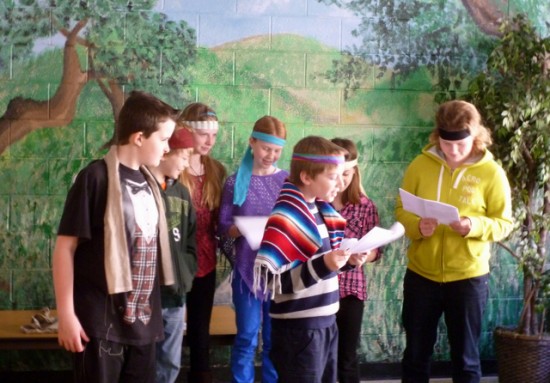
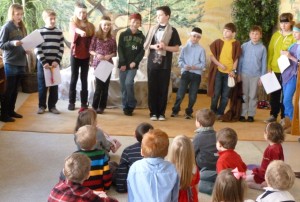
Last Sunday the 5th and 6th graders were in the Drama Workshop. They had a chance to review the story (which they knew quite well, seeing as this was week number five for this story). They quickly moved on to practicing a skit telling the story of Joseph’s Coat.

5th & 6th graders put on a skit
Joseph tells his brothers about his dream.

Time Out. Talk about…a speech bubble
Ask your kids what Joseph’s dreams were about.
What did Joseph’s brothers think of the dreams?

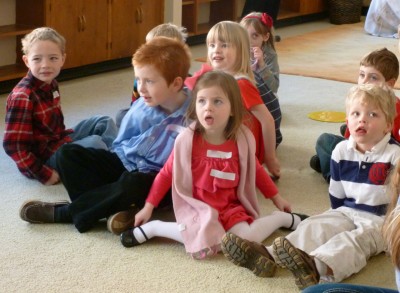
The rapt audience

Then the audience arrived for the real show! The preschool kids (who have also been learning in their own workshops about Joseph and his brothers) came upstairs on a field trip. They look pretty enthralled!

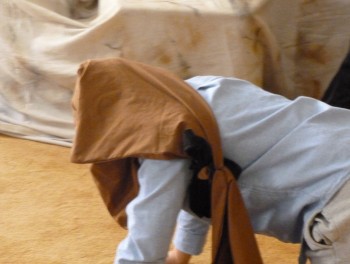
This show was complete with a spitting camel who arrived on the scene with some traveling traders. And this camel (seen below) really was playing the part! Watch out audience!

A camel was part of the cast

Time Out. Talk about…a speech bubble
In what scene in the story did the camel appear? (hint: camels were used on long journeys) How do you suppose Joseph felt at this point in the story? Do you suppose he wondered where God was?

The crew took a bow when it was over. And then they introduced themselves and proudly pointed out their little brothers and sisters in the audience!

the crew lines up to take a bow 2nd graders in the Puppet Workshop
The crew is introduced 2nd graders man the puppets!

Meanwhile, in the Puppet Workshop, the 2nd graders were busy enacting the story using puppets. There was a small class this week – only five, and all boys! But they still were able to put on a show. Here they are (on the right) with their puppets. Second grade boys sure have lots of energy! It’s a good thing our puppets are made to last. I’m not sure which they had the most fun at — putting on the puppet show or watching themselves on the TV afterwards? (We had taped the production. Hmm. I’ll have to see about posting that!)

Down in the kitchen, the 1st graders had a crushing experience! They each had one tasty-looking Oreo™ cookie and then the workshop leader smashed it! How did they feel about having crushed cookies? This was a good question that actually tied nicely into our story.
Time Out. Talk about…a speech bubble
What “crushing” experience did Joseph have?
Have there been times when you have felt “crushed” or disappointed, or let down?
What can you do when you feel that way?
Do you suppose learning our key Bible verse might help? (Romans 8:28a)

So, what to do with smooshed cookies? Let’s make the best of our crushing experience and turn it into something good to eat – “dirt pudding”! (Sorry, I didn’t make it to the kitchen on Sunday so these pictures are from the 5th & 6th grade visit to the Cooking Workshop.)

making dirt pudding from crushed Oreos carefully measuring ingredients

Time Out. Talk about…a speech bubble
What did Joseph do with the crushing experience of being sold in Egypt?
Do you suppose that Joseph remembered that God would always be with him?
What evidence do we have that God was with Joseph? (hint: read Genesis 39:1-5)

These last two pictures are silly…

shaking with a quick set of rabbit ears gummy worms go with dirt pudding!
Some shaking action was needed (and a quick set of rabbit ears) Can’t have “dirt pudding” without gummy worms!

Which workshop will your child be visiting this weekend? Find out here.


Photo credits:
Click here for info on banner photo (not visible in readers or email).
Other photos from my archives.

Where is God when we need him?

In preparing for our Rotation on Joseph’s Coat, I had an “ah-ha” moment. (It is times like this when I like to describe our Cool Disciples program as “adult education disguised as a children’s program.”) I was reading Genesis 37 and I was struck by the realization that in the entire chapter, God is never mentioned! That made me wonder:

Where is God in the story of Joseph and his coat?

That’s when I realized that this was the perfect chance to present this concept:

Recognize that in our lives God’s activity may be hidden.

Sometimes we wonder: where is God? And we want our kids to know that it is perfectly ok to have times in their lives when they may wail: Where are you God?!?

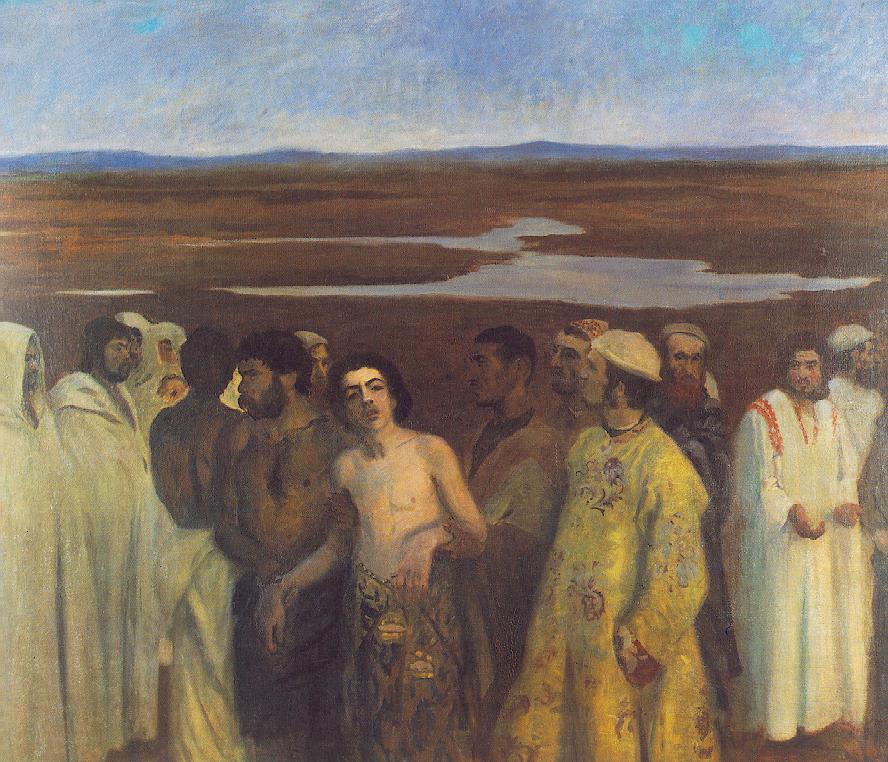
A painting of Joseph being sold by his brothers

Surely Joseph had these thoughts as he watching his brothers trade him for pieces of silver. (Let alone during the long trip to Egypt!)

Surely Jacob wondered, where is God, when his sons presented him with Joseph’s bloody coat.

Surely you’ve wondered: Where is God?  (I can think of dry times when I have!)

How about some discussion at the family dinner table? (Or wherever your family is gathered together.)

  • Share times when God has seemed far away in your life.
  • Allow others to share.
  • What brought you back to the reality of God as always being there with you?
  • What are ways that would help you remember that God is always with you?

God’s activity may be hidden to us. It may seem like God is ignoring us!

Rest assured that God is with you in all situations.

Sometimes God’s work takes place mysteriously out of sight. Joseph didn’t give up hope. It took time, but eventually Joseph was able to discover that God used each step of his life, the good and the bad, to complete a plan for Joseph’s life. Take a look at Genesis 50:20, as Joseph later (many years later!) said to his brothers:

You tried to harm me, but God made it turn out for the best.

We may not always see it, but God is always there!


Photo credits:
Click here for info on banner photo (not visible in readers or email).
Joseph is sold by Károly Ferenczy, a painting in the Public domain, via Wikimedia Commons.

The Perfect Audience

Our Rotation this month is about Jesus’ birth with a focus on the shepherds and angels portion of the story. The Message version of the Bible describes these shepherds as “camping in the neighborhood.”

A modern day shepherd boy

Hmmm… Camping… How about a family camping expedition in the living room? Pitch a “tent” (drape a blanket over some chairs), stuff the backpacks with snacks or maybe even hold a picnic! (Try something simple, like sandwiches.) Use this opportunity to talk about shepherds, ask some questions, and add some spiritual growth memories!


a speech bubbleIs it easy to stay clean when you are camping?

If you’ve ever been camping, you know how hard it is to be neat. You can image how hard it was for shepherds in the time of Jesus. They also probably smelled like sheep. And they had another stigma: in those days, shepherds were looked down upon. They were considered as lowly as a tax collector.

Yet these were the people who first heard the good news of Jesus’ birth!

A fake campfire

And heard the news in grand style!
Tell the story of the shepherds and angels (from Luke 2:8-18) around your pretend campfire. (What is camping without a campfire!)

a speech bubbleWhy are shepherds the perfect audience for angels announcing the birth of the Christ child?
Why do you suppose God didn’t chose “important” people to tell first?
Who would you expect God to tell?

There is a momentous message in God’s choice of society’s outcasts as the first visitors he invited to see his baby son!

a speech bubbleHave you ever felt not good enough to hear from God?

God’s gift of his son Jesus is for everyone, even you and me.

God sent his son Jesus as a way to bring people back into a relationship with God. Those who are young, old, broken, a mistake-making-mess, tired, forgotten, feeling unworthy… His message of love comes once again, perhaps as quietly as a sleeping baby or as unexpectedly as God’s glory blazing around!

Enjoy this video telling of our story from The Jesus Storybook Bible.


Photo credits:
Click here for info on banner photo (not visible in readers or email).
A young Bedouin shepherd boy by Ed Brambley from Cambridge, UK, who licensed this photo via Wikimedia Commons under a Creative Commons License, via Wikimedia Commons.
Campfire also licensed under Creative Commons, by Mike Davis.

Are you seeing ads? They are not from me! They are placed by WordPress, who otherwise offers a free platform from which to share lots of good-ness. If you see an inappropriate ad, please report it to support@wordpress.com. Include the URL, the date/time the ad appeared, and a screenshot of the ad.