How to tell God he matters to you?

Here it is — the first official Dinner Table Talk Guide! This is designed to be used in conjunction with our summer movie series, but if your kids missed class this past weekend (or, if you don’t have any kids in your household) don’t let that stop you! Use this guide to help your family cultivate a growing faith — bring love and joy to yourselves and to the world around you.

Our questions from this week’s lesson centered on showing respect to God, specifically through prayer.

God is our awesome creator, he is loving and powerful! We want to show him respect, but how?

By not ignoring God.

God puts an offer out there to always be available for conversation with us. Prayer is what we call talking and listening to God. When we pray we open ourself to God, sharing the parts of our life that matter most to us. We are saying, God you rank high in my book!

It is important to note that God lets us choose whether we decide to join in dialogue with him, or not. Getting to know God takes initiative on our part! What are some ways to help us in our prayers?

a child with a purple balloonIn our lesson we used balloons to pray! What a fun way to “lift” prayers to God.

We also reviewed a “recipe” to follow when praying. We’ve heard this one before — applying the acronym ACTS.

 
(I want to stress that a formula for prayer is not a requirement, but it can help one to stay focused. I find using ACTS beneficial, as it is too easy for me to be distracted whenever I pray; utilizing ACTS keeps me on track.)

What are some other ways to help us talk to God?
  • Invite God to your activities. The next time you are about to start an enjoyable venture, invite God to savor the experience with you. For example, before jumping into the pool, pray: Be with us, Jesus. Come and share this refreshing swim along side of us. We’re so grateful that You created water for us to enjoy!
  • Practice praying in silence. (It’s how most people pray!) Make the amount of time spent in silence appropriate to your kids’ ages. You may want to start out with just 15 seconds of silence.
  • Get out the crayons. Prayers don’t always have to be words. Provide coloring tools and have your child draw a picture of things for which they are thankful.
What prayer methods can you share?

See these past discussions on ways to mix up your prayer life:

Why we pray: a friendship needs feeding

Making prayer a part of every-day life

More (creative) ways to pray…


What is Breath Prayer

a blue line


Photo credits:
Purple balloon by Thomas Rydberg, who licensed this photo on Flickr under a Creative Commons License.

Are you seeing ads? They are not from me! They are placed by WordPress, who otherwise offers a free platform from which to share lots of good-ness. If you see an inappropriate ad, please report it to support@wordpress.com. Include the URL, the date/time the ad appeared, and a screenshot of the ad.

How to never underestimate the power of table talk?

It is time once again for our annual Sunday’s Cool summer movie series at FUMC!

As in previous years, this summer’s film series launches a way for you to share your faith with your kids. How?

By making a way for you to harness the power of table talk.

the power of table talkOur videos shown during Sunday’s Cool classes will help kids discover some answers to various questions that will be raised, but it’s up to you to continue the discussion with your household.

Whether it’s around the table or while you are together in the car, you can do this!

And I’ll help by providing starter questions.

 
Why is this type of conversation important?

It models the spiritual discipline of talking.

Yes! That’s a spiritual discipline! You see, God has a habit of showing up in the types of activities which John Wesley termed “the Means of Grace.”

Wesley taught that we can’t earn God’s grace (God’s loving kindness), but we don’t want to sit around waiting to hopefully experience it! We are to engage in certain activities — means of grace; things like worship, reading scripture, prayer, acts of mercy, and “Christian conversation” AKA Table Talk!

A bunch of questions about God to be addressed in our video series

Each week in Sunday’s Cool, we’ll address questions with the help of Clive & Ian and their Wonder-Blimp of Knowledge. If you sign up to receive emails when I post to this blog, then after each class you’ll find in your inbox a set of discussion helps.

Clive & Ian in the Wonder-Blimp

Won’t you join us with Clive and Ian as they go on adventures in search of answers by soaring in their Wonder-Blimp of Knowledge! Make sure you don’t underestimate the power of Table Talk!

a blue line


Photo credits:
Altered table photo from a Public Domain image. Other photos are from the producer of our video Clive & Ian’s Wonder-Blimp of Knowledge, under a fair use category.

Are you seeing ads? They are not from me! They are placed by WordPress, who otherwise offers a free platform from which to share lots of good-ness. If you see an inappropriate ad, please report it to support@wordpress.com. Include the URL, the date/time the ad appeared, and a screenshot of the ad.

Are you ready to review for the Big Game?

This Sunday at the downtown location, it’s time for the Big Game! Also known as Are You Smarter Than a Sixth Grader?

We’ll be playing a large group game to review Bible stories we’ve covered since September. It will be sort of like the old TV show “Who Wants to Be a Millionaire.”

This game is always loads of fun. We treat it as an end of school year celebration! (But Sunday’s Cool will continue during the summer.)

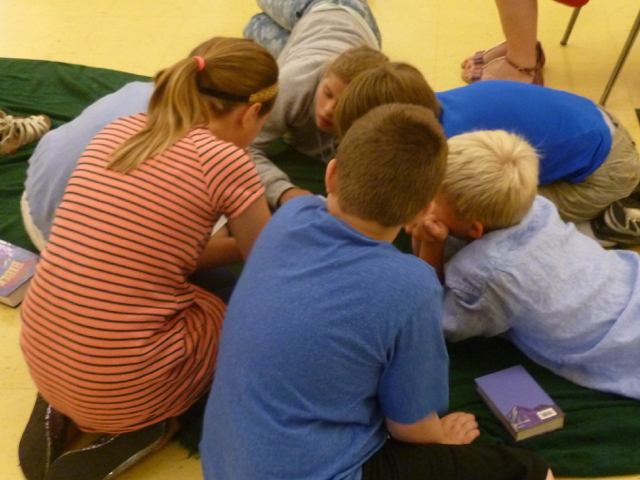
Big Game 2015 - 5th grade confiring on an answer

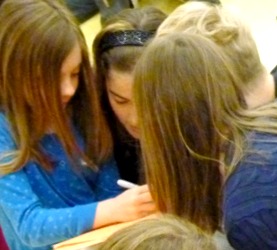
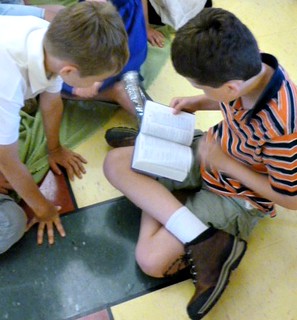
Class Teams work together closely. And checking the Bible for an answer is allowed (but you’d better be fast!)

The Big Game- a group huddle in 2011   The Big Game 2014 - checking the Bible for an answer

And, NEW this year! All parents are welcome to join the Parent Team to test their Bible knowledge against the 1st – 6th graders.

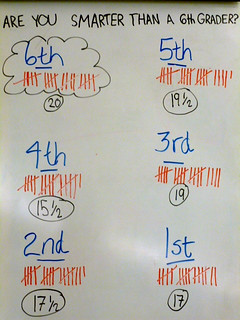
big game 2014 - Final scoreIn prior years the score has been close!
How will you prepare?

Review these stories: (And perhaps look at past review techniques I’ve suggested? Also here!)

See you at the Big Game!

a blue line


Photo credits:
Photos are from my archives.

Are you seeing ads? They are not from me! They are placed by WordPress, who otherwise offers a free platform from which to share lots of good-ness. If you see an inappropriate ad, please report it to support@wordpress.com. Include the URL, the date/time the ad appeared, and a screenshot of the ad.

What happens when jubilant children lead us in worship?

cast of the Jonah musical

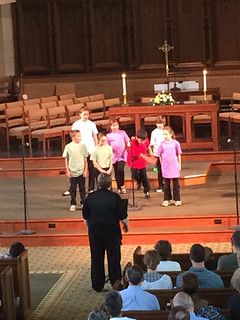
We experienced a treat this past Sunday: kids leading us in worship!

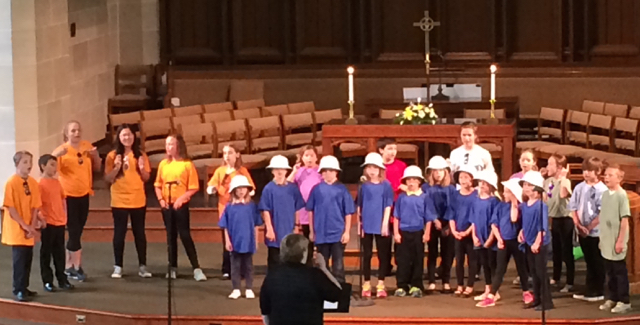
Children in worship, the Cherub Choir doing the response to Psalm 8Children executed all parts of worship – ushering, conducting the Call to Worship, playing hand chimes, singing in choirs, and reading scripture. Here the Cherub Choir — representing our youngest — provided the musical reply to a responsive reading of Psalm 8.
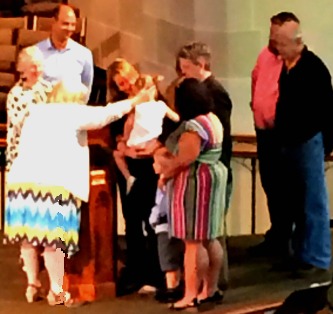
Baptism Tucked into the service, was also a baptism of a young child. An appropriate opening to the musical that the kids put on about the story of Jonah! In a baptism, the sprinkling with water in the name of the Father, Son and Holy Spirit, signifies a new life and becoming a child of God. Did Jonah experience his own sort of “sprinkling” to help him see his faith journey?
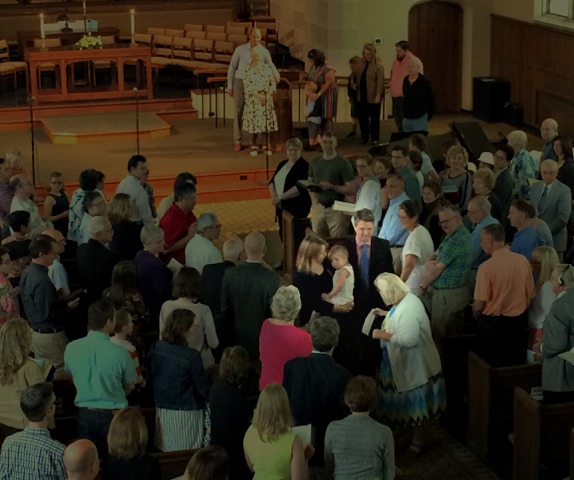
Being baptized means you join in our community of faith. One of my favorite parts of a baptism is when the pastor takes the child down the center aisle amidst everyone — parents usually in tow — where the congregation repeats their promise to nurture the faith of the child being baptized. Surrounded by love!

Baptism in the center of the congregation

On to the musical portion of the service! The Children’s choirs presented “Oh Jonah!”
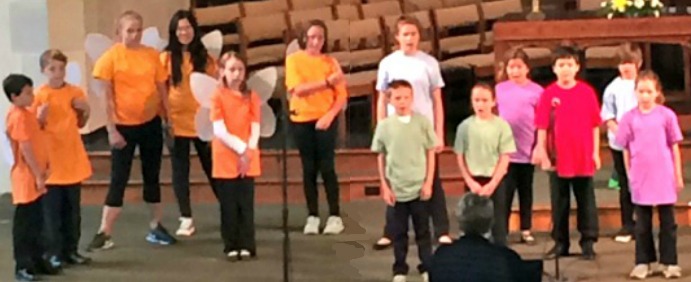
You know the story: Jonah is a reluctant prophet who at first chooses not to follow God’s instructions. He ended up in the belly of a big fish.

 
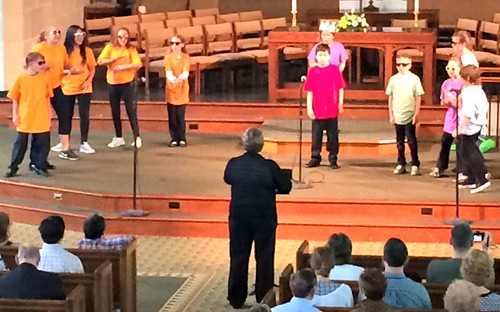
I like how the kids portrayed Jonah (dressed in red) as being “inside” the big fish — surrounded by kids who were the “whale.” That’s a group of angels in orange, hanging out near by to offer guidance to Jonah.

Jonah in a big fish watched over by angels

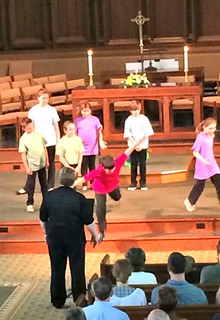
This is a story about choices and responsibility. When he was “spit out”…with gusto, it was a second chance!

Jonah is almost spit out   Jonah is spit out of the big fish

This time Jonah went to Nineveh and gave the people God’s message. (Look at all of those cool Ninevehites!)

Jonah goes before the King of Nineveh

How does the story turn out?

a blue line


Photo credits:
I created Oh Jonah from a claymation video by Riley Marchand, shared under a Creative Commons License on YouTube. (I altered this screen shot to make Jonah appear much smaller than the big fish.)
Rest of photos from my archives.

Are you seeing ads? They are not from me! They are placed by WordPress, who otherwise offers a free platform from which to share lots of good-ness. If you see an inappropriate ad, please report it to support@wordpress.com. Include the URL, the date/time the ad appeared, and a screenshot of the ad.

How to persist and hold the story in the limelight?

Our parenting-speak often sounds like a broken record. The phrase I’d say to my kids over and over (that always evoked a groan) was, “Make a different choice.” Either that, or it was when I’d break into song — à la Mr. Rogers: ♫ Let’s think of something to do while we’re waiting… ♫ (Can I get an encore?)

But that’s the way it should be.

Repeating keeps your story in the forefront.

You place a high value in reminding them that what they do/say is important in the world. (After all, they are a child of God!) You want them to be loving, kind, and to remember a few table manners.

One way to grow disciples of Christ is by keeping a Bible story front and center. It’s why we use the Workshop Rotation Model for Sunday Cool — persistent recurrence! You can use a similar reiterative scheme at home. Here are ideas to use with our just completed Rotation on the miracle of Jesus feeding over 5,000 people.

fish symbolThe next time you have food remaining after a meal, ask about the 12 baskets of leftovers collected after everyone had eaten their fill. What do you suppose people thought about all the leftovers? What about the disciples, what would they have been talking about? What do the leftovers tell us about Jesus?

fish symbolHear the story. Over and over. Read it at the dinner table or as a bedtime “book.” Each time you read, ask a couple questions.

  • Let’s put ourselves into the cast of characters that were there: Philip… Would you be annoyed with Jesus when he asked you about where to get food? (I mean, Duh. They were in the middle of nowhere.) Andrew… Would you feel almost silly announcing that fives loaves and two fish were available? The small boy… Would you feel scared? Curious?
  • How would you report this story if you were there and you had modern-day internet capabilities? What sort of Twitter post or text message would you write? What emoticons would you use? What sort of hashtag would you assign to this event?
  • When is it hard for you to share? (Include your own example, adults!)
  • In the beginning of the story it doesn’t seem like Philip and Andrew have much faith in Jesus to handle the problem of so many hungry people. When is a time when you forgot about your faith in Jesus?
  • Jesus could have created bread and fish in the basket of every person there, but he didn’t do it that way. Why do you suppose Jesus deliberately used a method that brought the disciples into the work?

fish symbolCreate a snack for a neighbor, or a meal for a family in need. Teach your kids to ask: What do they need?

Feeding the 5000 - cooking workshop

 
fish symbolput the fish in orderMake a game to put the story in order. Print out some storytelling fish shapes and challenge your household to work together to arrange them in the correct order.

If you have non-readers in your household, provide them with a sheet of paper divided into sections. Encourage them to draw each part of the story. Cut apart the sections. Can they put them back into story order?

 
fish symbolWatch together the various renditions of dramas presented on our story. As you view each one, what pops out as a new factoid about this story? What part of the dialogue did the disciples likely not say??

If reading this in an email, you can watch the 4th & 5th grade video on YouTube.


You can watch the 3rd grade (with few 5th graders) in this video on YouTube.


Or watch the 2nd grade video on YouTube.


(Or watch the 1st grade video on YouTube.)


How will your household grow disciples of Christ?

a blue line


Photo credits:
Photos by Beth Pascoe.

Are you seeing ads? They are not from me! They are placed by WordPress, who otherwise offers a free platform from which to share lots of good-ness. If you see an inappropriate ad, please report it to support@wordpress.com. Include the URL, the date/time the ad appeared, and a screenshot of the ad.

4 practical ways to help your family grow faith

Faith is caught, not taughtNo amount of teaching will do it. Faith is primarily caught, not taught.

Your kids are watching.

They will do as you do.

 
Here are ways for your family to hook a little faith…

A check-boxRedbud blossomsAsk: Where did you see God today?
Take notice of God at work and call out his wonderful miracles in creation. If you don’t spend lots of time with your kids, make a point to share a group time of recalling and naming God as a part of your life. When you notice, they will pay attention.

A check-box Tie life to a Bible story.
For example, our latest story is teaching us about the miracle of sharing. When more than 5,000 people were fed with just a little bit of lunch, perhaps Jesus encouraged a bestowing behavior? For preschoolers this means labeling sharing as it happens. (“You and I are sharing some grapes.” Or, “Let’s share our stories about our day.”) Intangibles — taking turns and working together on a project — are also a form of sharing. Use Bible stories to remind your child of the greater story: Living as Jesus taught.

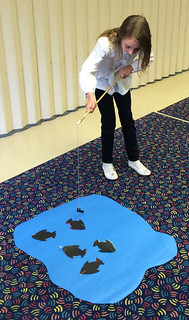
Feeding the 5000 - games - fishing   Feeding the 5000 - games - put the fish in order

Note: Please don’t bring up this story as an impetus for sharing, as in: “Let’s be like the boy who shared his lunch.” That’s a forced event — a connection that may not be remembered as good!

an adult Bible readingA check-box Nurture your own relationship to God.
Allow your child to “catch you” at prayer and/or reading the Bible. I have a strong memory of the response of a peer, whom I’d interrupted while praying: “Just a minute. I’m talking to God.” Her reply has stayed with me for 45 years! Model the importance of conversation with, and continued learning about God.

A check-box Engage in rituals.
At home your rituals probably already include a bedtime routine. Add bestowing a blessing on your child. Rituals within your spiritual community may include regularly serving at L.O.V.E. Thy Neighbor. Worshiping together as a family is a biggie. Making time for rituals connect us to God.

kid at youth worship

a blue line


Photo credits:
Faith is caught rendition (cropped and words added) is based on a photo by Virginia State Parks. Woman reading a Bible by Ariel Waldman. Both on Flickr under a Creative Commons License.
Games Workshop photos by Beth Pascoe.
Rest of photos from my archives.

When you discover who Jesus is, what will you do?

Wherever Jesus went, crowds generally formed and miracles turned up. He healed the sick, cured the lame, calmed a storm, turned water into wine, and brought the dead back to life — to name just a few.

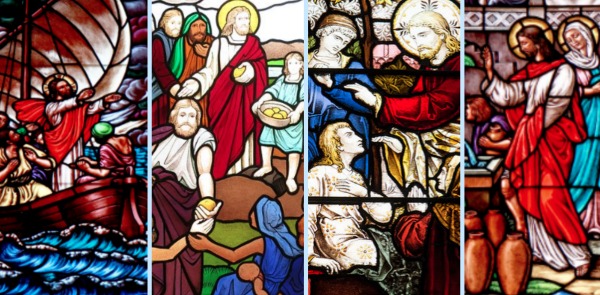
A collage of miracle stories

Why did Jesus do miracles?

The last thing Jesus would have wanted was his miracles to be seen as some sort of “magic.” His ambition was not to have people follow him around just to see him do miracles. Perhaps this is why he often told those cured to, “see that no one knows about this” (Matthew 9:30.)

Jesus had compassion for those who congregated before him. He saw their needs and helped them. But on the hillside that day, with over 5,000 people gathered… many of them could have been hungry, yet…

No one would have starved.

Why did Jesus choose to feed them all so miraculously?

He wanted everyone to discover who he was.

Jesus had said that he was the Son of God. He showed people that he came from God by doing many wonderful works. On this particular day people seemed to get the message. Afterwards (perhaps spurred by what Moses had told them) a long time ago, they all said:

Open quote markSurely this is the Prophet who was to come into the world! (John 6:14)
Jesus’ miracle had made people think: Could this be the one? The Messiah? The one we’ve been waiting for?

It appears that Jesus had accomplished what he’d set out to do: to teach who he was.

So these days, how does Jesus show you who he is?

And this stimulates more questions…

  • Are we ready to see more?
  • Do we have the same sort of “is this the one?” reaction when we encounter daily miracles?
  • Are we prompted to want to follow Jesus?
  • Do we seek to desire to know more about Jesus, to live like he did, to perform miracles in our own way, by bringing God’s love to others?
What result will this miracle produce in our hearts and minds?

a thin blue line


Photo credits:
Various miracles of Jesus, depicted in stained glass. I created this collage from images shared under various CC licenses. Images on either end by H. Zell. Windows in Iglesia de El Salvador, Santa Cruz de La Palma, Canary Islands, Spain, via Wikimedia Commons (CC BY-SA 3.0).
2nd image from left by: Nheyob. Windows in Chapel of the Immaculate Conception (University of Dayton), via Wikimedia Commons (CC BY-SA 4.0).
3rd from the left by: Fr Lawrence Lew, O.P. Window in Leicester Cathedral, UK, via Flickr (CC BY-NC-ND 2.0).

Are you seeing ads? They are not from me! They are placed by WordPress, who otherwise offers a free platform from which to share lots of good-ness. If you see an inappropriate ad, please report it to support@wordpress.com. Include the URL, the date/time the ad appeared, and a screenshot of the ad.

What can happen if we share? A beautiful miracle?

Look! Have you seen? Our earthly surroundings are awakening in miraculous re-birth! Point out these miracles to your family — and your friends — with awe in your voice…

Look at those tiny flowers! God has told the earth to wake up.
What other spring miracles can you find?

Make a daily habit to put God’s name with the miracles you see.

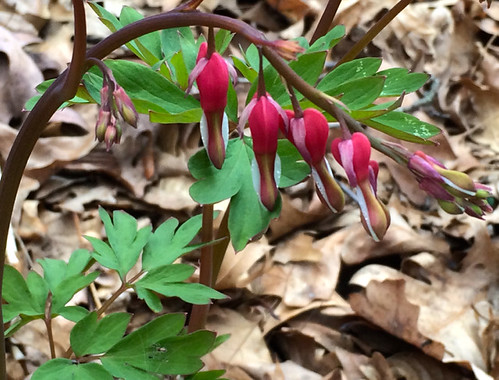
A Bleeding Heart prepares to bloom

Use instances of God at work in spring miracles as an opening to talking about the miracle we are studying – Jesus feeding over 5,000 people. Again, with awe in your voice…

God planned for plants to wake up in the spring. What a miracle God has given us!

Miracles point out a powerful God at work. What sort of power do you see happening in the miracle of Jesus feeding over 5,000 people?

A painting of the Feeding of the 5,000+

The obvious answer is that with a simple act of thanks to God (John 6:11a), Jesus unpacks a young boy’s lunch of five small loaves of bread and two fish, into a meal for more than 5,000. (There were even leftovers from this meal! 12 baskets of uneaten food.)

But could this multiplying have happened in a surprising but equally powerful way? Scholars have debated about what is the real miracle in this story. Is it that Jesus multiplied the bread and fish, or that the people really did bring along a little lunch and ended up sharing it?

Rev. Doug Norris shares this:

Open quote markPerhaps the little guy inspired others to share. Wouldn’t it be something if the miracle was a miracle of sharing, as people, one by one, pulled food out of their backpacks and shared with those around them? Perhaps Jesus walked through the crowd, encouraging, touching, blessing, visiting, and the stingy, the selfish, and the hoarders gradually warmed up, and realized their potential by not only sharing their food, but by experiencing the joy of doing something significant with and for Jesus.

A miracle made possible with sharing. We can participate in this!

But the sharing habit needs to be taught. Here are some possibilities for building sharing muscles:

  • Go grocery shopping together to bring a food item to the worship service on the first Sunday of every month. This month, the L.O.V.E. Thy Neighbor program, which makes lunches for the homeless and distributes them at Saturday morning breakfast at St. Andrews, will benefit from our food sharing.
  • Make a meal for a stressed family. Involve your kids in planning a meal, shopping and preparation and delivery. I still remember a church member who brought us a meal after I had been in the hospital. She very patiently unloaded our supper and her small children and brought them to the door to deliver the meal. What a great lesson her kids learned that day – service!
  • Set up birthday parties with gifts to designated for others. Have party participants bring a wish-list item for the Human Society.
  • Spring clean inside the house by selecting out-grown clothes or toys to donate. Include the kids in dropping off the delivery.
  • Spring clean outside by involving the family in tidying up an elderly neighbor’s yard.
In what way will you create a beautiful shared miracle?

a blue line


Photo credits:
Bleeding Hearts flower is from my archives.
The Feeding of over 5,000 people by Jim Padgett, from now-out-of-print Read’n Grow Picture Bible, via Wikimedia Commons, courtesy of Sweet Publishing, Ft. Worth, TX, and Gospel Light, Ventura, CA. Released under a Creative Commons License.

Are you seeing ads? They are not from me! They are placed by WordPress, who otherwise offers a free platform from which to share lots of good-ness. If you see an inappropriate ad, please report it to support@wordpress.com. Include the URL, the date/time the ad appeared, and a screenshot of the ad.