January – February 2015 Schedule: The Story of Esther

Happy New Year! We start off the New Year with a Rotation on the Old Testament story of Esther.

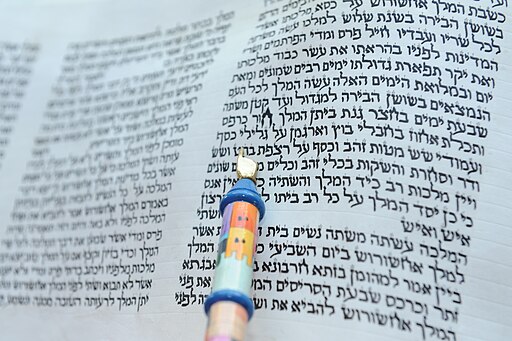
First chapter of a hand-written scroll of the Book of Esther, with reader's pointer

The Old Testament book of Esther is a story of one woman who changed the course of history for the Jewish people. It’s a story with all the ingredients of a Disney fairy tale (or maybe a soap opera, depending on how many details you reveal in the telling). There’s a beautiful heroine, a villain, and surprising plot twists. It is a good story for family read aloud over several nights (if you paraphrase a bit for the younger set). Come join us for our story!

For Saturdays at the Green Wood location, here is the schedule…

Date Workshop or Activity
1/10  Art Workshop
1/17  Games Workshop
1/24  Cooking Workshop
1/31  Worship with your family.
2/7  To be announced.

And on Sundays, at the downtown location.

Date Our workshops for 1st through 5th graders…
Art Cooking Video Bible Skills & Games
Room 212 Social Hall Room 215 Room 211
1/11 2nd & 5th grade 3rd grade 1st grade 4th grade
1/18 1st  grade 4th grade 3rd grade 2nd & 5th grade
1/25 3rd grade 2nd & 5th grade 4th grade 1st grade
2/1 Enjoy worship and Communion with your family.
The sermon is on how to begin again: A new direction!
2/8 4th grade 1st grade  2nd & 5th grade 3rd grade

And here’s what the 6th graders will be doing this month…
(They’ll always be in the Pine Room!)

1/11 1/18 1/25 2/1
 Special cooking project  Cooking Workshop  Games Workshop Worship with your family

What’s happening in each workshop?

  • Art Workshop: Learn about how prayer ties to the story of Esther. Second through fifth graders will create prayer boxes in the shape of a pyramid out of marbleized paper and make marbleized paper for the next class to use. 1st grade will decorate a prayer box with a magnetized lid.
  • Video Workshop: Watch portions of the Veggie Tales video, Esther: The Girl Who Became Queen.
  • Cooking Workshop: Make Hamantaschen (cookies) & learn about the Jewish festival of Purim.
  • Games Workshop: Learn story details & story sequence by playing a game of Hangman. (Which is very appropriate for this story!)

On Saturday nights and on Sunday mornings at FUMC our Cool Disciples experience Rotation Model Christian education, as they learn about Bible stories and concepts through kid-friendly multimedia workshops. If you are in the area please join us for the fun learning at First United Methodist Church in Ann Arbor, MI.

Photo credits: Click here for info on banner photo (not visible in readers or email).
Scroll of the Book of Esther by Chefallen, who licensed this photo on Wikimedia Commons under a Creative Commons License.

Are you seeing ads? They are not from me! They are placed by WordPress, who otherwise offers a free platform from which to share lots of good-ness. If you see an inappropriate ad, please report it to support@wordpress.com. Include the URL, the date/time the ad appeared, and a screenshot of the ad.

God chose David; God chooses you

“He is the one.”

Samuel distinctly heard God say the words. In a flourish, Samuel uncorked the animal horn; the one he had so carefully carried all the way to Bethlehem; the horn that held the olive oil. Not for cooking! No, this oil would be used in a sacred ceremony.

We are not told what words accompanied the pouring of oil on David’s head, but we do know the significance of this action: this “anointing” signified assignment of a special task. David had been chosen by God to be the next king of Israel!

David is anointed with oil

What do you suppose the family dinner table conversation sounded like that night? It could have gone something like this…

open quote
Jesse (David’s father): … I was very surprised at how it all turned out!
Eliab (Jesse’s oldest son): I realize that it was God doing the choosing and all, but it was unnerving! As we all approached, Samuel kept muttering, “The Lord hasn’t chosen him…”
Jesse: Please pass the bread.
Abinadab (Jesse’s 2nd son): All seven of us…one by one… nixed!
Shammah (Jesse’s 3rd son): When Samuel asked you, “Are there any others?” I thought to myself, “what does he mean? All of us kingly-handsome, nice-and-strong sons are right in front of you!”

David was an unlikely candidate for king. He was a downright surprise candidate! After all, boy-David — who was probably 10 to 15 years old — hadn’t even been initially invited to visit with the prophet Samuel. Nope; small-fry-David was sent to tend sheep.

So why did God choose David?

Because God looks at the inside character of people. (See 1 Samuel 16:7c)
And God liked what he saw.

God decided that David was a man after God’s own heart.

A man after God’s own heart? What’s that mean?

Let’s back up in our Bible story. We know that God was in search of a replacement for Israel’s current king, Saul. Saul had started off as an okay king, but then he turned away from God. The prophet Samuel reported on the consequences for Saul:

You have not kept the Lord’s commands. Your kingly rule is falling to pieces. God is out looking for your replacement; he is looking for someone after his own heart. (Translation of 1 Samuel 13:14).

Of course “heart” in this case doesn’t mean the organ that pumps our blood. (You might know this but what about the youngsters around you? Explain it as: The Bible uses “heart” meaning our inner thoughts and feelings; the part of us where we wrestle with life, where we check it out inside.)

God was looking for someone who had a “heart” just like his!

Someone who…

  • Cares about the same stuff that God cherishes;
  • Is humble; empties themselves so they are not focused on their own plans and agenda;
  • Admits to their wrongs and keeps on turning to God for forgiveness, for guidance and for help.

And do you know what?

God believes that this describes your heart!

God thinks of you as someone who has potential! As someone who displays admirable inside character. You are the one! Chosen by God!

You are a person after God’s own heart.

Who? Me?

Yes you! We do not have to be “perfect” to be chosen by God. David was far from perfect! (Refer to 2 Samuel 11:2-4, 14-17.) God values each one of us because we were created by him. God sees good qualities and possibilities in each one of us; each person is important to God!

So what does it mean to be a person after God’s own heart?

Hard work! God gives us a choice. We can choose to work at living up to the way God sees us, or we can ignore God and make a go of it all on our own.

What you can do?

  • Talk with your kids about how hard this can be in the midst of today’s societal pressures. Living a Christ-like life means we often have to go against the ways of society. (Good news: God has given us the Holy Spirit to help us attain this; to follow the example of Christ.)
  • Role-play situations where this choice may be exhibited: Standing up to a bully; noticing someone cheating; observing someone doing good. (Yes, practice affirming the positive!)
  • Over time we come to believe the words we say to ourselves. Fill your child’s mind with affirmations by regularly blessing them.

God looks at our heart, our motivations, and desires, at who we are on the inside. He chooses you! How will you respond?

--------------

Photo credits…
David is Anointed from an unknown publisher of Bible Cards, Date=early 1900’s; in the Public Domain via Wikimedia Commons.

Who do you want to become?

Do you remember that persistent question you faced from a very young age?

What do you want to do when you grow up?

I always hated that question. (Because, how did I know?)

I believe we are asking kids (and ourselves) the wrong question. Instead we should be asking…

Who do you want to become?

We are surrounded by a culture where the focus is on “appearances.” Who thinks about what a person can become? People are impressed by good looks, by how well you speak or how strong you are. How are we to help our kids combat this bias?

By teaching them to look inside.

Our current Rotation is a good place to start. In our story, David is chosen as the next king of Israel. Can you hear his family sputtering, “Him? He’s just a young boy; a lowly sheep-keeper.”

Ah, but we learn that God doesn’t look at outside qualities, he looks at our inside, at our heart.

word art

Here’s what God tells Samuel about why David’s older brother, Eliab, wasn’t the one chosen king:

'Samuel, don’t think Eliab is the one just because he’s tall and handsome. He isn’t the one I’ve chosen. People judge others by what they look like, but I judge people by what is in their hearts.  1 Samuel 16:7

What did God “see” in David’s heart?

Potential!

David is thought to have been between 10 and 15 years old when he was designated as Israel’s next king, but he didn’t take the leadership right away. David continued to care for sheep, building courage, a good leadership quality. David also wrote Psalms. We can look in his Psalms to find other seen-by-God heart characteristics.

Bring out a Bible and read the following Psalms. Try to figure out the heart quality conveyed.

  • Psalm 23 “The LORD is my shepherd; I shall not want…” (Potential expressed heart-quality: Trust)
  • Psalm 5:7 “I am filled with wonder as I bow down to worship.” (A worshipful attitude)
  • Psalm 139:14 “I praise you because of the wonderful way you created me. 
Everything you do is marvelous! Of this I have no doubt.” (Gratitude)
  • Psalm 5:3 “Each morning you listen to my prayer, as I bring my requests to you and wait for your reply.” (Asking for help)
  • Psalm 19:11 “By your teachings, Lord, I am warned; by obeying them, I am greatly rewarded.” (Obedience)
  • Psalm 25:11 “Be true to your name, Lord, by forgiving each one
of my terrible sins.” (A repentant attitude)
  • Psalm 16:2 “I say to God, ‘Be my Lord!’ Without you, nothing makes sense.” (taken from The Message) (Realizing the importance of a connection to God)

God sees these qualities and possibilities in each one of us; each person is important to God. God looks at who we can become.

Discuss with your family about what heart-attitudes you see in each other. You may be surprised!
Are their qualities you need to work on adding?

Who do you want to become?

-------


Photo credits:
Heart-shaped word art was created by moi, using Image Chef Word Mosaic.

Starting off the school year with… A Chosen King

I’m a summer kind of gal… kicked-back, long days, sunshine, and gardening! Yes, please! So fall is not my favorite time of year. But there is one thing that I do find appealing about fall: the return to a full program of the Rotation Model!

Rotation Model logoThe Workshop Rotation Model of Christian Education at FUMC rocks! Here’s why I get excited:

  • A Bible story is explored and learned in-depth through a variety of creative teaching mediums (workshops) over a period of several weeks.
  • Each new workshop visited deepens kids lesson memory.
  • Adults who help out in our program are learning right along with the kids! (It’s adult ed disguised as a children’s program!)
  • Kids from age 3 to 6th grade, whether attending Sunday’s downtown or Saturday’s at Green Wood, are all focusing on the same story, which allows families to share learning at home.

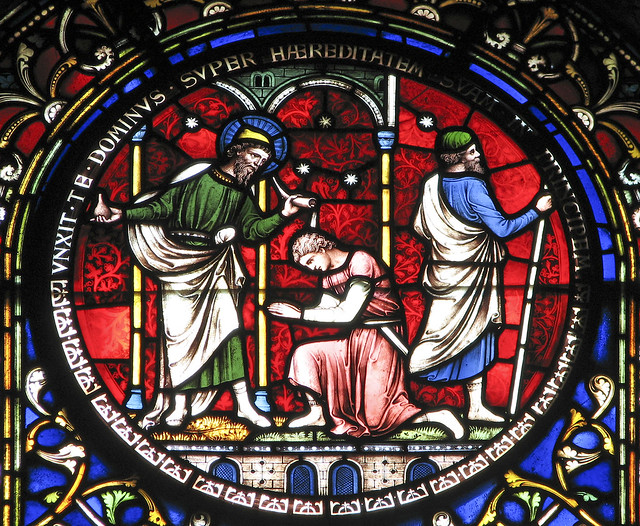
To kick off, we are studying about how a lowly shepherd-boy, David, was chosen by God to be the King of Israel. The prophet Samuel anointed David with oil (shown below).

Why did God choose him as king??

Read about our story in 1 Samuel 16:1-13. And come along with us as we begin our year of Rotation!

Stained glass from a cathedral in Ely, England

To see a growing list of opportunities to foster faith learning at home…
for this month’s story :: click here.

This is where the “Schedule” used to appear — which grades were visiting which workshops over the course of this Rotation. However it was removed as it was sort of out of date 🙂 Our current schedule of workshops, for whatever Rotation we are currently on, can be found on this page.

For prosperity, here is what we did in each workshop during this Rotation:

  • In the Art Workshop students will create modern “name” art based on the style of artist Paul Klee. Contemplate your inner character as you work!
  • In the Cooking Workshop two teams of students will make muffins with two different recipes. One has something special in it and one does not! Students will note that both look the same in a raw state. I wonder about the baked muffins?
  • In the Creative Writing Workshop students will create an acrostic poem using the word “heart” and describe their inner character. What attitudes are in your heart?
  • In the Bible Skills & Games Workshop students will participate in a variety of games – voting with your body, a game of “Spoons,” and a quiz game that involves collecting “heart” qualities (graffiti-style).

If you are in the area please join us for the fun learning at First United Methodist Church in Ann Arbor, MI.


Photo credits:
Stained glass of David’s anointing by Lawrence OP, who licensed this photo on Flickr under a Creative Commons License.

Are we good enough?

Buck Denver and Chester Whigget's Popsicle Stick Theater

Where has summer gone!? There is one week left to join us on our movie adventure. In the meantime, continue the learning at home!

Last week we learned about Esther. Our video included a presentation by Chester Whigget’s famous Popsicle Stick Theater. Watch the start of Esther’s story in this video. (If you are reading this in an email click here to view the video).

Yep. King Xerxes definitely had too much coffee. Here are some questions to talk about at the family dinner table. (Or wherever your family is gathered together.) You can ask these questions even if you missed the video showing last weekend! For other sets of discussion questions view here. If desired, print out this family discussion guide here. (Spread this out over several days.)

HAVE SOME FAMILY DISCUSSION…

  • Pass around a Bible. The person holding the Bible gets to be the one who shares their glads and sads for the day. (Or perhaps you call them peaks and pits?)
  • Just as a library has different types of books, so does the Bible! Did you know that there are books we call “History books” in the Bible? What sort of history do you suppose those books tell?
  • The books of History tell of the interaction of God with people in history. Why do you suppose that learning about God’s past interaction with people is important?
  • Esther is a book of History. What can you tell me about Esther?
  • Esther is good storytime reading. Read it together with feeling! (You may wish to paraphrase parts for the younger set.)
  • Did you know that in the book of Esther, God is never mentioned!?! Why do you suppose that is? (Scholars continue to debate this question!) Do you suppose it is for us to see that God is always with us even though he doesn’t get talked about?
  • Puppet Brother Louie from What's in the Bible? DVD

    God is always with us, but are we good enough for God? I mean, as humans we mess up all the time! (And we forget to ask God for help.) How can we be good enough for God? (Brother Louie asked this question in our video.)

  • Do we need God in our lives or can we do it on our own?
  • We are humans. We fail. We do things that separate us from God and from other people (we call that sin). What we learn from the historical books of the Old Testament is that people throughout history have tried and tried to be good enough for God. What usually ends up happening? (That’s right – they fail. Just like we do. But rather than being depressing, it points out our need for Jesus as our Savior!)
  • God used an ordinary woman named Esther to save his people. Do you suppose that God could use you to do something special? How does it change your life to know that God has something special planned for you to do?


Photo credits:
Click here for info on banner photo (not visible in readers or email).
Other photos from the producer of our video What’s in the Bible, under a fair usage category.

Are you seeing ads? They are not from me! They are placed by WordPress, who otherwise offers a free platform from which to share lots of good-ness. If you see an inappropriate ad, please report it to support@wordpress.com. Include the URL, the date/time the ad appeared, and a screenshot of the ad.

How to love others

Cute little girl holding red heart - a 1910 Valentine greeting
 
Did you get any valentines last week?
 
Why do we need a “Hallmark holiday” to remind us to love those around us?


Because sometimes it’s hard to love.

I’m not talking about your loving your family and your friends. I’m talking about loving those who are different, or difficult, or down-right irritating!

But Jesus told us to love our neighbor as we love ourselves (Matthew 22:37-39).

Doing good, loving our neighbor — the stranger, the person who pushes our boundaries — it’s easier said than done.

Last week we talked about ways to love God. By loving God we are keeping the first four of the Ten Commandments. By loving our neighbor we are following the last six.

Love God Love Others
1.  Do not worship any god except me. 5.  Respect your father and mother.
2.  Do not make statues of gods (idols). 6.  Do not murder.
3.  Do not misuse my name. 7.  Do not commit adultery.
4.  Remember the Sabbath day. 8.  Do not steal.
9.  Do not tell lies about others.
10. Do not long for what belongs to
     someone else.


How do we talk to our family about loving our neighbor?

 
Start close to home…

  • Identify who your neighbors are. Do you know the names of the people who live around you?
  • Discuss why you live where you do. Did the “neighborhood” have anything to do with where you live?
  • What are some activities you enjoy doing? How might these activities help you to be more neighborly to those in your neighborhood?

Move out a bit…

  • Did Jesus mean neighbor, as in someone who lives next door?
  • Name some of our “neighbors” who don’t live in your neighborhood.
  • How do we recognize a “neighbor?” (Hint: It’s about recognizing a need.)
  • What are some needs we see in our community? In the world?
  • Move out further…

  • What do we do with our doubts? (The needs are so great!)
  • What if people around us want to throw their hands up and say, “What good can I do”?
  • What do we do when our attempts to “love” a neighbor are rejected?
  • How can we persevere?
  •  

    How is your life a testimony to your love of God and neighbor?


    Photo credits:
    A valentine from 1910 by Royce Bair via Stock Solution Photo Agency. Shared under a Creative Commons License.

    Are you seeing ads? They are not from me! They are placed by WordPress, who otherwise offers a free platform from which to share lots of good-ness. If you see an inappropriate ad, please report it to support@wordpress.com. Include the URL, the date/time the ad appeared, and a screenshot of the ad.

    Loving God by loving others with our words

    It has been a while since I’ve written a blessing for you to use with your child. How about one that ties to our current Rotation story on the Jesus’ Greatest Commandment? Something about loving God with all you’ve got, and loving others as you love yourself.

    A blessing is a way of giving someone love, and when you love others you are loving God.

    DESCRIPTION HERE

    Here is a suggested blessing that is good to use with little ones (and touches on the all you’ve got portion of our Bible story). Touch each part of their body as you say the words…

    May your head always think thoughts of God.
    May your ears hear whispers of God’s love.
    May your eyes see God’s wonders.
    May your lips speak kind words to others.
    May your heart beat strongly in tune to God’s ways.
    May your hands do the work of God.
    May you spend time on your knees in God’s presence.
    May your feet always follow God’s path.

    You will be speaking words to your child that are like love letters from God, delivered by you.


    Click on a box if you would like to…
    A check-box Satisfy your curiosity about why you should bless your child.
    A check-box View other suggested blessings.


    Photo credits:
    Father and daughter by Judy Baxter, who licensed this photo on Flickr under a Creative Commons License.

    Are you seeing ads? They are not from me! They are placed by WordPress, who otherwise offers a free platform from which to share lots of good-ness. If you see an inappropriate ad, please report it to support@wordpress.com. Include the URL, the date/time the ad appeared, and a screenshot of the ad.

    How to love God

    Let’s review the Ten Commandments. What was the first one?

    A sign says 'Rule #1: Don't pick up the goats'

     
    Well, the Ten Commandments can be hard to remember. I guess it’s a good thing that this month we are learning about how Jesus shortened them for us by giving us what is called the Greatest Commandment.

    Someone once asked Jesus which of God’s rules was the most important. Jesus’ reply recorded in Matthew 22:34-40, actually had two parts. He essentially told us to

    Love God, and love your neighbor.

    What a minute; I don’t remember either of those as one of the Ten C. What gives?

    Jesus didn’t pick from the ten; he summarized all of the commandments into two. In fact we see that this nicely divides the Ten Commandments! The first four of the ten, show us how to love God (Exodus 20:3-11). The last six show us how to love others (Exodus 20:12-17).

    Love God Love Others
    1.  Do not worship any god except me. 5.  Respect your father and mother.
    2.  Do not make statues of gods (idols). 6.  Do not murder.
    3.  Do not misuse my name. 7.  Do not commit adultery.
    4.  Remember the Sabbath day. 8.  Do not steal.
    9.  Do not tell lies about others.
    10. Do not long for what belongs to
    someone else.

     
    Here is a discussion outline for your family to take a closer look at following the first portion of the Greatest Commandment: How to love God.

    (For a discussion guide on talking about how to love others, look here.)

    Spend time as a family (at the family dinner table perhaps) with everyone sharing one glad and one sad for the day. (Don’t try to fix anything, just listen and celebrate / commiserate.)

    a blue line

    Tell kids that you are going to play a game. Have everyone think of something they love (a person, a place or a thing). Also have everyone think of something that they don’t love. Then go around the table and have everyone say “I love ____” filling in the blank with something that they love or don’t love. Have everyone decide if they really do love that item. Play a few rounds. Who can stump everyone with their choices?

    Ask: What clues tell us that you love something?
    How do you suppose people know that we love God?
    How do we show that we love God?
    Make a list and post it on the fridge! Are you doing these things every day?

    A list of ways to love God

    Not to detract from following the Ten Commandments but if we focus on loving God, in a sense we will be living the first four of the Ten Commandments and won’t have to worry about the details. By loving God we will be automatically obeying the first four commandments!


    Photo credits:
    For the love of goats (a sign at a petting zoo) by Gord McKenna, who licensed this photo on Flickr under a Creative Commons License.

    Are you seeing ads? They are not from me! They are placed by WordPress, who otherwise offers a free platform from which to share lots of good-ness. If you see an inappropriate ad, please report it to support@wordpress.com. Include the URL, the date/time the ad appeared, and a screenshot of the ad.