How to never underestimate the power of table talk?

It is time once again for our annual Sunday’s Cool summer movie series at FUMC!

As in previous years, this summer’s film series launches a way for you to share your faith with your kids. How?

By making a way for you to harness the power of table talk.

the power of table talkOur videos shown during Sunday’s Cool classes will help kids discover some answers to various questions that will be raised, but it’s up to you to continue the discussion with your household.

Whether it’s around the table or while you are together in the car, you can do this!

And I’ll help by providing starter questions.

 
Why is this type of conversation important?

It models the spiritual discipline of talking.

Yes! That’s a spiritual discipline! You see, God has a habit of showing up in the types of activities which John Wesley termed “the Means of Grace.”

Wesley taught that we can’t earn God’s grace (God’s loving kindness), but we don’t want to sit around waiting to hopefully experience it! We are to engage in certain activities — means of grace; things like worship, reading scripture, prayer, acts of mercy, and “Christian conversation” AKA Table Talk!

A bunch of questions about God to be addressed in our video series

Each week in Sunday’s Cool, we’ll address questions with the help of Clive & Ian and their Wonder-Blimp of Knowledge. If you sign up to receive emails when I post to this blog, then after each class you’ll find in your inbox a set of discussion helps.

Clive & Ian in the Wonder-Blimp

Won’t you join us with Clive and Ian as they go on adventures in search of answers by soaring in their Wonder-Blimp of Knowledge! Make sure you don’t underestimate the power of Table Talk!

a blue line


Photo credits:
Altered table photo from a Public Domain image. Other photos are from the producer of our video Clive & Ian’s Wonder-Blimp of Knowledge, under a fair use category.

Are you seeing ads? They are not from me! They are placed by WordPress, who otherwise offers a free platform from which to share lots of good-ness. If you see an inappropriate ad, please report it to support@wordpress.com. Include the URL, the date/time the ad appeared, and a screenshot of the ad.

How to persist and hold the story in the limelight?

Our parenting-speak often sounds like a broken record. The phrase I’d say to my kids over and over (that always evoked a groan) was, “Make a different choice.” Either that, or it was when I’d break into song — à la Mr. Rogers: ♫ Let’s think of something to do while we’re waiting… ♫ (Can I get an encore?)

But that’s the way it should be.

Repeating keeps your story in the forefront.

You place a high value in reminding them that what they do/say is important in the world. (After all, they are a child of God!) You want them to be loving, kind, and to remember a few table manners.

One way to grow disciples of Christ is by keeping a Bible story front and center. It’s why we use the Workshop Rotation Model for Sunday Cool — persistent recurrence! You can use a similar reiterative scheme at home. Here are ideas to use with our just completed Rotation on the miracle of Jesus feeding over 5,000 people.

fish symbolThe next time you have food remaining after a meal, ask about the 12 baskets of leftovers collected after everyone had eaten their fill. What do you suppose people thought about all the leftovers? What about the disciples, what would they have been talking about? What do the leftovers tell us about Jesus?

fish symbolHear the story. Over and over. Read it at the dinner table or as a bedtime “book.” Each time you read, ask a couple questions.

  • Let’s put ourselves into the cast of characters that were there: Philip… Would you be annoyed with Jesus when he asked you about where to get food? (I mean, Duh. They were in the middle of nowhere.) Andrew… Would you feel almost silly announcing that fives loaves and two fish were available? The small boy… Would you feel scared? Curious?
  • How would you report this story if you were there and you had modern-day internet capabilities? What sort of Twitter post or text message would you write? What emoticons would you use? What sort of hashtag would you assign to this event?
  • When is it hard for you to share? (Include your own example, adults!)
  • In the beginning of the story it doesn’t seem like Philip and Andrew have much faith in Jesus to handle the problem of so many hungry people. When is a time when you forgot about your faith in Jesus?
  • Jesus could have created bread and fish in the basket of every person there, but he didn’t do it that way. Why do you suppose Jesus deliberately used a method that brought the disciples into the work?

fish symbolCreate a snack for a neighbor, or a meal for a family in need. Teach your kids to ask: What do they need?

Feeding the 5000 - cooking workshop

 
fish symbolput the fish in orderMake a game to put the story in order. Print out some storytelling fish shapes and challenge your household to work together to arrange them in the correct order.

If you have non-readers in your household, provide them with a sheet of paper divided into sections. Encourage them to draw each part of the story. Cut apart the sections. Can they put them back into story order?

 
fish symbolWatch together the various renditions of dramas presented on our story. As you view each one, what pops out as a new factoid about this story? What part of the dialogue did the disciples likely not say??

If reading this in an email, you can watch the 4th & 5th grade video on YouTube.


You can watch the 3rd grade (with few 5th graders) in this video on YouTube.


Or watch the 2nd grade video on YouTube.


(Or watch the 1st grade video on YouTube.)


How will your household grow disciples of Christ?

a blue line


Photo credits:
Photos by Beth Pascoe.

Are you seeing ads? They are not from me! They are placed by WordPress, who otherwise offers a free platform from which to share lots of good-ness. If you see an inappropriate ad, please report it to support@wordpress.com. Include the URL, the date/time the ad appeared, and a screenshot of the ad.

What sort of fascinated fan are you raising?

Young sports fanAre you raising a “Go Blue” sports fan? (Or perhaps a “Go Green”?) If you are a fan of a certain team, it’s very likely that your kids are too.

You are probably not intentionally raising such a child – drilling the Michigan fight song every night or teaching them player nuances – it just sort of happens doesn’t it? Because you are interested, they become predisposed.

What about raising a Jesus fan?

Is that just “happening” in your household without any effort on your part?

I’ll admit, when my kids were young, I did not focus much on raising them to be disciples of Christ. My thinking went along the lines of:

  • Who me? I can’t do that. (That’s the church’s job.)
  • I don’t know enough. (I didn’t go to Bible school.)
  • I’ll screw them up / turn them off to religion. (I’ll probably say something wrong!)
Raising a Jesus fan takes some intention.

Does it help you to know that Jesus struggled with the role he was to play in God’s plan of redemption for the world?

We see it prominently in the Garden Of Gethsemane, the spot where Jesus and his followers went after the Passover meal (the one we now call the Last Supper). Jesus knew he faced imminent distressing events — arrest, torture, and death on a cross. At this critical juncture, Jesus is compelled to spend time with God in prayer.

Spend Time in Prayer.

Share your feelings of uncertainty with God. Jesus did. Matthew describes a time of intense agony in amongst the olive trees, with Jesus’ words expressing his anguish:

Open quote markMy Father, if it is possible, take this cup of suffering away from me.

This is like Jesus saying: “If it is possible, can’t we do this in some other way?”

Christians believe that in Jesus, God became fully human; he was a human being who faced temptations and feelings of anxiety! Isn’t it freeing to realize that we don’t have to stand up to pressures and trials with super-sized strength? It is okay to be fearful, questioning, angry, and to feel agony.

It is okay to struggle!

We know from the prayer that Jesus prayed in the garden, that in the very same sentence of asking for a different path, Jesus turns and submits completely to God, “I want your will, not mine.” This is not an admission of defeat; he says it with a cadence of perfect trust.

Acting as Jesus did can be a tough pill to swallow. Here’s what I tell myself when faced with something I’m unsure I really have the guts to do:

Do the next thing. Do it with prayer.

a blue line

Here’s something to pursue this week: Be on the lookout for a “trigger” which prompts a short burst of prayer.

A collage of green thingsTaking a cue from the Garden of Gethsemane, when you see something green (a houseplant, some produce, a stray toy) thank God for the ability to speak openly with him in prayer!

Try this out yourself for a couple of days. Then report back to your kids. Get them onto the hunt for a little green prompting.

What spiritual practice can you include in your family’s life this Lent? How will you plant seeds of faith in the lives of your Jesus fans?

Stay tuned for other Lenten prayer hints.


Photo credits:
Young sports fan by PublicDomainPictures, and the collage of green things – from other artists – all who licensed these photos on Pixabay under a Public Domain Dedication.

Are you seeing ads? They are not from me! They are placed by WordPress, who otherwise offers a free platform from which to share lots of good-ness. If you see an inappropriate ad, please report it to support@wordpress.com. Include the URL, the date/time the ad appeared, and a screenshot of the ad.

Did Jesus storytell to shock his audience?

Perhaps Jesus hoped that encountering an unexpected twist — something that caused us to gasp in surprise — would lead us on a fresh approach to life? His first century listeners were likely astounded by the telling of the Parable of the Prodigal Son, but are we?

Jesus frequently taught with a genre called a parable. His parable storytelling employed examples from everyday life – farming, feasts, and families. Jesus used parables to teach a lesson that had a hidden message. Theologian Barclay tells us that a parable was “an earthly story with a heavenly meaning” [1].

The “earthly” part: your typical messy family with teenagers who want their own way. So what is the “heavenly meaning” behind our current Rotation story? What is Jesus hoping that we hear?

Not surprisingly, to extract this unrevealed explanation requires contemplation! So dig right in! Gather your family around and discuss. Reflecting on this parable will likely challenge your thoughts about how God works; the nature of God’s grace!

A sign with a fist says I want it now!When we hear the story of the Prodigal Son, does any portion of it bring you to a complete stop?

Does it bother you that the youngest son asks his father for his share of the estate? (After all, it was as if he were saying: “I wish you were dead so I could have my money.”)

We’ve heard it expressed from our kids (and even from adults?): I want it now!

Jesus’ first listeners were likely waiting for the father to put this nervy son in his place. But surprisingly, the father generously divides his property between his two sons! What is happening here?

Does it bother you that this son then leaves home and goes out and spends lavishly and earns the title: Prodigal Son? (A prodigal being a word most frequently associated with reckless and wasteful spending.) He has sinned big time, with underlying transgressions: broken relationships and alienation from his home community (because you can be sure that the whole town heard about his choices).

Does the father try to stop him? Nope.

And when he sees the light and comes back home (with his tail between his legs) does the father lecture with “I told you so!”?

Prodigal Son banner

No! The father runs to greet his wayward son! He throws a welcome home party! He shows love and compassion rather than judgment and condemnation!

Ah, here comes a hint of the hidden lesson of this parable – allegory is at work — This father represents God!

Is this how God works?

Yep. This surprising story twist helps us see that regardless of the offense, there is always forgiveness and grace from God! Pretty shocking isn’t it?

a blue line

Discuss this story at the family dinner table, or wherever your family is gathered. (In the car?) Start off with reading our story in Luke 15:11-32.)

Ask these questions:

  • What did you think of the way the father reacted when his son came home?
  • Were you surprised? Did you expect him to say “I told you so,” and scold his son for what he did?
  • The son had intended to work his way back into his father’s favor; how does that plan work out?
  • The father doesn’t allow his son to pay him back. No maneuvering or bargaining on the part of the son was required. It’s as if the father is handing him a do-over. Does it surprise you to think that God acts the same way towards us?
  • How do you suppose we can receive this sort of forgiveness from God? (simply by confessing and asking for forgiveness)
  • What shall we do in response to such extravagant love?


a blue line

[1] Barclay, William. The Daily Study Bible Series: The Gospel of Mark.


Photo credits:
I want it now! by Denise Krebs, who licensed this photo on Flickr under a Creative Commons License.
Prodigal Son banner © 2005-2015, SparkleBox Teacher Resources Limited; used with permission.

Are you seeing ads? They are not from me! They are placed by WordPress, who otherwise offers a free platform from which to share lots of good-ness. If you see an inappropriate ad, please report it to support@wordpress.com. Include the URL, the date/time the ad appeared, and a screenshot of the ad.

How to portray grace by bending wire

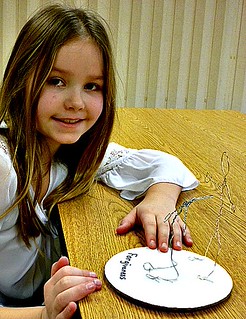
Child with wire sculpture creationprodigal son art sculpture

In the Art Workshop for our current Rotation, kids are creating grace poses.

What??

After hearing the Parable of the Prodigal Son, they are sculpting with wire or pipe cleaners, a picture of forgiveness and grace in action.

Because that is what the father offered his wayward son: grace.

Surprising isn’t it?

Exhibited behavior by the son has deeply wounded his father.

The father could have replied with rub-it-in-your-face contempt: I knew you’d amount to nothing. I told you so!
He could have displayed disgust: You’re back? Don’t expect a handout from me.
He could have shown a stiff shoulder: Who are you and what do you want?

But instead, he shows love and forgiveness; he grants grace.

This Art Workshop lesson gives kids a chance to visualize and express what it is that grace looks like. I saw hugging, arms out-stretched and bended knees.

What is grace?

Grace is God’s unconditional love that forgives us even when we mess up.
We deserve the worst, but we are offered an escape route. A do-over.
And it’s a free gift!

Explore this concept further in your family unit. When your child brings home their wire sculpture, ask them if you can play with it. (You may need to remove the staples holding the figures in their current pose.) Reread the story in Luke 15:11-32 with your child and pause to shape the figures…

  • Read Luke 15:11-13. Show the scene of the son leaving home. How do you suppose the father looks? What about the older brother?
  • Read Luke 15:14-19. What would the ah-ha moment look like when the son came to his senses? How do you suppose the presumably waiting and watching father is looking?
  • Read Luke 15:20-24. Shape a scene of grace.
  • Read Luke 15:25-32. How does the angry older brother look?
  • Jesus didn’t provide an ending to this story! Do you suppose the older brother goes to the party? Shape an ending scene to the story the way you think it happened.


Photo credits: from my archives.

Are you seeing ads? They are not from me! They are placed by WordPress, who otherwise offers a free platform from which to share lots of good-ness. If you see an inappropriate ad, please report it to support@wordpress.com. Include the URL, the date/time the ad appeared, and a screenshot of the ad.

Give your family a gift. Will you make a new habit?

This coming Sunday, Rev. Nancy starts off a new sermon series on Stewardship. The scripture passage will be Matthew 25:14-28, which happens to be our story for our next Rotation!

Here’s a suggestion for giving your family a gift…

a couple with coffeeAttend the 9:30 service and then, leave with the kids after the children’s time.

The kids head to class and you grab some coffee.

(No, that’s not the gift.)

It’s a little known factoid that coffee is ready in time for the choir members to imbibe. (You may need to look in the kitchen. Please be sure to make a donation for your coffee during Connections time.)

Find a quiet place to sit for 40 minutes. Though space on Sunday mornings is at a premium, wander about, you’ll find a spot. Catch up on your reading. (Please keep your chatting to a hush in a space like the Social Hall where a class is being held.) Then at 11:15… (here comes the gift)…

Attend worship as a family.

Use these discussion questions to debrief the service:

  • What was your favorite part of worship? Did you have a least favorite part?
  • In the Bible story, how much did the master give to each of his servants? (Answer)
  • What did the story mean by a “talent?” (Ans: In Bible times a talent was a measure of the weight of a precious metal.)
  • What did each servant do with what the master gave him?
  • How did the master feel about each servants choice?
  • Today we use the word “talent” to mean our abilities. Go around the table and identify an ability – a talent – of the person on your left.
  • How do you suppose God feels when we use our skills to help others?
  • How do you suppose God feels if we “hide” our talents?
  • What skill or talent would you like to develop? What do you feel you need to do to start?
  • God gave us our talents. God gave us everything we have! What prayer can we say to thank God for all of our wonderful gifts.

Perhaps you’ll start a new habit every Sunday during this sermon series.


Photo credits:
An edited photo of coffee for two by Nathan Walker, who has released this photo to the Public Domain. Offered at unsplash.com.

Are you seeing ads? They are not from me! They are placed by WordPress, who otherwise offers a free platform from which to share lots of good-ness. If you see an inappropriate ad, please report it to support@wordpress.com. Include the URL, the date/time the ad appeared, and a screenshot of the ad.

Why did Ruth make a startling (crazy?) choice?

a thoughtful childHave you ever admired something in someone, causing you to wonder: What makes them tick?

I’m not talking about wonderment in a swooning sort of way — more wanting to know what it is that motivates a person. What is their driving force?

The Bible doesn’t give us many clues but Naomi must have exhibited behaviors that Ruth applauded, eliciting a, “Hey, I want to be like her” response in Ruth.

This coming Sunday kids will be in worship as we celebrate All Saints Day, a time when we commemorate the lives of those who have shown us a picture of faith. Though this is a day set-aside to remember faith-warriors who have died in the last year, we can stretch our definition of a saint to someone who is living; someone who wears their faith on their sleeve.

Naomi must have worn her faith on her sleeve.

Ruth acted on her admiration for her mother-in-law Naomi. She made a startling choice:

Where you go, I will go, and where you stay, I will stay. Your people will be my people, and your God my God. Ruth 1:16b,c

Time Out. Talk about…speech bubble
Ask these questions at the family dinner table. (Or wherever your family is gathered together.)

  • What could have made Ruth decide to follow Naomi’s God?
  • Who to you seems like they are close to God?
  • Have you ever thought about asking them how they got connected to God?
  • Identify people you know who seem to be “God followers.” Make a plan to ask them about their faith.
  • What is it about YOUR faith that might make other’s think: “how can I be like them?”
How are you wearing your faith on your sleeve?

a blue line


Photo credits:
A thoughtful child by Ryse Lawrence, in the Public Domain, offered at Pixabay.com.

Are you seeing ads? They are not from me! They are placed by WordPress, who otherwise offers a free platform from which to share lots of good-ness. If you see an inappropriate ad, please report it to support@wordpress.com. Include the URL, the date/time the ad appeared, and a screenshot of the ad.

How to make bold, Ruth-like promises to people we care about

Naomi had packed up her belongings, and with her two daughter-in-laws, was heading to Bethlehem. What a trio – three widows without any children! (People hearing this story in Bible times knew about the perilous predicament of a widow without a son to care for her.) These three likely hadn’t gotten very far before Naomi urged them to make a different choice.

Go home. Go back to your families. What possible reason would you have for returning with me? (Ruth 1:11)

One of the daughter-in-laws does just that. She returns to her home in Moab… to her mother… to what was well-known… to her gods (Moab was a land of multiple pagan gods)… to a place where she wasn’t likely to be shunned (Israelites looked down on Moabites). She was looking out for number one – herself. Nothing to be faulted for that!

Meanwhile, Ruth makes a bold, surprising promise:

Where you go, I will go, and where you stay, I will stay. Your people will be my people, and your God my God. Ruth 1:16

Two kids make a pinky promise (by linking their pinky fingers)

Such an extravagant commitment!

This is a story about love, loyalty, devotion. And it’s about making hard choices.

What “Ruth-like” promises have you made for the people in your life?

While this strategy can apply to everyone in the family, I’m specifically talking to the parents here. How about making one (or all) of these promises:

  • I’ll attend worship with my family every week – even though the kids might squirm, sigh loudly, and make a fuss. (Because worshiping with your kids is good parenting in action.)
  • I’ll make sure that I am cultivating my own faith and I’ll talk about my faith journey with my family.
  • I’ll ask my child every night, “How can I be praying for you?”
  • I will daily invest in blessing my child.

a blue line

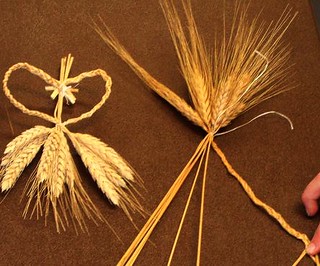
a Ruth wheat braiding projectIf your kids attend FUMC as Cool Disciples, they are mentally absorbing the basics. Each week they hear the story details. As they craft wheat creations or knead barley biscuits, they are learning definitions for widow, famine, and gleaning; they are hearing Ruth’s bold statement of trust.

But, with only (at best) 45 minutes in class, we can’t dig deep enough. We try, but we don’t have the time.

 
We need parents and caregivers to continue the learning.

We need you to make some Ruth-like promises, to ensure your child’s spiritually is nurtured.

Here’s my Ruth-like, stretching-myself promise to you (because I care about your kids): I’ll keep bugging you to grow your kids faith!


Photo credits:
Pinky promise by Cheryl Holt, in the Public Domain, offered at Pixabay.com.
Other photo from my archives.

Are you seeing ads? They are not from me! They are placed by WordPress, who otherwise offers a free platform from which to share lots of good-ness. If you see an inappropriate ad, please report it to support@wordpress.com. Include the URL, the date/time the ad appeared, and a screenshot of the ad.